Concrete Mix Design Steps Explained
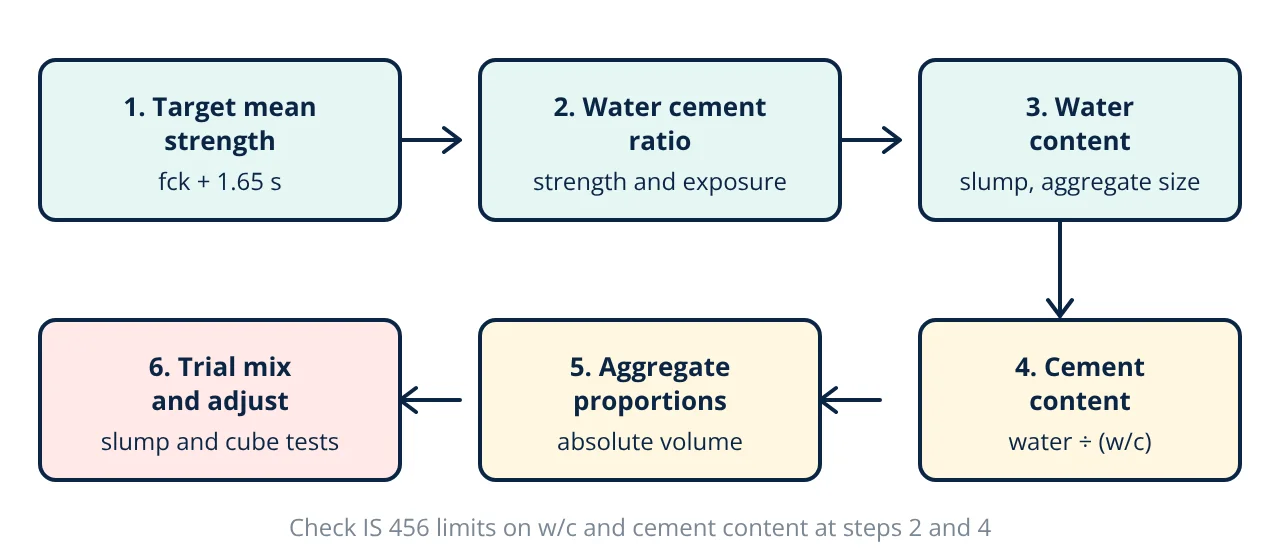
Concrete mix design is the process of choosing the proportions of cement, water, fine aggregate, coarse aggregate and admixtures so that concrete reaches a required strength, workability and durability at least cost. The main steps are target mean strength, water cement ratio, water content, cement content, aggregate proportions and trial mixes.
Concrete mix design turns a specification such as “M25, moderate exposure, 100 mm slump” into batch weights in kilograms per cubic metre. In India the method is set out in IS 10262:2019, and in North America in ACI 211.1. Both follow the same logic: design for an average strength above the specified value, control the water cement ratio, then fill the remaining volume with aggregates.
Why concrete mix design matters
Concrete made from the same materials can be strong and durable or weak and porous, depending on the proportions. A designed mix gives three benefits:
- Reliable strength: the mix is aimed at a target mean strength, so very few test results fall below the specified grade.
- Durability: the water cement ratio and cement content are kept within the IS 456 limits for the exposure condition.
- Economy: cement is the most expensive ingredient, and a designed mix uses no more than needed, which also reduces heat of hydration and shrinkage.
IS 456 permits nominal mixes (fixed proportions) only for grades M20 and lower, and states that design mix concrete is preferred. Nominal mixes ignore the actual properties of the local cement and aggregates.
Inputs needed before you start
A mix design needs the following data, mostly from the structural drawings and from laboratory tests on the materials:
- Grade designation (characteristic strength fck, measured on 150 mm cubes at 28 days).
- Type of cement and any mineral admixture such as fly ash or slag (see types of cement).
- Exposure condition as defined in IS 456, which fixes the maximum water cement ratio and minimum cement content.
- Maximum nominal size of coarse aggregate and its shape (angular crushed stone or rounded gravel).
- Required workability, normally given as slump in mm.
- Grading zone of the fine aggregate as per IS 383 (Zone I to Zone IV).
- Specific gravities and water absorption of the aggregates, and the specific gravity of cement.
- Type and dosage of any chemical admixture, such as a superplasticiser.
Concrete mix design steps
Step 1: Target mean strength
Because test results scatter, the mix is designed for a target mean strength higher than the characteristic strength. IS 10262:2019 takes the greater of:
where s is the standard deviation and X is a factor based on grade. The factor 1.65 means that only about 5% of results are expected to fall below fck, which matches the IS 456 definition of characteristic strength. When no site data exist, the code gives assumed values of s: 3.5 MPa for M10 and M15, 4.0 MPa for M20 and M25, 5.0 MPa for M30 to M60, and 6.0 MPa for M65 and above. ACI 211.1 uses the same idea, with the required average strength taken from the specified strength and the site standard deviation.
Step 2: Water cement ratio
The water cement ratio is read from the relationship between strength and w/c for the cement being used, then compared with the IS 456 maximum for the exposure condition. The lower of the two values governs. The reasons are explained in the article on the water cement ratio.
Step 3: Water content
The water needed for workability depends mainly on the maximum aggregate size, aggregate shape and slump, and only slightly on the cement content. IS 10262 tabulates the water content for 50 mm slump with angular coarse aggregate (186 kg/m³ for 20 mm aggregate) and increases it by about 3% for every additional 25 mm of slump. Rounded aggregates need less water, and a water reducing admixture or superplasticiser lowers it further.
Step 4: Cement content
The result is checked against the minimum cement content in IS 456 Table 5 for the exposure, and against the IS 456 upper limit of 450 kg/m³ of OPC (excluding fly ash and slag). If the minimum governs, the cement content is raised and the w/c is recalculated downward.
Step 5: Aggregate proportions
IS 10262 gives the volume of coarse aggregate per unit volume of total aggregate, based on aggregate size, fine aggregate zone and w/c. For 20 mm aggregate with Zone II sand at w/c 0.50 the value is 0.62, adjusted by 0.01 for each 0.05 change in w/c (higher when w/c falls). The masses then follow from the absolute volume method: one cubic metre of concrete is the sum of the volumes of cement, water, admixture, entrapped air and aggregates.
Step 6: Trial mixes and adjustment
The calculated mix is made in the laboratory with the actual materials. Slump is measured, and cubes are cast and tested. IS 10262 recommends further trials with the water cement ratio varied up and down, so that a strength against w/c line can be drawn for those materials. The final mix is the one that meets the target strength and workability, and site batch weights are corrected for aggregate moisture.
Key formulas for concrete mix design
| Quantity | Formula | Symbols and units |
|---|---|---|
| Target mean strength | f’ck = fck + 1.65 s (or fck + X, whichever greater) | fck, f’ck, s and X in MPa (N/mm²) |
| Cement content | C = W ÷ (w/c) | C and W in kg/m³ |
| Volume of a solid ingredient | V = M ÷ (1000 G) | M in kg, G = specific gravity, V in m³ |
| Volume of all in aggregate | V_agg = 1 − V_air − V_c − V_w − V_ad | all in m³ per m³ of concrete |
| Coarse aggregate mass | M_CA = V_agg × P × 1000 G_CA | P = volume fraction of coarse aggregate |
| Fine aggregate mass | M_FA = V_agg × (1 − P) × 1000 G_FA | G_FA = specific gravity of fine aggregate |
- Given
- Grade M25, moderate exposure (IS 456: maximum w/c 0.50, minimum cement 300 kg/m³), OPC with specific gravity 3.15, 20 mm angular crushed coarse aggregate (specific gravity 2.74), Zone II sand (specific gravity 2.65), slump 100 mm, no admixture. Assumed s = 4.0 MPa and X = 5.5 MPa from IS 10262. W/c of 0.45 read from the strength curve for this cement. Entrapped air 1% (0.01 m³). Coarse aggregate volume fraction 0.62 at w/c 0.50.
- Find
- Target mean strength and the mass of each ingredient per cubic metre.
- Assumptions
- Aggregates in saturated surface dry condition; 1 litre of water weighs 1 kg; concrete placed by normal methods, not pumped.
- Solution
- f’ck = 25 + 1.65 × 4.0 = 31.6 MPa (greater than 25 + 5.5 = 30.5 MPa)
W/c = 0.45, below the 0.50 limit
Water = 186 × (1 + 0.03 × 2) = 197.2 kg/m³
Cement = 197.2 ÷ 0.45 = 438 kg/m³ (between 300 and 450)
Coarse aggregate fraction = 0.62 + 0.01 = 0.63
V_c = 438.1 ÷ 3150 = 0.139 m³; V_w = 0.197 m³
V_agg = 1 − 0.01 − 0.139 − 0.197 = 0.654 m³
CA = 0.654 × 0.63 × 2740 = 1129 kg/m³
FA = 0.654 × 0.37 × 2650 = 641 kg/m³ - Answer
- Trial mix per m³: cement 438 kg, water 197 kg, fine aggregate 641 kg, coarse aggregate 1129 kg, a ratio of about 1 : 1.46 : 2.58 by mass at w/c 0.45, for a target mean strength of 31.6 MPa
- Limitations
- The w/c from the strength curve and the table values must be confirmed for the actual cement and aggregates; the trial mix may need adjustment. Using a superplasticiser would cut the water and therefore the cement content.
Once the proportions are fixed, the quantities for a given volume of concrete can be worked out with the calculator below or by the methods in quantity estimation.
IS 10262 and ACI 211.1 compared
| Aspect | IS 10262:2019 | ACI 211.1 |
|---|---|---|
| Strength margin | fck + 1.65 s or fck + X | Required average strength from specified strength and standard deviation |
| Specimen | 150 mm cubes at 28 days | 150 × 300 mm cylinders at 28 days |
| Water content | Table by aggregate size, for 50 mm slump, adjusted for slump | Table by aggregate size and slump, with and without air entrainment |
| Coarse aggregate | Volume fraction by size, sand zone and w/c | Dry rodded volume by size and fineness modulus of sand |
| Fine aggregate | By absolute volume | By absolute volume or by estimated concrete mass |
The main practical difference is that cube strength is higher than cylinder strength for the same concrete, so grades from the two systems are not directly interchangeable.
Common mistakes in concrete mix design
- Using the strength based w/c without checking the IS 456 exposure limit.
- Forgetting to correct batch water for wet sand, which raises the actual w/c on site.
- Treating table water contents as exact; they are starting values for trials.
- Skipping trial mixes, so the design never meets the real materials.
- Exceeding 450 kg/m³ of cement, which raises shrinkage and heat without adding durability.
The strength achieved by the mix is the value the designer uses in limit state design of RCC, so good mix design is the link between the materials laboratory and the structure.
Concrete mix design interview and viva questions
- What is the purpose of concrete mix design? It selects the proportions of cement, water, aggregates and admixtures to achieve the required strength, workability and durability economically with the available materials.
- How is the target mean strength found in IS 10262:2019? It is the greater of fck + 1.65 s and fck + X, where s is the standard deviation and X is a grade dependent factor.
- Why is the w/c compared with IS 456? Strength alone does not ensure durability, so the w/c chosen for strength must not exceed the maximum allowed for the exposure condition.
- What is the absolute volume method? It assumes one cubic metre of concrete equals the sum of the solid volumes of cement, water, aggregates, admixture and entrapped air, which fixes the total aggregate volume.
- Why are trial mixes necessary? Table values are general, so trials with the actual materials confirm slump and cube strength and allow the proportions to be adjusted.
Frequently asked questions
What is the difference between nominal mix and design mix concrete?
A nominal mix uses fixed volume proportions such as 1:1.5:3 regardless of the actual materials. A design mix is proportioned by calculation and trial for the specific cement, aggregates and admixtures, so it meets the required strength, workability and durability more reliably and often with less cement. IS 456 permits nominal mixes only up to M20 and prefers design mixes.
Why is the target mean strength higher than the characteristic strength?
Concrete strength varies from batch to batch. The characteristic strength is the value below which not more than 5% of results are expected to fall, so the mix must be designed for a higher average. Adding 1.65 times the standard deviation gives that margin for a normal distribution of results.
Is the calculated mix used directly on site?
No. The calculated proportions are only a starting point. IS 10262 requires trial mixes with the actual materials to check workability and cube strength, and the proportions are adjusted until both are met. Site batch weights are then corrected for the moisture content of the aggregates.
References
- IS 10262:2019 Concrete Mix Proportioning, Guidelines (Second Revision), Bureau of Indian Standards
- IS 456:2000 Plain and Reinforced Concrete, Code of Practice (Fourth Revision), Bureau of Indian Standards
- IS 383:2016 Coarse and Fine Aggregate for Concrete, Specification (Third Revision), Bureau of Indian Standards
- ACI 211.1-91 (Reapproved 2009) Standard Practice for Selecting Proportions for Normal, Heavyweight, and Mass Concrete, American Concrete Institute
- A. M. Neville, Properties of Concrete, 5th ed., Pearson
- M. S. Shetty, Concrete Technology: Theory and Practice, S. Chand
Get one engineering email a week
New articles, worked examples and study notes every week. Free, no spam, unsubscribe any time.