Types of Bricks and Their Properties
The main types of bricks are burnt clay bricks, graded by compressive strength under IS 1077, and non-clay bricks such as fly ash lime, sand lime (calcium silicate) and concrete bricks. Special bricks include engineering bricks, which are dense and strong with low water absorption, and fire bricks for furnace linings. They differ in strength, absorption and use.
Bricks are small rectangular masonry units laid in mortar to build walls, piers, arches and footings. Most bricks in use are still burnt clay, but fly ash, sand lime and concrete bricks now take a large share of the market. The types of bricks differ in raw material, how they are hardened, compressive strength, water absorption and efflorescence, and those properties decide where each one belongs in a building.
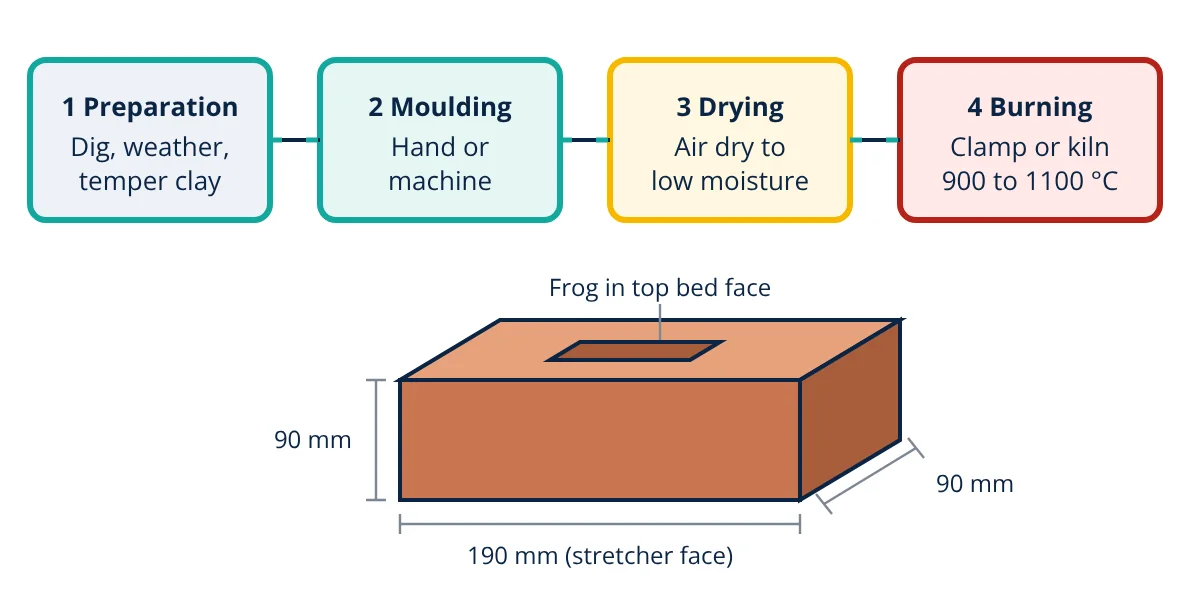
Size and shape of a standard brick
IS 1077 sets the modular brick at 190 × 90 × 90 mm. With a 10 mm mortar joint it occupies 200 × 100 × 100 mm, so dimensions work out in round numbers. A thinner 190 × 90 × 40 mm unit is also allowed, along with the older non-modular sizes of 230 × 110 × 70 mm and 230 × 110 × 30 mm that many sites still use.
A frog is a shallow recess in one bed face, typically on bricks 70 mm high or more. Mortar fills it and keys the brick to the course above. The faces are named by position: the long side face is the stretcher, the short end face is the header and the large faces are the beds.
How burnt clay bricks are made
Good brick earth is mainly silica and alumina. Duggal gives typical proportions:
| Constituent | Typical share by weight | Effect |
|---|---|---|
| Silica | 50 to 60 percent | Keeps shape, prevents cracking and warping; too much makes the brick brittle |
| Alumina | 20 to 30 percent | Gives plasticity for moulding; too much causes shrinkage and cracking on drying |
| Lime | 2 to 5 percent | Lets silica fuse slightly; excess makes the brick melt and lose shape |
| Iron oxide | 5 to 6 percent | Acts as a flux and gives the red colour |
| Magnesia | Less than 1 percent | Small amounts give a yellow tint and reduce shrinkage |
Manufacture has four stages, as the diagram shows.
The clay is dug, cleaned of stones and organic matter, left to weather, then tempered with water until it is uniform and plastic. It is moulded by hand or by machine (wire cut or pressed). The green bricks are dried in air before burning, because a wet brick cracks in the kiln. Burning in a clamp or a kiln, such as a Bull’s trench or Hoffman kiln, at about 900 to 1100 °C turns the clay into a hard ceramic.
Classification of burnt clay bricks
By strength class under IS 1077
IS 1077:1992 classes common burnt clay bricks by their average compressive strength in N/mm²: 35, 30, 25, 20, 17.5, 15, 12.5, 10, 7.5, 5 and 3.5. A class 10 brick has an average strength of at least 10 N/mm². The same standard limits water absorption after 24 hour immersion to 20 percent by weight for classes up to 12.5 and 15 percent for higher classes. Efflorescence may be no worse than moderate up to class 12.5 and no worse than slight above it.
By quality in field practice
Site engineers and older textbooks still sort bricks into four field grades.
| Field class | How it looks and sounds | Typical use |
|---|---|---|
| First class | Well burnt, uniform colour, sharp edges, metallic ring when struck | Exposed facing work, load bearing walls |
| Second class | Well burnt with slight irregularities or hair cracks | Plastered walls |
| Third class | Under burnt, soft, light colour, dull sound | Temporary structures in dry areas |
| Fourth class (jhama) | Over burnt, distorted, very hard | Crushed as aggregate for foundations and floors |
Non-clay types of bricks
Fly ash lime bricks (IS 12894) are made from pulverized fuel ash from thermal power stations, lime and often gypsum, pressed and cured rather than fired. They use an industrial waste and have uniform size, so walls need less plaster.
Sand lime or calcium silicate bricks (IS 4139) are pressed from sand and lime and hardened by steam curing under pressure in an autoclave. They are smooth, uniform and light grey or white.
Concrete bricks are cast from cement, sand and fine aggregate and cured with water. Their strength depends on the mix, and the water cement ratio matters here just as in other concrete. Sun dried (unburnt) bricks are only air dried, so they are weak and lose strength when wet; they suit temporary work in dry climates.
Special types of bricks
Engineering bricks are dense clay bricks burnt at high temperature. BS 3921 defined Class A with a compressive strength of at least 125 N/mm² and water absorption up to 4.5 percent, and Class B with at least 75 N/mm² and absorption up to 7 percent. They go into sewers, manholes, retaining walls, damp proof courses and heavily loaded piers.
Fire bricks are made from fire clay and resist high temperatures without softening. They line furnaces, kilns, chimneys and boilers. Other shapes, such as bullnose, coping and perforated bricks, are standard bricks with special profiles or holes for corners, wall tops and lighter weight.
ASTM C62 grades building bricks for durability against freezing and thawing: SW for severe weathering, MW for moderate weathering and NW for negligible weathering.
Tests on bricks
IS 3495 (Parts 1 to 4) sets the laboratory tests:
- Compressive strength (Part 1). The frog is filled with 1:3 cement mortar, the specimens are stored under damp jute and then immersed in water, and the brick is crushed flat between the platens. Strength is the maximum load divided by the bed face area.
- Water absorption (Part 2). The brick is oven dried to constant mass, immersed in water for 24 hours and weighed again.
- Efflorescence (Part 3). The brick stands in a dish of distilled water until it dries out, and the salt deposit is rated nil, slight, moderate, heavy or serious.
- Warpage (Part 4). The distortion of faces and edges is measured.
Simple field checks support these: a good brick gives a ringing sound when two are struck together, shows no lime nodules when broken and does not break when dropped flat from about 1 m.
Key formulas for types of bricks
| Quantity | Formula | Symbols and units |
|---|---|---|
| Compressive strength | f = P ÷ A | P = maximum load in N, A = bed face area in mm², f in N/mm² |
| Water absorption | W = (M₂ − M₁) ÷ M₁ × 100 | M₁ = dry mass, M₂ = mass after 24 h immersion, W in percent |
| Number of bricks | N = V ÷ V_nominal | V = masonry volume in m³, V_nominal = brick size with mortar joint in m³ |
| Mortar volume (wet) | V_m = V − N × V_brick | V_brick = actual brick size in m³ |
For a modular brick of 190 × 90 mm bed face, A = 17 100 mm², so a crushing load of 180 kN gives 180 000 ÷ 17 100 = 10.5 N/mm², which meets class 10.
- Given
- 10 m³ of brick masonry in IS 1077 modular bricks (190 × 90 × 90 mm, nominal 200 × 100 × 100 mm with 10 mm joints) laid in 1:6 cement mortar. Bulk density of cement 1440 kg/m³; one bag = 50 kg.
- Find
- Number of bricks, cement and sand.
- Assumptions
- Dry volume factor of 1.27 for mortar; frogs and wastage ignored.
- Solution
- Nominal brick volume = 0.2 × 0.1 × 0.1 = 0.002 m³
N = 10 ÷ 0.002 = 5000 bricks
Actual brick volume = 0.19 × 0.09 × 0.09 = 0.001539 m³
Wet mortar = 10 − 5000 × 0.001539 = 2.305 m³
Dry mortar = 2.305 × 1.27 = 2.927 m³; total parts = 7
Cement = 2.927 ÷ 7 = 0.418 m³ × 1440 = 602 kg = 12.0 bags
Sand = 2.927 × 6 ÷ 7 = 2.51 m³ - Answer
- 5000 bricks, about 602 kg (12 bags) of cement and 2.51 m³ of sand
- Limitations
- Add wastage for bricks and mortar, extra mortar to fill frogs, and adjust for non-modular bricks, which give a different count.
Choosing among the types of bricks
| Situation | Usual choice |
|---|---|
| Load bearing walls | Burnt clay brick of the class the design calls for, or fly ash bricks of matching strength |
| Exposed facing work | First class burnt clay or sand lime bricks |
| Partition and infill walls | Fly ash, concrete or lower class burnt clay bricks |
| Sewers, manholes, damp ground | Engineering bricks |
| Furnaces, chimneys, boilers | Fire bricks |
| Foundation and floor aggregate | Crushed over burnt (jhama) bricks |
Masonry needs a sound base, so see types of foundations and bearing capacity of soil. Mortar cement is covered in types of cement, and brickwork quantities in quantity estimation methods.
Types of bricks interview and viva questions
- What is the size of a modular brick under IS 1077? It is 190 × 90 × 90 mm, which becomes 200 × 100 × 100 mm with a 10 mm mortar joint.
- How are burnt clay bricks classified under IS 1077? By average compressive strength in N/mm², in classes from 35 down to 3.5, with limits on water absorption and efflorescence for each range of classes.
- What is the water absorption limit in IS 1077? Not more than 20 percent by weight after 24 hour immersion for classes up to 12.5, and 15 percent for higher classes.
- Why is a frog provided in a brick? Mortar fills the frog and forms a key with the course above; it also reduces the weight of the brick slightly.
- How are sand lime bricks hardened? Sand and lime are pressed and then steam cured under pressure in an autoclave, instead of being fired in a kiln.
Frequently asked questions
What is the standard size of a brick in India?
IS 1077 gives a modular brick of 190 × 90 × 90 mm, which becomes 200 × 100 × 100 mm with a 10 mm mortar joint. It also allows a 190 × 90 × 40 mm brick and non-modular sizes of 230 × 110 × 70 mm and 230 × 110 × 30 mm, which are still common on site.
Why does a brick have a frog?
The frog is a shallow indentation in one bed face. Mortar fills it and forms a key between the brick and the course above, and it also slightly reduces the weight of the brick. Bricks are normally laid frog up.
What causes white patches on brick walls?
The white deposit is efflorescence. Soluble salts in the brick or the mortar dissolve in water, move to the surface and are left behind as the water evaporates. IS 3495 Part 3 rates it as nil, slight, moderate, heavy or serious, and IS 1077 limits it by brick class.
References
- IS 1077:1992 Common Burnt Clay Building Bricks, Specification, Bureau of Indian Standards
- IS 3495 (Parts 1 to 4):1992 Methods of Tests of Burnt Clay Building Bricks, Bureau of Indian Standards
- IS 12894:2002 Pulverized Fuel Ash Lime Bricks, Specification, Bureau of Indian Standards
- IS 4139:1989 Calcium Silicate Bricks, Specification, Bureau of Indian Standards
- ASTM C62, Standard Specification for Building Brick (Solid Masonry Units Made From Clay or Shale), ASTM International
- BS 3921:1985 Specification for Clay Bricks, British Standards Institution (now replaced by BS EN 771-1)
- S. K. Duggal, Building Materials, 4th ed., New Age International
Get one engineering email a week
New articles, worked examples and study notes every week. Free, no spam, unsubscribe any time.