Water Cement Ratio and Its Effect on Concrete Strength
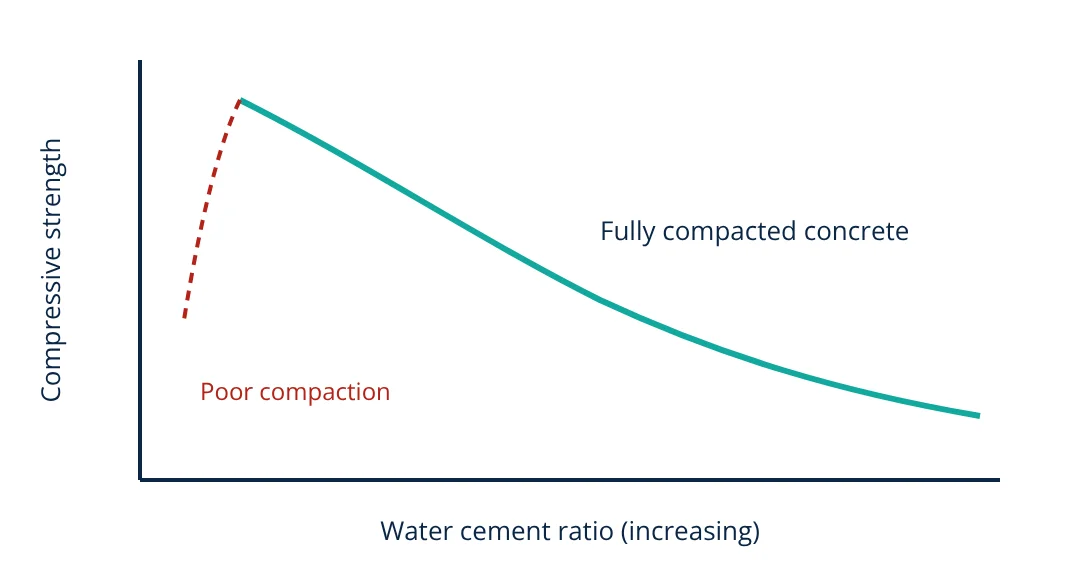
The water cement ratio (w/c) is the mass of free water divided by the mass of cement in a concrete mix. It is the single most important factor in concrete strength and durability: for fully compacted concrete, strength falls as w/c rises (Abrams’ law). Structural concrete usually has a w/c of about 0.40 to 0.55, and IS 456 sets maximum values for each exposure condition.
Water is needed in concrete for two reasons: to react with cement, and to make the mix workable enough to place and compact. The trouble is that the second need usually asks for more water than the first. Every extra litre left in the mix weakens the hardened concrete. Understanding the water cement ratio explains why site workers should never “add a little water” to a stiff mix and why mix designs specify it so carefully.
What is the water cement ratio?
Both quantities are per cubic metre of concrete or per batch. Where supplementary materials such as fly ash or slag are used, the water to binder (w/b) ratio uses the total cementitious content.
For example, a mix with 380 kg of cement and 171 kg of water per cubic metre has w/c = 171 / 380 = 0.45.
Abrams’ law: why water controls strength
In 1918 Duff Abrams showed that, for fully compacted concrete made with given materials, compressive strength depends mainly on the water cement ratio. His relationship has the form:
where A and B are constants for the particular materials and test conditions. The exact numbers vary, but the trend is universal: lower w/c, higher strength.
The reason lies in the cement paste. Complete hydration chemically binds water equal to roughly a quarter of the cement mass, and some more is held in the gel pores of the hydration products, so a w/c of roughly 0.4 is about the least that allows full hydration. Water beyond that leaves capillary pores when it evaporates. Capillary porosity is what makes paste weak and permeable. Halving the porosity does far more for strength than any other change to the mix.
The left side of the curve also matters. At very low w/c without admixtures the mix becomes too stiff to compact. Trapped air voids then reduce strength, so the law only holds for concrete that is properly compacted.
Effect of water cement ratio on durability
Water cement ratio controls permeability, and permeability controls durability. A porous concrete lets in water, chlorides, carbon dioxide and sulphates, which corrode reinforcement and attack the paste. IS 456 therefore limits w/c and sets minimum cement content and grade for each exposure condition.
| Exposure (IS 456 Table 5, RCC) | Max free w/c | Min cement (kg/m³) | Min grade |
|---|---|---|---|
| Mild | 0.55 | 300 | M20 |
| Moderate | 0.50 | 300 | M25 |
| Severe | 0.45 | 320 | M30 |
| Very severe | 0.45 | 340 | M35 |
| Extreme | 0.40 | 360 | M40 |
Lower w/c also reduces drying shrinkage and cracking, and improves abrasion resistance in floors and pavements such as rigid concrete pavements.
Other properties affected by water cement ratio
- Permeability: rises sharply at higher w/c, because the capillary pores become connected through the paste.
- Shrinkage: more mixing water means more water to lose on drying, so drying shrinkage and cracking increase.
- Creep: concrete with higher w/c deforms more under sustained load.
- Bleeding and segregation: wet mixes let water rise to the surface and heavy aggregate settle, leaving a weak, porous top layer.
- Abrasion and freeze thaw resistance: both improve with lower w/c and denser paste.
Workability and how to keep w/c low
Workability is usually measured by the slump test. Adding water raises slump but damages strength, so good practice gets workability by other means:
- Water reducing admixtures and superplasticisers: disperse cement particles and allow the same slump with much less water.
- Well graded, rounded aggregates: need less paste to coat and fill voids.
- Mineral admixtures: fly ash improves flow; silica fume needs a superplasticiser but greatly reduces permeability.
- Correct batching: adjust batch water for the free moisture on wet sand and the absorption of dry aggregates.
Mix proportioning under IS 10262 starts by choosing the w/c from the target strength and exposure, then sets water content from the required slump and aggregate size, and finally calculates the cement content as water / (w/c).
- Given
- A mix design for moderate exposure specifies 380 kg/m³ of cement and 171 kg/m³ of free water. On site, workers add 20 litres of water per cubic metre to make placing easier.
- Find
- The designed and actual water cement ratios, and whether the IS 456 limit is still met.
- Assumptions
- Aggregates in saturated surface dry condition; 1 litre of water = 1 kg.
- Solution
- Design w/c = 171 / 380 = 0.45
Actual water = 171 + 20 = 191 kg/m³
Actual w/c = 191 / 380 = 0.50 (0.503) - Answer
- The ratio rises from 0.45 to just over 0.50, exceeding the 0.50 limit for moderate exposure; strength and durability both drop
- Limitations
- The strength loss depends on the materials. The correct fix is a superplasticiser dose or a revised mix, not site water.
Checking water cement ratio in fresh concrete
The water cement ratio of fresh concrete is hard to measure directly, so control relies on accurate batching. Batching plants weigh cement and water and record each batch, which gives a reliable check. On smaller sites, measuring water with marked containers instead of a hose, and keeping the slump within the specified range, are practical controls. A slump far above the specified value is a warning sign that extra water has been added.
Practical rules for site engineers
- Never add water to ready mixed concrete without the supplier’s approval; use admixture redosing if slump is lost.
- Check aggregate moisture daily, especially sand, and correct the batch water.
- Cure properly: water lost early by evaporation stops hydration at the surface, giving a weak, dusty, permeable skin.
- Record slump and cube results; a sudden drop in cube strength often traces back to extra water.
The choice of type of cement affects the water demand and strength gain, and the resulting concrete strength feeds into limit state design of RCC. Accurate quantities of cement, sand and aggregate for a job come from quantity estimation.
Frequently asked questions
What is the ideal water cement ratio for concrete?
There is no single ideal value. For reinforced concrete, IS 456 sets a maximum of 0.55 for mild exposure down to 0.40 for extreme exposure. Most structural mixes fall between about 0.40 and 0.55, chosen in the mix design for the required strength and durability, with workability adjusted using admixtures.
Why does adding water make concrete weaker?
Only part of the water is used by cement hydration. The rest occupies space in the paste and later evaporates or remains in pores, leaving capillary voids. More water means more voids, lower density of the hardened paste and lower strength and durability.
Can you get workable concrete with a low water cement ratio?
Yes. Water reducing admixtures and superplasticisers disperse cement particles so the mix flows with less water. This is how high strength and self-compacting concretes achieve high workability at low water cement ratios.
Does water cement ratio include water in the aggregates?
It refers to free water, meaning water available to the cement paste. Water absorbed inside the aggregate pores does not count, but surface moisture on wet aggregates does, so batch water must be corrected for aggregate moisture.
References
- IS 456:2000 Plain and Reinforced Concrete, Code of Practice, Bureau of Indian Standards (Table 5)
- IS 10262:2019 Concrete Mix Proportioning, Guidelines, Bureau of Indian Standards
- A. M. Neville, Properties of Concrete, 5th ed., Pearson
- D. A. Abrams, Design of Concrete Mixtures, Bulletin 1, Structural Materials Research Laboratory, Lewis Institute, Chicago, 1918
- M. S. Shetty, Concrete Technology: Theory and Practice, S. Chand
Get one engineering email a week
New articles, worked examples and study notes every week. Free, no spam, unsubscribe any time.