Flexible vs Rigid Pavement: Differences Explained
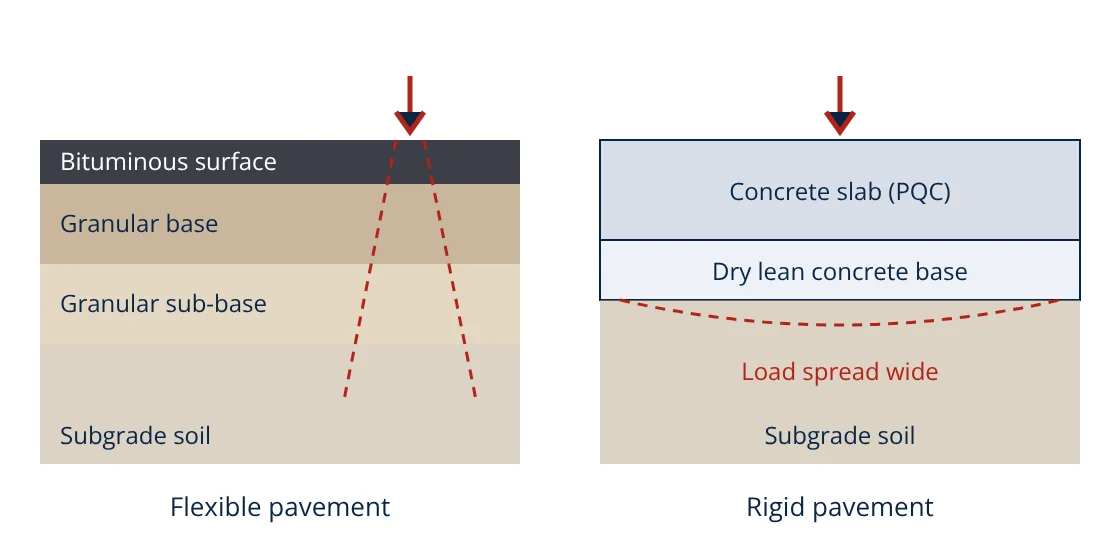
In the flexible vs rigid pavement comparison, the difference is how load reaches the soil. A flexible pavement (bituminous) is a stack of granular and bituminous layers that spread the wheel load gradually, so the subgrade strength governs its thickness. A rigid pavement (cement concrete) is a stiff slab that bends and spreads the load over a wide area, so the concrete’s flexural strength governs. Flexible pavements are cheaper to build; rigid pavements last longer with less maintenance.
Roads, runways, ports and industrial yards all need a pavement that carries repeated wheel loads without excessive deformation or cracking. The two classic answers are flexible (bituminous) and rigid (concrete) pavements. They are built from different materials, behave differently under load, are designed by different methods and suit different situations.
How each pavement carries load
Flexible pavement. Each layer has low bending stiffness. The wheel load is passed down through grain to grain contact, spreading over a wider area with depth. The best (stiffest and most expensive) material is placed at the top where stresses are highest. Layers below are progressively cheaper. Because the pavement follows any deformation of the subgrade, the thickness is set mainly by the subgrade strength (CBR or resilient modulus) and the cumulative traffic in million standard axles (msa).
Rigid pavement. The concrete slab has high flexural stiffness and acts like a plate on an elastic foundation. It bends under the wheel and spreads the load over a large area of subgrade, so subgrade pressures are low. Design is governed by the flexural (tensile) stress in the concrete from wheel loads and temperature curling, based on theories developed by Westergaard. Small variations in subgrade strength matter much less than for flexible pavements.
Layers of each pavement
Flexible pavement (IRC:37-2018):
- Bituminous surface course (bituminous concrete or similar) for riding quality and waterproofing.
- Bituminous binder or base course (dense bituminous macadam) on heavier roads.
- Granular base (wet mix macadam or water bound macadam) or cement treated base.
- Granular sub-base, which also drains water.
- Compacted subgrade.
Rigid pavement (IRC:58-2015):
- Pavement quality concrete (PQC) slab with joints, dowel bars and tie bars.
- Separation membrane between slab and base.
- Dry lean concrete (DLC) base.
- Granular sub-base for drainage.
- Compacted subgrade.
Flexible vs rigid pavement: key differences
| Feature | Flexible pavement | Rigid pavement |
|---|---|---|
| Surface material | Bitumen with aggregates | Cement concrete slab |
| Load transfer | Grain to grain, layer by layer | Slab (beam) action over wide area |
| Flexural strength | Negligible | High |
| Design governed by | Subgrade strength and traffic (msa) | Concrete flexural strength, traffic, temperature stresses |
| Effect of weak subgrade | Large; thicker layers needed | Smaller |
| Joints | None | Required |
| Initial cost | Lower | Higher |
| Maintenance | More frequent (overlays, patching) | Less frequent, but repairs are harder |
| Design life (typical, major roads) | Shorter | Longer |
| Opening to traffic | Soon after laying | After curing, typically weeks |
| Strengthening | Easy by overlay in stages | Difficult |
| Night visibility | Dark surface | Lighter, better reflection |
IRC guidelines commonly use a design period of about 20 years for flexible pavements on major highways and about 30 years for rigid pavements, though projects set their own values.
Common failures
Flexible pavement failures usually show as:
- Rutting: permanent depressions in the wheel paths from deformation of bituminous or granular layers or the subgrade.
- Fatigue (alligator) cracking: interconnected cracks from repeated bending at the bottom of the bituminous layer.
- Ravelling and potholes: loss of aggregate from the surface, often started by water and poor binder.
- Shoving and bleeding: surface distortion or excess bitumen rising to the surface in hot weather.
Rigid pavement failures usually show as:
- Corner and transverse cracking: from loads at slab corners and edges combined with curling stresses.
- Joint faulting: a step between adjacent slabs where load transfer across the joint is poor.
- Pumping: water and fine soil squeezed out at joints under traffic, leaving voids beneath the slab.
- Spalling and joint seal damage: breaking of concrete along joints, often because hard material has entered the joint.
Good drainage, proper compaction and timely maintenance prevent most of these problems in both types.
Where each is used
- Flexible pavements: most rural and urban roads, highways with stage construction, roads on good subgrade, places where early opening and easy future widening matter.
- Rigid pavements: heavily loaded corridors, bus terminals, container yards, toll plazas, airport aprons, junctions with braking and turning traffic, waterlogged and weak soil areas where bituminous layers would strip.
- Given
- A 1 km length of two lane rigid pavement, 7.0 m wide, with a 300 mm PQC slab over a 150 mm dry lean concrete base.
- Find
- Volumes of PQC and DLC required.
- Assumptions
- Uniform width and thickness; no allowance for wastage, edge thickening or shoulders.
- Solution
- PQC = 1000 × 7.0 × 0.30 = 2100 m³
DLC = 1000 × 7.0 × 0.15 = 1050 m³ - Answer
- 2100 m³ of pavement quality concrete and 1050 m³ of dry lean concrete per kilometre
- Limitations
- The DLC is usually wider than the slab to support the edges. Add wastage and use the actual cross section drawings for the bill of quantities.
Construction differences
Flexible pavements are laid in layers with graders, pavers and rollers, and each layer is compacted to a specified density before the next is placed. Bituminous mixes must be laid within a temperature window, and the road can carry traffic soon after rolling. Rigid pavements are cast with slipform or fixed form pavers. The concrete is textured for skid resistance, cured with curing compound or wet hessian, and joints are cut with saws at the right time to control cracking. Traffic usually waits until the concrete reaches its design flexural strength.
Choosing between flexible and rigid pavement
The decision is usually made on life cycle cost: construction cost plus discounted maintenance, rehabilitation and user delay costs over the analysis period. Other factors include traffic volume and axle loads, subgrade strength, drainage, availability of aggregates, bitumen and cement, construction speed and the agency’s maintenance capacity.
Concrete quality for rigid pavements depends heavily on a low water cement ratio and the right type of cement. Road levels and gradients are set out by levelling in surveying, and pavement quantities come from quantity estimation methods.
Frequently asked questions
Which is better, flexible or rigid pavement?
Neither is better everywhere. Flexible pavements cost less to build, can be opened quickly and are easy to repair and strengthen in stages. Rigid pavements cost more initially but last longer with less maintenance and suit heavy traffic, weak subgrades, waterlogged areas and places like bus depots and toll plazas. The choice is made on life cycle cost and site conditions.
Why do rigid pavements have joints?
Concrete expands, contracts and curls with temperature and moisture changes. Without joints it would crack randomly. Contraction, expansion, construction and longitudinal joints control where cracks form, with dowel bars and tie bars transferring load and holding slabs together.
What is a composite pavement?
A pavement that combines both types, for example a bituminous overlay on a concrete slab, or a concrete overlay (whitetopping) on an existing bituminous road. It aims to combine the structural strength of concrete with the riding quality or ease of maintenance of bituminous surfacing.
References
- IRC:37-2018 Guidelines for the Design of Flexible Pavements, Indian Roads Congress
- IRC:58-2015 Guidelines for the Design of Plain Jointed Rigid Pavements for Highways, Indian Roads Congress
- S. K. Khanna, C. E. G. Justo and A. Veeraragavan, Highway Engineering, 10th ed., Nem Chand and Bros
- Y. H. Huang, Pavement Analysis and Design, 2nd ed., Pearson
Get one engineering email a week
New articles, worked examples and study notes every week. Free, no spam, unsubscribe any time.