Types of Cement and Their Uses
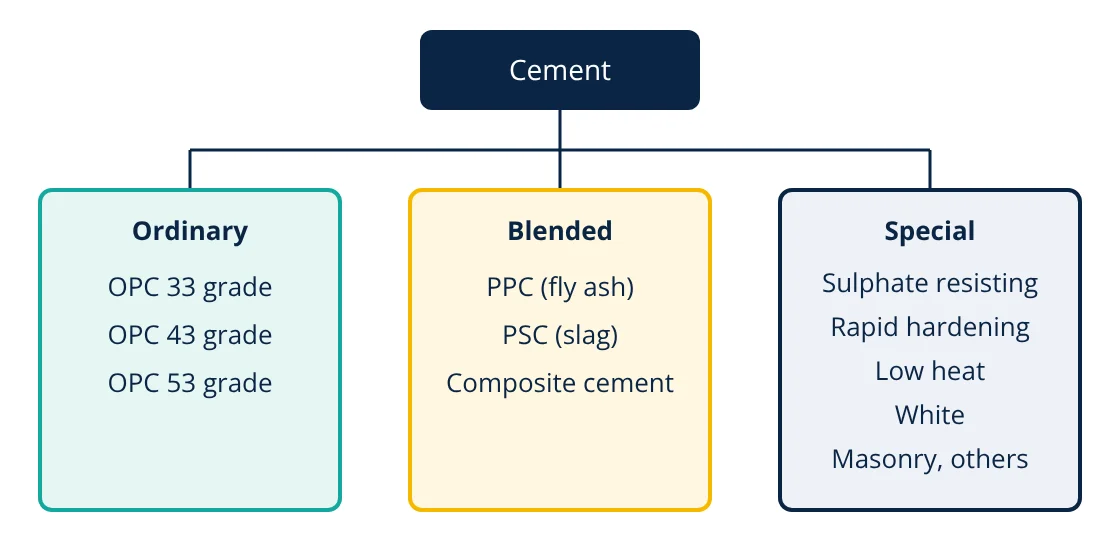
The main types of cement are Ordinary Portland Cement (OPC, in 33, 43 and 53 grades), blended cements such as Portland Pozzolana Cement (PPC) and Portland Slag Cement (PSC), and special cements such as sulphate resisting, rapid hardening, low heat and white cement. OPC suits work needing early strength; blended cements give lower heat and better durability; special cements solve particular problems.
Cement is the binder that turns sand and aggregate into concrete and mortar. All common cements are hydraulic: they set and harden by reacting with water and keep their strength under water. They differ in composition, fineness and added materials, which changes how fast they gain strength, how much heat they release and how well they resist chemical attack. Choosing among the types of cement is one of the first decisions in concrete technology.
How Portland cement is made
Limestone and clay (or shale) are ground, mixed and burned in a rotary kiln at about 1450 °C to form clinker. The clinker is ground with a small amount of gypsum, which controls setting. The four main compounds in clinker give cement its properties:
| Compound | Short form | Role |
|---|---|---|
| Tricalcium silicate | C₃S | Early strength, high heat |
| Dicalcium silicate | C₂S | Later strength, low heat |
| Tricalcium aluminate | C₃A | Fast reaction and heat; vulnerable to sulphate attack |
| Tetracalcium aluminoferrite | C₄AF | Colour and minor strength contribution |
Changing the proportions of these compounds, the fineness, or blending with other materials produces the different types of cement.
Ordinary Portland Cement (OPC)
OPC is specified in India by IS 269, which covers three strength grades. The grade is the minimum 28 day compressive strength of standard mortar cubes in MPa.
- OPC 33 grade: lower early strength; suitable for plastering, masonry mortar and non-structural work.
- OPC 43 grade: the general purpose cement for RCC buildings, pavements and masonry.
- OPC 53 grade: high early strength; used for precast elements, prestressed concrete, high grade concrete and when formwork must be stripped early. It releases more heat and needs careful curing to limit shrinkage cracks.
Blended cements
Blended cements replace part of the clinker with industrial by-products that react with the calcium hydroxide released during hydration (the pozzolanic reaction) or have latent hydraulic properties.
- Portland Pozzolana Cement (PPC), IS 1489 Part 1: contains fly ash (typically 15 to 35 percent). It gives lower heat of hydration, better workability, lower permeability and improved resistance to chlorides and sulphates. Early strength is lower, so curing must continue longer. It is widely used for general construction, mass concrete and marine works.
- Portland Slag Cement (PSC), IS 455: contains ground granulated blast furnace slag (25 to 70 percent). It offers low heat, good sulphate and chloride resistance and a lighter colour. It is popular for foundations, marine structures, sewage works and mass concrete.
- Composite cement: combines fly ash and slag with clinker.
Blended cements also reduce the carbon dioxide emitted per tonne, because less clinker is burned.
Special types of cement
- Sulphate resisting cement (SRC), IS 12330: limits C₃A (to 5 percent) to resist sulphate attack in foundations, sewers and aggressive soils.
- Rapid hardening cement, IS 8041: finer and richer in C₃S, it gains strength faster than OPC. Used for repairs and road work where early opening is needed. It is not the same as quick setting cement.
- Low heat cement, IS 12600: less C₃S and C₃A to limit temperature rise and cracking in dams and thick rafts.
- White cement, IS 8042: made from raw materials low in iron and manganese, for architectural finishes, tiles and terrazzo.
- Hydrophobic cement, IS 8043: grains coated with a water repellent film for storage in humid conditions.
- Masonry cement, IS 3466: for mortars and plasters, not for structural concrete.
- High alumina cement: very fast strength and heat resistance for refractories; it loses strength over time in warm, moist conditions and is not used for structural concrete in most codes.
- Given
- 1 m³ of cement mortar in the proportion 1:6 (cement : sand by volume) for brick masonry. Bulk density of cement 1440 kg/m³; one bag = 50 kg.
- Find
- Cement and sand required.
- Assumptions
- Dry volume factor of 1.27 to allow for voids and bulking (common estimating practice; some engineers use 1.33). Wastage ignored.
- Solution
- Dry volume = 1 × 1.27 = 1.27 m³; total parts = 1 + 6 = 7
Cement = 1.27 / 7 = 0.181 m³ × 1440 = 261 kg = 5.2 bags
Sand = 1.27 × 6 / 7 = 1.09 m³ - Answer
- About 261 kg (5.2 bags) of cement and 1.09 m³ of sand per cubic metre of 1:6 mortar
- Limitations
- Add a wastage allowance and adjust for actual sand bulking measured on site.
Common tests on cement
Cement quality is checked with standard tests, in India under the various parts of IS 4031:
- Fineness: by specific surface (Blaine air permeability); finer cement reacts faster and gains early strength.
- Normal consistency: the water content giving standard paste stiffness, used as the basis of the other tests.
- Initial and final setting time: measured with the Vicat apparatus; the initial set must allow time to mix and place concrete.
- Soundness: Le Chatelier and autoclave tests detect excess free lime or magnesia that would cause expansion later.
- Compressive strength: mortar cubes tested at 3, 7 and 28 days, which defines the grade.
Each bag also carries the manufacturer’s name, type, grade and week of packing, which should be checked on delivery.
How to choose the right type of cement
| Situation | Usual choice |
|---|---|
| General RCC buildings | OPC 43, OPC 53 or PPC |
| Early strength, precast, prestressed | OPC 53 or rapid hardening |
| Mass concrete, thick rafts, dams | PPC, PSC or low heat |
| Sulphate bearing soil or water | SRC or PSC, as the specification requires |
| Marine and coastal works | PSC or PPC with low water cement ratio |
| Plaster and masonry | PPC, OPC 33 or masonry cement |
Whatever the type, the water cement ratio still governs strength and durability, and IS 456 exposure rules apply. Store cement off the ground in dry sheds and use it in the order received, since it gradually loses strength once exposed to moisture. Quantities are worked out by quantity estimation, and the chosen cement’s strength enters limit state design of RCC.
Frequently asked questions
Which type of cement is best for house construction?
Both OPC 43 grade and PPC are widely used for houses. PPC gains strength more slowly but gives lower heat, better workability and better long term durability, which suits plastering, masonry and general concrete. OPC 53 is preferred where early strength is needed, such as precast work or fast formwork turnaround.
What does 53 grade cement mean?
It means the cement reaches a minimum compressive strength of 53 MPa at 28 days when tested as a standard mortar cube under IS 4031. Similarly 43 and 33 grade cements reach at least 43 and 33 MPa.
Is PPC weaker than OPC?
PPC gains strength more slowly at early ages because fly ash reacts later, but its long term strength can equal or exceed OPC of similar class. It also reduces permeability, which improves durability.
When should sulphate resisting cement be used?
Where concrete is in contact with soil or groundwater containing high sulphate levels, such as some foundations, sewers and coastal or industrial sites. Its low tricalcium aluminate content limits the expansive reaction between sulphates and cement paste.
References
- IS 269:2015 Ordinary Portland Cement, Specification, Bureau of Indian Standards
- IS 1489 (Part 1):2015 Portland Pozzolana Cement, Specification, Part 1 Fly Ash Based, Bureau of Indian Standards
- IS 455:2015 Portland Slag Cement, Specification, Bureau of Indian Standards
- IS 12330 Sulphate Resisting Portland Cement, Specification, Bureau of Indian Standards
- A. M. Neville, Properties of Concrete, 5th ed., Pearson
- M. S. Shetty, Concrete Technology: Theory and Practice, S. Chand
Get one engineering email a week
New articles, worked examples and study notes every week. Free, no spam, unsubscribe any time.