PLC vs DCS: Differences and How to Choose
PLC vs DCS compares two control system types. A PLC is a rugged controller built for fast discrete and machine logic, programmed per machine or unit. A DCS is a complete plant system of redundant controllers, I/O, network, operator stations and one shared database, built for continuous processes with many interacting control loops.
The PLC vs DCS question comes up at the start of almost every automation project. Both read sensors, run logic and drive actuators, and both are programmed with the languages of IEC 61131-3. They grew from different industries, though, and they still differ in how they are engineered, how they scale and how they fail. This article compares the two and shows a simple way to choose.
Where PLCs and DCSs came from
The programmable logic controller (PLC) was developed in the late 1960s to replace relay panels in car factories. Its job was sequencing: start this motor, wait for that limit switch, open a clamp. It had to be rugged, easy for electricians to understand and quick to reprogram when the product changed, which is why ladder logic copies the look of relay circuits. You can see that style in PLC ladder logic.
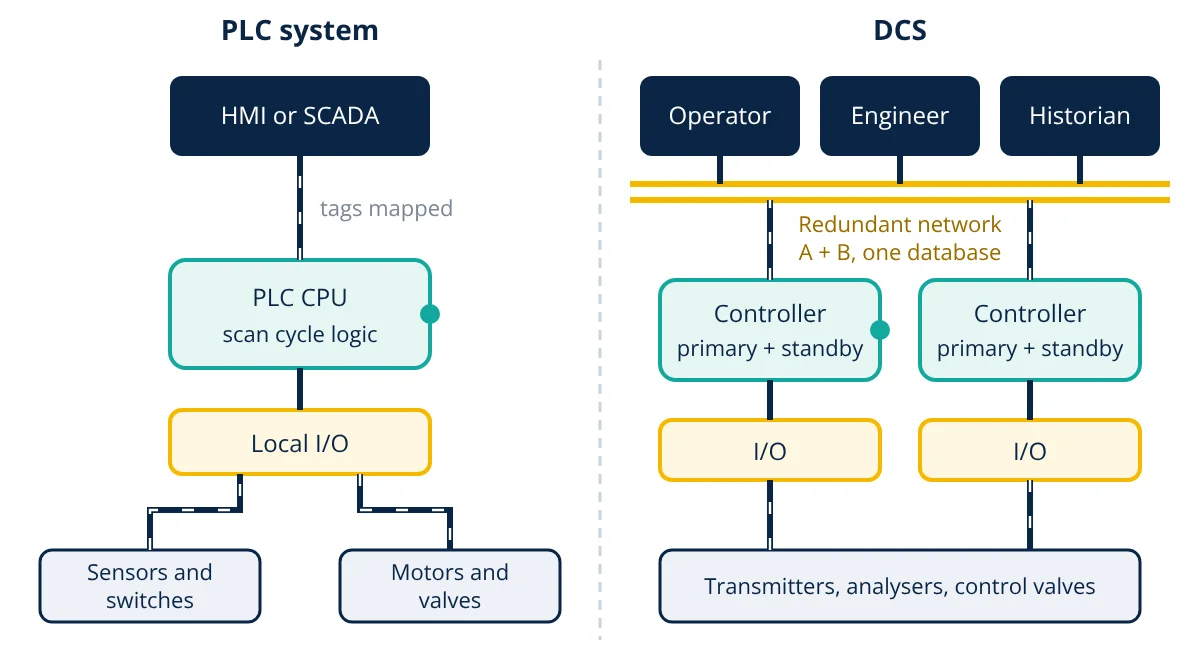
The distributed control system (DCS) appeared in the mid 1970s for refineries, chemical plants and power stations. Those plants ran hundreds of analog control loops from panel mounted controllers. A DCS put many digital controllers close to the process, linked them by a redundant network and gave operators one set of screens for the whole plant. The layers are described in DCS architecture.
PLC vs DCS architecture compared
In a PLC system, each PLC is a self-contained unit. It reads its inputs, executes the user program and writes its outputs, then repeats this scan cycle continuously, as described by Bolton. An HMI or SCADA package is added on top, and the tags in the PLC are mapped into it, often by a separate engineering tool.
In a DCS, controllers, I/O, operator displays, alarms, trends and the historian are designed as one product. A tag created once in the engineering database appears everywhere it is needed, with standard faceplates and alarm settings. Controllers, power supplies and networks are normally supplied in redundant pairs, so a single hardware fault does not stop the process.
PLC vs DCS comparison table
| Feature | PLC | DCS |
|---|---|---|
| Original purpose | Discrete and sequential machine control | Continuous process control with many loops |
| Typical scope | One machine, line or process unit | Whole plant or large plant area |
| Control style | Fast scan of logic, interlocks, motion | Function blocks for PID, cascade, ratio and batch |
| Programming | IEC 61131-3 languages, mainly ladder and structured text | IEC 61131-3 style function block libraries and vendor templates |
| Database | Separate for PLC, HMI and historian | Single plant wide tag database |
| Redundancy | Optional, often only on larger models | Standard for controllers, networks and power |
| Operator interface | Added separately (HMI or SCADA) | Built in, with standard faceplates and alarm management |
| Online changes | Supported on many models, varies by vendor | Designed in, with download to a running controller |
| Upfront cost | Lower for small systems | Higher entry cost, competitive at large scale |
| Typical users | Packaging, automotive, material handling, skids | Refining, chemicals, power, pharmaceuticals, pulp and paper |
Key differences explained
Speed and control style
PLCs grew up around fast discrete logic: counting parts, reacting to a photo eye, sequencing a press. Their strength is deterministic logic execution and close coordination with drives and motion. DCS controllers execute function blocks at configured periods, which suits process loops where flow, level and temperature change over seconds to minutes. Both can do the other job, but each is optimised for its home ground.
Engineering and integration
The largest practical difference is engineering effort. In a PLC based plant the integrator must keep the PLC program, HMI screens, alarm lists and historian tags consistent, often across products from different vendors. A DCS gives one configuration environment, so a change to a loop updates the controller, display and alarm system together. Liptak’s handbook stresses that this integration becomes more valuable as loop count and plant complexity grow.
Availability and redundancy
A process plant may run for years between shutdowns, so DCSs treat redundancy as standard: a hot standby controller takes over without a bump, and failed modules are replaced online. Many PLC families offer redundant CPUs too, but it is usually an option that adds cost and design work. The safety instrumented system stays separate from both under IEC 61511.
Hardware and environment
Both follow tough equipment requirements. IEC 61131-2 sets the environmental, electrical and EMC tests for programmable controllers. Selecting modules, CPU and power supply for a PLC is covered step by step in PLC hardware selection.
Position in the plant hierarchy
In the IEC 62264 (ISA-95) model, both PLCs and DCSs sit at level 1 and 2: sensing, manipulation and supervisory control. Above them, manufacturing operations systems and business systems exchange schedules and production data. A DCS usually includes more of level 2 itself, while a PLC system relies on separate HMI, SCADA and historian products.
When to use which
Choose a PLC when:
- The task is a machine, a packaging line, a conveyor system or a self-contained process skid.
- Logic is mostly discrete, with interlocks, sequences, motion and a modest number of loops.
- The owner wants low entry cost and local technicians who know ladder logic.
Choose a DCS when:
- The plant is a large continuous or batch process with hundreds of analog loops.
- High availability is essential and an unplanned trip is costly or hazardous.
- Operators need one consistent interface, alarm system and history for the whole site.
Many plants use both. Package units such as compressors, water treatment or filling machines arrive with their own PLCs, and the plant DCS supervises them over a fieldbus or Ethernet link such as Modbus TCP.
Worked example: a weighted selection
- Given
- A new solvent recovery unit. The project team rates four criteria with weights: availability 0.35, loop count and integration 0.30, lifecycle engineering effort 0.20, upfront cost 0.15. Each option is scored 1 to 5 by the team: PLC with SCADA scores 3, 2, 3, 5; DCS scores 5, 5, 4, 2.
- Find
- The weighted score of each option and the preferred system.
- Assumptions
- Weights and scores are the project team’s own judgement for this unit; weights add to 1.00.
- Solution
- Check weights: 0.35 + 0.30 + 0.20 + 0.15 = 1.00
PLC = 0.35 × 3 + 0.30 × 2 + 0.20 × 3 + 0.15 × 5 = 1.05 + 0.60 + 0.60 + 0.75 = 3.00
DCS = 0.35 × 5 + 0.30 × 5 + 0.20 × 4 + 0.15 × 2 = 1.75 + 1.50 + 0.80 + 0.30 = 4.35 - Answer
- DCS 4.35 against PLC 3.00, so the DCS is preferred for this unit
- Limitations
- The result is only as good as the weights and scores. Repeat the matrix with real vendor quotes, I/O counts and lifecycle cost estimates, and test how sensitive the ranking is to each weight.
If the unit were a small skid where upfront cost carried most of the weight, the same method could easily favour the PLC. The value of the matrix is that it makes the team state its priorities before talking to vendors.
Common misconceptions
- “PLCs cannot do process control.” They can. PID blocks are standard, and many small process plants run entirely on PLCs.
- “A DCS is just a big PLC.” The controllers are similar in principle, but the integrated database, operator interface, alarm management and redundancy make the DCS a different product.
- “The DCS also does the safety shutdown.” Safety functions belong in a separate SIS designed to IEC 61511, whether the basic control is a PLC or a DCS.
PLC vs DCS interview and viva questions
- What is the main design difference between a PLC and a DCS? A PLC is a standalone controller optimised for fast discrete logic, while a DCS is an integrated plant system of controllers, network, operator stations and one shared database for many process loops.
- What is a PLC scan cycle? The PLC reads all inputs, executes the user program and then updates all outputs, repeating this cycle continuously.
- Why is redundancy standard in a DCS? Process plants run for long periods and a trip can be costly or hazardous, so redundant controllers, networks and power supplies keep control running through a single fault.
- Which standard defines PLC programming languages? IEC 61131-3, which defines ladder diagram, function block diagram, structured text and sequential function chart, plus instruction list, which the 2013 edition marks as deprecated.
- Where do PLCs and DCSs sit in the ISA-95 model? At levels 1 and 2, covering sensing, manipulation and supervisory control, below manufacturing operations and business systems.
Related reading
Frequently asked questions
Can a PLC do PID control?
Yes. Almost every modern PLC has PID function blocks and analog I/O, and many machines and small process skids run their loops in a PLC. The difference is scale and integration: a DCS is built to run hundreds of loops with a shared tag database, standard faceplates, alarm handling and online changes across the whole plant.
Is SCADA the same as a DCS?
No. SCADA is a supervisory layer that collects data from PLCs or remote terminal units spread over a wide area, such as pipelines or water networks, and lets operators send commands. A DCS performs the closed loop control itself in controllers inside one plant, with the operator interface as part of the same system.
Are PLC and DCS still separate products?
The line has blurred. Large PLC based systems now offer redundancy and plant wide engineering tools, and DCS controllers handle fast discrete logic. Vendors still market both, and the choice usually depends on plant size, number of loops, required availability and the skills of the people who will maintain the system.
References
- IEC 61131-3:2013 Programmable controllers, Part 3: Programming languages
- IEC 61131-2:2017 Programmable controllers, Part 2: Equipment requirements and tests
- IEC 62264-1:2013 Enterprise-control system integration, Part 1: Models and terminology (ISA-95)
- W. Bolton, Programmable Logic Controllers, 6th ed., Newnes
- B. G. Liptak (ed.), Instrument Engineers' Handbook, Vol. 3: Process Software and Digital Networks, 4th ed., CRC Press
- IEC 61511-1:2016 Functional safety, Safety instrumented systems for the process industry sector, Part 1
Get one engineering email a week
New articles, worked examples and study notes every week. Free, no spam, unsubscribe any time.