Aircraft Stability: Static and Dynamic Explained
Aircraft stability is the ability of an aircraft to return to its trimmed flight condition after a disturbance such as a gust. Static stability is the initial tendency to return, set mainly by the centre of gravity lying ahead of the neutral point. Dynamic stability describes whether the resulting oscillation then dies out, stays constant or grows over time.
Aircraft stability decides how an aeroplane behaves when a gust, a control input or a change in load pushes it away from steady flight. A stable aircraft settles back on its own, which reduces pilot workload and makes the aircraft safe to fly hands off for short periods. This article explains static and dynamic stability about all three axes, the neutral point and static margin, and the natural modes of motion that every flight dynamics course covers.
Equilibrium, trim and the three axes
An aircraft is in equilibrium (trimmed) when the sum of forces and the sum of moments about the centre of gravity (CG) are zero. The forces involved, lift, weight, thrust and drag, and the roll, pitch and yaw axes are introduced in forces of flight and aircraft axes. Stability analysis asks what happens next when something disturbs that equilibrium.
Stability is studied about each axis:
- Longitudinal stability: pitch about the lateral axis.
- Lateral stability: roll about the longitudinal axis.
- Directional stability: yaw about the vertical axis.
Because roll and yaw are strongly coupled, the last two are usually analysed together as lateral directional stability.
Static aircraft stability
The FAA Pilot’s Handbook describes three cases using the picture of a ball. A ball in a bowl rolls back when pushed (positive static stability), a ball on a flat table stays where it is pushed (neutral), and a ball on top of a dome rolls away (negative). Aircraft are designed for positive static stability about all three axes.
Longitudinal static stability
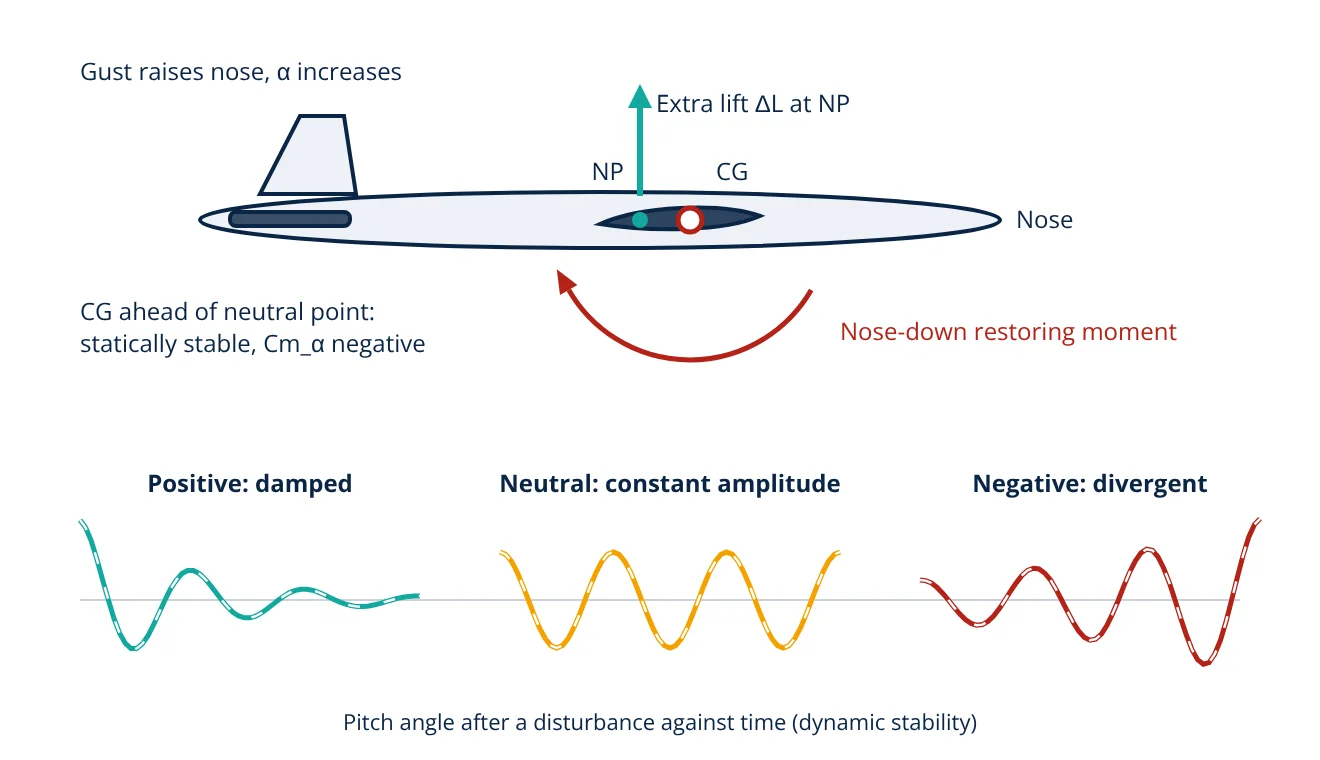
Suppose a vertical gust raises the nose and increases the angle of attack α. Lift on the wing and tail increases. The combined lift increase acts at a point called the neutral point (NP), the stick fixed aerodynamic centre of the whole aircraft. If the CG is ahead of the NP, the extra lift acts behind the CG and produces a nose-down pitching moment, which reduces α back towards trim. This is the condition shown in the upper part of the diagram.
In coefficient form, the pitching moment coefficient about the CG must fall as α rises, so the slope is negative. A second condition is that , the moment coefficient at zero lift, is positive, so that the aircraft trims at a positive, useful angle of attack. A conventional aircraft achieves both with a horizontal tail set at a lower incidence than the wing.
The distance between the CG and the NP, divided by the mean aerodynamic chord, is the static margin. The slope of the moment curve is linked to it by:
where h and h_n are the CG and neutral point positions as fractions of the mean aerodynamic chord. A larger static margin means a stronger restoring moment but heavier control forces. With the CG exactly at the NP the aircraft is neutrally stable in pitch; behind it, unstable. This is the reason flight manuals set forward and aft CG limits.
The tail contribution is often summarised by the horizontal tail volume ratio:
where l_t is the distance from the CG to the tail aerodynamic centre, S_t the tail area, S the wing area and c̄ the mean aerodynamic chord. A bigger tail or a longer tail arm moves the NP aft and increases the static margin.
Directional and lateral static stability
Directional (weathercock) stability comes mainly from the vertical fin. If the aircraft yaws so that the relative wind arrives from one side (a sideslip angle β), the fin produces a side force that turns the nose back into the wind. In coefficient form, the yawing moment slope must be positive.
Lateral stability is the tendency to roll wings level after a sideslip. It comes from wing dihedral, a high wing position and wing sweep. The rolling moment slope must be negative, which is often called the dihedral effect.
Dynamic aircraft stability
Static stability guarantees only that the aircraft starts to move back. Because the aircraft has inertia, it usually overshoots and oscillates. Dynamic stability describes that motion over time:
- Positive: the oscillation amplitude decreases and the aircraft settles (damped).
- Neutral: the oscillation continues at constant amplitude.
- Negative: the amplitude grows (divergent).
The lower part of the diagram shows the three cases. For a second order mode with natural frequency ω_n and damping ratio ζ, a damped oscillation decays with an envelope proportional to , and the time to halve the amplitude is:
Longitudinal modes
Nelson and Etkin show that the linearised longitudinal equations have two oscillatory modes:
- Short period mode: a rapid pitching oscillation at nearly constant speed, with a period of a few seconds and usually heavy damping. It governs how the aircraft responds to elevator inputs.
- Phugoid (long period) mode: a slow exchange of kinetic and potential energy. The aircraft climbs and slows, then dives and speeds up, at nearly constant angle of attack. It is lightly damped but so slow that a pilot easily corrects it.
Lanchester’s classic approximation gives the phugoid period from flight speed alone:
Lateral directional modes
- Roll subsidence: a heavily damped, non-oscillatory roll response to aileron input.
- Spiral mode: a slow, non-oscillatory mode. If it is divergent, a small bank angle slowly grows into a tightening descending spiral. A slow divergence is often accepted because the pilot can correct it.
- Dutch roll: a coupled yawing and rolling oscillation. Strong dihedral effect compared with weathercock stability makes Dutch roll worse, while a large fin improves it but worsens the spiral mode. Many jet transports use a yaw damper to add Dutch roll damping.
Worked example: static margin and phugoid period
- Given
- A light aircraft has a mean aerodynamic chord of 1.5 m and a whole aircraft lift curve slope of 5.0 per radian. The neutral point is at 0.40 of the chord and the CG at 0.28 of the chord, both measured from the leading edge of the mean aerodynamic chord. It cruises at 60 m/s. Take g = 9.81 m/s².
- Find
- The static margin, the pitching moment slope, how far the CG can move aft before the aircraft becomes neutrally stable, and the approximate phugoid period.
- Assumptions
- Stick fixed, rigid aircraft, linear aerodynamics at small angles, Lanchester phugoid approximation with drag neglected.
- Solution
- Static margin = h_n − h = 0.40 − 0.28 = 0.12 (12% of chord)
Cm_α = −5.0 × 0.12 = −0.60 per radian (negative, so statically stable)
Distance from CG to NP = 0.12 × 1.5 m = 0.18 m
T_p ≈ π × √2 × 60 ÷ 9.81 = 27.2 s - Answer
- Static margin 0.12, Cm_α = −0.60 per rad, neutral stability if the CG moves 0.18 m aft, phugoid period about 27 s
- Limitations
- Stick free static margin is smaller than the stick fixed value. Real phugoid periods and damping depend on drag, thrust and compressibility and are found from the full linearised equations or flight test.
Key formulas for aircraft stability
| Quantity | Formula | Symbols and units |
|---|---|---|
| Static margin | SM = h_n − h | h_n, h = NP and CG positions as fractions of mean aerodynamic chord |
| Pitch stiffness | Cm_α = −CL_α × (h_n − h) | CL_α = lift curve slope, per rad; stable when Cm_α is negative |
| Tail volume ratio | V_H = l_t S_t ÷ (S c̄) | l_t in m, S_t and S in m², c̄ in m |
| Directional stability | Cn_β positive | Cn_β = yawing moment slope with sideslip, per rad |
| Lateral stability | Cl_β negative | Cl_β = rolling moment slope with sideslip, per rad |
| Time to half amplitude | t_half = 0.693 ÷ (ζ ω_n) | ζ = damping ratio, ω_n in rad/s, t in s |
| Phugoid period | T_p ≈ π √2 U_0 ÷ g | U_0 = flight speed in m/s, g = 9.81 m/s² |
Stability, control and design
Stability is balanced against control. The elevator, ailerons and rudder must be powerful enough to trim and manoeuvre the aircraft at the most forward CG, where the static margin is largest. The lift from the wings, explained in how wings generate lift, and the structure that carries tail loads, described in aircraft structural components, both enter these design choices.
Modern fly by wire aircraft use flight control computers and sensors, covered in avionics systems overview, to add damping and sometimes to fly with relaxed static stability. Multirotor drones are inherently unstable and rely completely on feedback control, as explained in how a quadcopter flies.
Aircraft stability interview and viva questions
- What is the neutral point of an aircraft? It is the CG position at which the pitching moment slope Cm_α is zero, so the aircraft is neutrally stable in pitch. It is the aerodynamic centre of the complete aircraft.
- What is static margin and why must it be positive? Static margin is the distance from the CG to the neutral point as a fraction of the mean aerodynamic chord. A positive value places the CG ahead of the NP, which gives a nose-down restoring moment when angle of attack increases.
- Can an aircraft be statically stable but dynamically unstable? Yes. It may start to return to equilibrium but overshoot with growing oscillations if damping is negative, so static stability is necessary but not sufficient.
- Describe the phugoid mode. It is a lightly damped, long period oscillation in which speed and height exchange energy at nearly constant angle of attack.
- What is Dutch roll and how is it controlled? Dutch roll is a coupled yawing and rolling oscillation that occurs when dihedral effect is strong compared with directional stability. A larger fin or a yaw damper improves its damping.
Frequently asked questions
Is a more stable aircraft always better?
No. Stability and manoeuvrability pull in opposite directions. A very stable aircraft resists every change, so the pilot needs larger control forces and deflections to manoeuvre. Designers choose a level of stability that gives safe, predictable handling while keeping control forces reasonable, and some fighters are made unstable on purpose and stabilised by a flight control computer.
Why does loading an aircraft too far aft make it dangerous?
Moving the centre of gravity aft shrinks the static margin. As the CG approaches the neutral point, the restoring pitching moment after a disturbance becomes weak, the aircraft becomes sensitive in pitch, and stall and spin recovery can become difficult. Behind the neutral point the aircraft is statically unstable in pitch. This is why the flight manual sets an aft CG limit.
What is the difference between static and dynamic stability?
Static stability is the initial tendency of the aircraft to return towards equilibrium after a disturbance. Dynamic stability describes the motion over time: whether the resulting oscillation dies out, stays constant or grows. An aircraft must be statically stable to be dynamically stable, but static stability alone does not guarantee that the oscillations will damp.
References
- R. C. Nelson, Flight Stability and Automatic Control, 2nd ed., McGraw-Hill
- B. Etkin and L. D. Reid, Dynamics of Flight: Stability and Control, 3rd ed., Wiley
- J. D. Anderson Jr., Introduction to Flight, 9th ed., McGraw-Hill
- FAA, Pilot's Handbook of Aeronautical Knowledge, FAA-H-8083-25C, Chapter 5 Aerodynamics of Flight
- M. V. Cook, Flight Dynamics Principles, 3rd ed., Butterworth-Heinemann
Get one engineering email a week
New articles, worked examples and study notes every week. Free, no spam, unsubscribe any time.