How Wings Generate Lift: Angle of Attack and Lift Equation
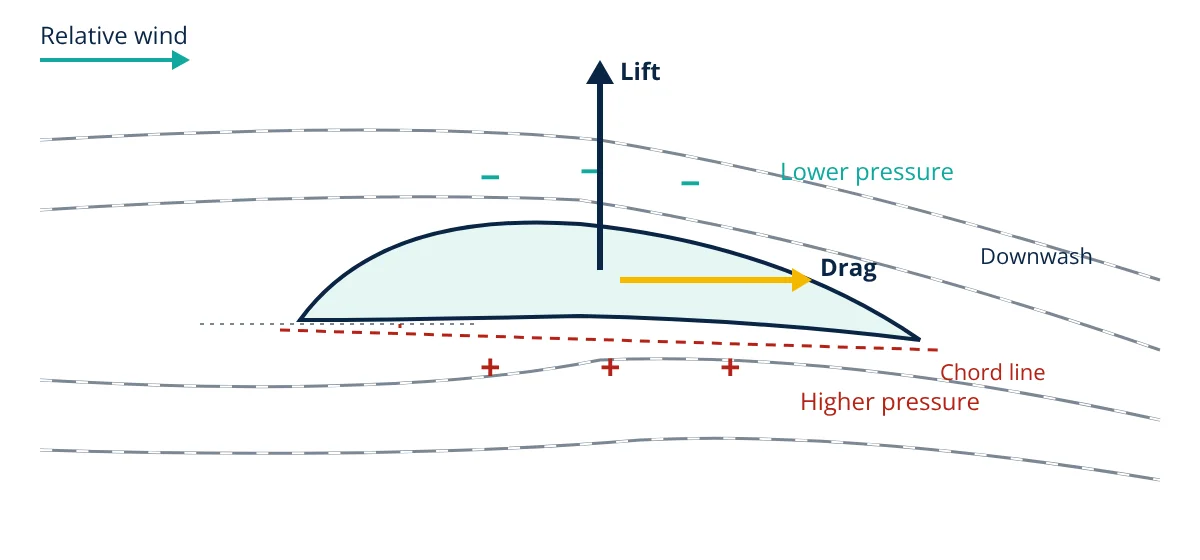
How wings generate lift: the airfoil shape and angle of attack of a wing turn the oncoming air downward, creating lower pressure above the wing and higher pressure below. That pressure difference acting over the wing area is lift, L = ½ρv²SC_L. Lift rises with angle of attack until the wing reaches its critical angle and stalls.
Every aircraft, from a glider to an airliner, and every helicopter rotor, wind turbine blade and racing car wing, relies on the same principle. Understanding lift helps explain takeoff speeds, stalls, high lift devices and why aircraft fly differently at high altitude.
The airfoil
A wing’s cross-section is an airfoil. Key terms:
- Leading edge and trailing edge.
- Chord line: straight line from leading to trailing edge; chord is its length.
- Camber: curvature of the mean line between upper and lower surfaces. Cambered airfoils produce lift even at zero angle of attack.
- Thickness: maximum thickness, usually as a percentage of chord.
- Angle of attack (α): angle between the chord line and the oncoming airflow (relative wind).
How wings generate lift: the pressure difference
Air flowing around the wing must follow its shape. Over the curved upper surface, the flow is accelerated and bent; to follow a curved path, there must be lower pressure on the inside of the curve, so pressure above the wing drops below ambient. Below the wing, the flow is slowed and pressure rises slightly. The net result is that the wing deflects a large mass of air downward (downwash). By Newton’s third law, the air exerts an equal and opposite upward force on the wing.
Bernoulli’s principle states that along a streamline, higher speed means lower pressure:
so the faster flow above the wing corresponds to lower pressure, as described in Bernoulli’s equation. Bernoulli and Newton describe the same physics; neither alone tells the whole story without the other.
The lift equation
- ρ air density (1.225 kg/m³ at sea level, standard conditions).
- v true airspeed.
- S wing planform area.
- C_L lift coefficient, which depends on airfoil shape, angle of attack, Reynolds number and Mach number.
The term ½ρv² is the dynamic pressure. Lift grows with the square of speed: doubling speed quadruples lift at the same angle of attack.
Angle of attack and stall
For a typical airfoil, C_L increases roughly linearly with angle of attack, by about 0.1 per degree (2π per radian in thin airfoil theory), until near the critical angle of attack, often about 15 to 18°. Beyond this, the boundary layer separates from the upper surface, lift falls sharply and drag rises: the wing stalls. Maximum lift coefficient C_L,max is typically about 1.2 to 1.6 for a clean wing.
The stall speed in level flight, when lift equals weight W at C_L,max, is:
Stall occurs at the critical angle of attack, not at a fixed speed: in turns or pull-ups, the wing must carry more than the aircraft’s weight, so stall speed rises.
- Given
- A light aircraft has a mass of 1100 kg and wing area 16.2 m². Clean C_L,max = 1.5; with flaps, C_L,max = 2.1. Sea level density 1.225 kg/m³.
- Find
- Stall speed clean and with flaps, and the lift coefficient needed to cruise at 55 m/s.
- Assumptions
- Level flight, lift equals weight, g = 9.81 m/s².
- Solution
- W = 1100 × 9.81 = 10 791 N
Clean: V_s = √(2 × 10 791 ÷ (1.225 × 16.2 × 1.5)) = √(21 582 ÷ 29.77) = √725 = 26.9 m/s (about 52 knots)
Flaps: V_s = √(21 582 ÷ (1.225 × 16.2 × 2.1)) = √(21 582 ÷ 41.67) = √518 = 22.8 m/s (about 44 knots)
Cruise C_L = 2W ÷ (ρ v² S) = 21 582 ÷ (1.225 × 3025 × 16.2) = 21 582 ÷ 60 031 = 0.36 - Answer
- Stall speed about 27 m/s clean and 23 m/s with flaps; cruise at 55 m/s needs only C_L ≈ 0.36, a small angle of attack
- Limitations
- Real stall speeds depend on centre of gravity, power, wing condition and certification test methods.
Key formulas for how wings generate lift
| Quantity | Formula | Symbols and units |
|---|---|---|
| Bernoulli equation (along a streamline) | p + ½ρv² = constant | p static pressure (Pa), ρ (kg/m³), v (m/s) |
| Lift | L = ½ρv²SC_L | S wing area (m²), L in N |
| Dynamic pressure | q = ½ρv² | Pa |
| Lift curve slope (thin airfoil) | dC_L/dα ≈ 2π per radian | About 0.1 per degree |
| Stall speed | V_s = √(2W ÷ (ρSC_L,max)) | W weight (N), V_s in m/s |
| Lift coefficient in level flight | C_L = 2W ÷ (ρv²S) | Dimensionless |
High lift devices
To fly slowly for takeoff and landing, aircraft temporarily increase C_L,max and wing area:
- Trailing edge flaps (plain, split, slotted, Fowler) increase camber and often area.
- Leading edge slats and slots energise the upper surface flow and delay stall to higher angles.
- Vortex generators mix energetic air into the boundary layer.
Airliners can reach C_L,max of around 2.5 to 3 with full high lift systems.
Factors that affect lift
- Altitude: lower air density reduces lift at a given true airspeed, so aircraft need higher true speed and longer runways at high altitude airports and on hot days (high density altitude).
- Wing contamination: ice, frost or dirt disrupt the flow and can dramatically reduce C_L,max; aircraft must be de-iced before takeoff.
- Aspect ratio: long, slender wings produce less induced drag for a given lift, which is why gliders and efficient airliners have high aspect ratio wings.
- Wingtip vortices: high pressure air below the wing curls around the tips to the low pressure top, creating vortices and induced drag. Winglets reduce this effect.
Measuring lift
Engineers measure lift and drag in wind tunnels using force balances and pressure taps on model surfaces, and calculate them with computational fluid dynamics. Flight tests then confirm stall speeds and handling before certification.
Lift in the bigger picture
Lift is one of the four forces of flight, balanced against weight, thrust and drag. The same physics explains propeller and rotor thrust in quadcopters, turbine and compressor blades in jet engines, and the blades of wind turbines. Understanding how wings generate lift is the starting point for aerodynamics and aircraft design.
How wings generate lift interview and viva questions
- How does a wing generate lift? It turns the oncoming airflow downward, creating lower pressure above and higher pressure below; the pressure difference over the wing area is lift.
- Do Bernoulli and Newton give different explanations of lift? No. They describe the same flow: the pressure difference (Bernoulli) and the downward momentum given to the air (Newton) are consistent views.
- What is angle of attack? The angle between the chord line and the relative wind; lift coefficient rises with it until the critical angle.
- What happens at the stall? Beyond the critical angle of attack, often about 15 to 18°, the flow separates from the upper surface, lift falls sharply and drag rises.
- Why do flaps reduce stall speed? They raise the maximum lift coefficient, and stall speed is inversely proportional to the square root of C_L,max.
Frequently asked questions
Is the equal transit time explanation of lift correct?
No. The popular claim that air over the top must meet air under the bottom at the trailing edge at the same time is false; in reality air over the top arrives earlier. Lift is explained correctly by the pressure difference that results from the wing turning the airflow downward, consistent with both Newton's laws and Bernoulli's principle.
Why can aircraft fly upside down?
Lift depends mainly on angle of attack, not only on wing camber. An aerobatic aircraft flying inverted holds its nose up relative to the flight path so the wing meets the air at a positive angle of attack and still pushes air downward relative to the aircraft. Symmetric airfoils are common on aerobatic aircraft for this reason.
What happens when a wing stalls?
Beyond the critical angle of attack, typically around 15 to 18 degrees for many airfoils, the airflow can no longer follow the curved upper surface and separates. Lift drops sharply and drag rises. A stall is recovered by reducing the angle of attack, regardless of airspeed or attitude.
References
- J. D. Anderson Jr., Fundamentals of Aerodynamics, 6th ed., McGraw-Hill
- J. D. Anderson Jr., Introduction to Flight, 9th ed., McGraw-Hill
- I. H. Abbott and A. E. von Doenhoff, Theory of Wing Sections, Dover
- FAA, Pilot's Handbook of Aeronautical Knowledge, FAA-H-8083-25C, Chapter 5 Aerodynamics of Flight
- NASA Glenn Research Center, Beginner's Guide to Aeronautics: Lift
Get one engineering email a week
New articles, worked examples and study notes every week. Free, no spam, unsubscribe any time.