Four Forces of Flight and Aircraft Axes
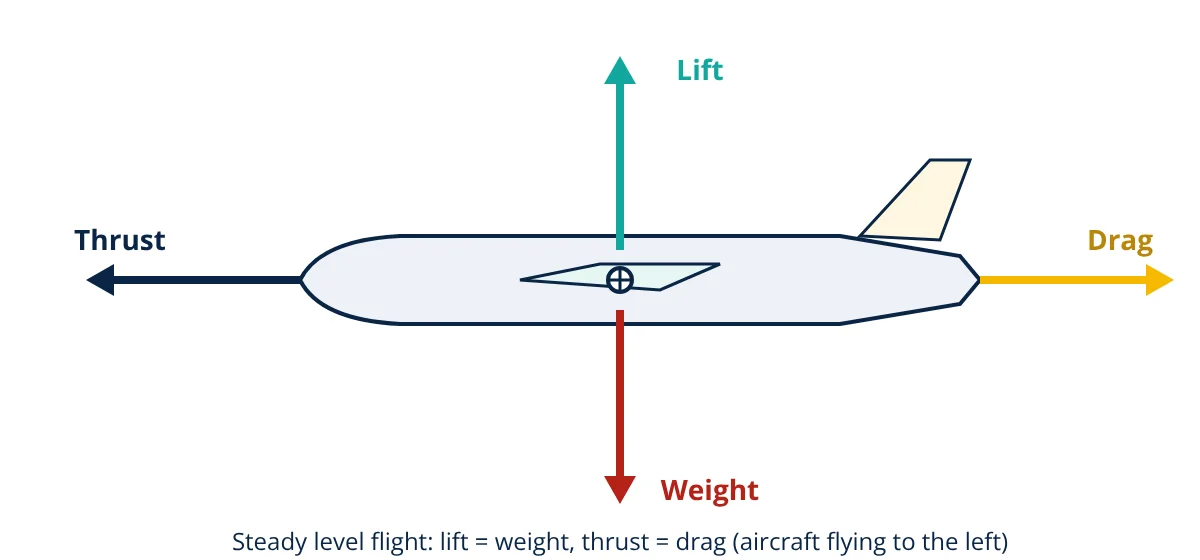
The four forces of flight are lift, which acts perpendicular to the flight path, weight, acting down through the centre of gravity, thrust along the flight path and drag opposing motion. In steady level flight, lift equals weight and thrust equals drag. An aircraft rolls, pitches and yaws about three axes using ailerons, elevator and rudder.
Understanding the four forces and three axes is the foundation of flight mechanics, aircraft performance and pilot training. Every manoeuvre, from takeoff to landing, is a matter of changing the balance between these forces and rotating the aircraft about its axes.
The four forces of flight
Lift
Produced mainly by the wings as they turn the airflow downward, as explained in how wings generate lift. Lift acts perpendicular to the relative wind, through the centre of pressure:
Weight
The force of gravity on the aircraft’s mass, W = mg, acting vertically downward through the centre of gravity (CG). Weight decreases during flight as fuel burns. CG position must stay within limits for stability and control.
Thrust
The forward force from engines or propellers, produced by accelerating air or exhaust gas rearward. Engine types are compared in turbojet vs turbofan vs turboprop.
Drag
The aerodynamic force opposing motion through the air:
- Parasite drag (C_D0 term): skin friction, form drag and interference drag; grows with speed squared.
- Induced drag (second term): caused by producing lift and wingtip vortices; falls as speed rises because less C_L is needed. AR is wing aspect ratio and e the span efficiency factor.
The speed for minimum total drag is where parasite and induced drag are equal; it gives the best lift to drag ratio (L/D) and the best glide range.
Forces in different flight conditions
- Steady level flight: L = W, T = D.
- Steady climb at angle γ: a component of weight acts backward along the flight path, so thrust must exceed drag: T = D + W sin γ, and L = W cos γ.
- Gliding descent: no thrust; a component of weight provides the forward force. The glide angle satisfies tan γ = D/L, so a glider with L/D = 40 travels 40 km for every 1 km of height lost.
- Level turn with bank angle φ: lift is tilted; its vertical component balances weight and its horizontal component provides centripetal force. Lift must increase: load factor n = L/W = 1/cos φ.
- Given
- An aircraft of mass 5000 kg cruises level with lift to drag ratio 12. It then performs a level turn at 60° bank.
- Find
- Lift, drag and thrust required in level cruise, and the lift and load factor in the turn.
- Assumptions
- g = 9.81 m/s²; L/D unchanged for the cruise calculation.
- Solution
- W = 5000 × 9.81 = 49 050 N
Cruise: L = W = 49 050 N; D = L ÷ 12 = 4088 N; thrust T = D = 4088 N
Turn: n = 1 ÷ cos 60° = 2.0; L = 2.0 × 49 050 = 98 100 N - Answer
- In cruise, lift is about 49 kN and thrust equals drag at about 4.1 kN; in a 60° banked level turn, lift doubles to about 98 kN (load factor 2), and drag and stall speed both increase
- Limitations
- Induced drag rises sharply in the turn, so more thrust is needed; stall speed rises by √n ≈ 1.41.
Key formulas for the forces of flight
| Quantity | Formula | Symbols and units |
|---|---|---|
| Lift | L = ½ρv²SC_L | ρ (kg/m³), v (m/s), S wing area (m²), L in N |
| Weight | W = mg | m mass (kg), g = 9.81 m/s² |
| Drag | D = ½ρv²SC_D, with C_D = C_D0 + C_L² ÷ (πe AR) | e span efficiency, AR aspect ratio |
| Steady climb | T = D + W sin γ, L = W cos γ | γ = climb angle |
| Glide angle | tan γ = D ÷ L | Best glide at maximum L/D |
| Level turn load factor | n = L ÷ W = 1 ÷ cos φ | φ = bank angle; stall speed rises by √n |
The three aircraft axes
All three axes pass through the centre of gravity and are perpendicular to each other.
| Axis | Runs | Motion | Primary control | Stability provided by |
|---|---|---|---|---|
| Longitudinal | Nose to tail | Roll | Ailerons (and spoilers) | Dihedral, wing sweep |
| Lateral | Wingtip to wingtip | Pitch | Elevator or stabilator | Horizontal stabiliser, CG ahead of neutral point |
| Vertical (normal) | Top to bottom | Yaw | Rudder | Vertical stabiliser (fin) |
- Ailerons move in opposite directions: one up, one down, changing lift on each wing to roll the aircraft. Adverse yaw from the down-going aileron’s extra drag is corrected with rudder.
- Elevator changes the tail’s lift, pitching the nose up or down and changing the wing’s angle of attack.
- Rudder swings the tail left or right to yaw, used for coordinated turns and crosswind landings.
- Trim tabs relieve control forces for steady flight.
Fly by wire aircraft use computers between the pilot’s controls and the surfaces, applying control laws and protections; avionics are covered in aircraft avionics systems overview.
Takeoff and landing
During the takeoff roll, thrust exceeds drag and rolling friction, so the aircraft accelerates. At rotation speed, the pilot raises the nose with the elevator, increasing angle of attack until lift exceeds weight and the aircraft lifts off. On approach, the pilot reduces thrust and uses flaps to increase lift and drag, allowing a slower, steeper descent. In the flare just before touchdown, the nose is raised to reduce the descent rate. Both phases are where the balance of the four forces changes fastest and where most training focuses.
Stability
An aircraft is statically stable if it tends to return to its original attitude after a disturbance. Longitudinal stability requires the CG to be ahead of the neutral point; a horizontal tail provides the restoring moment. Directional stability comes from the fin, like the feathers on an arrow. Lateral stability comes from dihedral and sweep. Designers balance stability against manoeuvrability.
Centre of gravity and balance
Pilots calculate weight and balance before every flight to keep the centre of gravity within approved limits. A CG too far forward makes the aircraft heavy in pitch and raises stall speed; too far aft reduces stability and can make recovery from a stall difficult or impossible.
The four forces of flight in other vehicles
The same forces act on helicopters, where the rotor provides both lift and thrust by tilting, and on multirotor drones, described in how a quadcopter flies. Even cars and sails can be understood with lift and drag. The structure that carries these forces is described in aircraft structural components.
Forces of flight interview and viva questions
- What are the four forces of flight? Lift, weight, thrust and drag; in steady level flight lift equals weight and thrust equals drag.
- Why must lift increase in a level turn? The lift vector is tilted, so only its vertical component balances weight; lift must rise to W ÷ cos φ, which is a load factor of 2 at 60° bank.
- Which control surface controls each axis? Ailerons control roll about the longitudinal axis, the elevator controls pitch about the lateral axis and the rudder controls yaw about the vertical axis.
- What is adverse yaw? The extra drag of the down going aileron yaws the nose away from the turn, so it is corrected with rudder.
- Why must the centre of gravity stay within limits? A CG too far forward makes the aircraft heavy in pitch and raises stall speed; too far aft reduces stability and can make stall recovery difficult.
Frequently asked questions
In steady level flight, is lift greater than weight?
No. In steady, unaccelerated level flight, lift equals weight and thrust equals drag. Lift greater than weight would cause the aircraft to accelerate upward. Extra lift is needed only to change the flight path, for example to start a climb or to turn.
What are the two types of drag?
Parasite drag comes from the aircraft moving through air: skin friction, form (pressure) drag and interference drag; it increases with the square of speed. Induced drag is a by-product of producing lift, linked to wingtip vortices; it is highest at low speed and high angle of attack. Total drag is lowest at the speed where the two are equal.
Which control surface controls which axis?
Ailerons control roll about the longitudinal axis, the elevator (or stabilator) controls pitch about the lateral axis, and the rudder controls yaw about the vertical axis. All three axes pass through the aircraft's centre of gravity.
References
- J. D. Anderson Jr., Introduction to Flight, 9th ed., McGraw-Hill
- FAA, Pilot's Handbook of Aeronautical Knowledge, FAA-H-8083-25C, Chapters 5 and 6
- B. W. McCormick, Aerodynamics, Aeronautics, and Flight Mechanics, 2nd ed., Wiley
- NASA Glenn Research Center, Beginner's Guide to Aeronautics: Four Forces on an Airplane
Get one engineering email a week
New articles, worked examples and study notes every week. Free, no spam, unsubscribe any time.