Aircraft Avionics Systems Overview
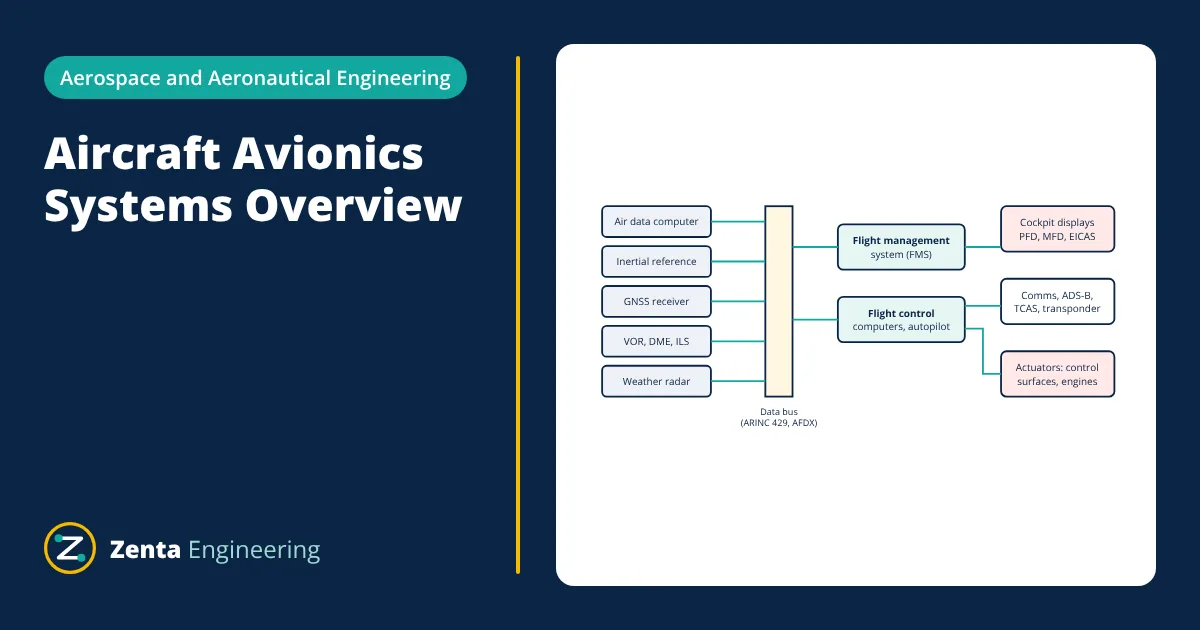
Avionics systems are the electronic systems of an aircraft: flight displays, communication radios, navigation (inertial, GNSS, radio aids and the flight management system), surveillance (transponder, ADS-B, TCAS and weather radar) and flight control and automation. They are linked by data buses such as ARINC 429 and AFDX and certified to standards such as DO-178C.
Avionics have transformed flying. Where early pilots navigated by compass, map and landmarks, modern aircraft can fly precise satellite based approaches in poor weather, avoid collisions automatically, and land themselves. Avionics can account for a large share of an aircraft’s value and are essential for safety, efficiency and airspace capacity.
Flight instruments and displays
The basic flight instruments show attitude, airspeed, altitude, heading, vertical speed and turn coordination. In a glass cockpit:
- Primary flight display (PFD): attitude, speed and altitude tapes, flight director, flight mode annunciations.
- Navigation or multifunction display (ND or MFD): moving map, route, weather radar, terrain and traffic.
- Engine indicating and crew alerting system (EICAS or ECAM): engine parameters, system synoptics, warnings and checklists.
- Head up displays (HUD) project key information onto a transparent screen in the pilot’s view.
Data comes from the air data computer, which uses pitot and static pressure probes and temperature sensors to compute airspeed, altitude and Mach number, and from attitude and heading reference or inertial systems. Pitot and static measurements apply the same principles as differential pressure flow measurement in industry.
Communication
- VHF radio (118 to 137 MHz) for voice with air traffic control over line of sight.
- HF radio for long range oceanic communication.
- SATCOM for voice and data anywhere via satellites, discussed in GEO vs MEO vs LEO satellites.
- Data link (ACARS, CPDLC) for text messages, clearances and operational data.
- Cockpit voice and flight data recorders capture audio and parameters for investigation.
Navigation
- Inertial reference system (IRS): ring laser or fibre optic gyros and accelerometers compute position, velocity and attitude without external signals.
- GNSS: GPS and other constellations provide accurate position worldwide, augmented by SBAS for approaches.
- Radio navigation: VOR (bearing), DME (distance), NDB and ILS (instrument landing system) giving lateral and vertical guidance to the runway.
- Flight management system (FMS): combines sensors, stores routes and performance data, computes the optimal flight path and guides the autopilot. It enables performance based navigation (PBN) procedures.
Electrical power for avionics
Avionics depend on clean, reliable power. Airliners generate 115 V AC at 400 Hz from engine driven generators, and convert it to 28 V DC through transformer rectifier units for many avionics loads. Batteries, a ram air turbine and an auxiliary power unit provide backup. Essential and emergency buses keep the most critical instruments, radios and flight controls powered after major failures, so the crew can always fly and navigate.
Surveillance and collision avoidance
- Transponder (Mode S) replies to secondary radar with identity and altitude.
- ADS-B broadcasts GNSS position and velocity, used by controllers and other aircraft.
- TCAS (traffic collision avoidance system) interrogates nearby transponders and issues resolution advisories such as “climb” or “descend”.
- Weather radar detects precipitation and turbulence.
- TAWS / EGPWS warns of terrain conflicts using a terrain database and position.
Flight controls and automation
- Autopilot holds attitude, heading, altitude, speed or follows FMS lateral and vertical guidance; autothrottle manages thrust.
- Autoland flies ILS approaches to touchdown in very low visibility.
- Fly by wire: pilot inputs go to flight control computers, which command actuators through control laws that provide stability, envelope protection and load alleviation. Systems use multiple redundant computers, often with dissimilar hardware and software.
The flight controls move the surfaces described in four forces of flight and aircraft axes.
Data buses and architecture
- ARINC 429: a one way, point to point serial bus at 12.5 or 100 kbit/s, widely used in older and current aircraft.
- MIL-STD-1553: a command response bus used in military aircraft.
- ARINC 664 Part 7 (AFDX): deterministic, redundant switched Ethernet used on modern airliners.
- Integrated modular avionics (IMA): many functions share common computing modules with partitioning, reducing weight and wiring.
These networks follow the layered principles in OSI vs TCP/IP model, with extra determinism and redundancy.
Reliability and certification
Avionics functions are classified by the severity of their failure effects. Catastrophic failure conditions must be extremely improbable, often quantified as less than 10⁻⁹ per flight hour. For independent redundant channels, the probability that all fail during a flight is approximately the product of their individual probabilities:
- Given
- An attitude source has a failure rate of 1 × 10⁻⁴ per flight hour. A flight lasts 5 hours. The aircraft carries three independent attitude sources.
- Find
- The probability that one source fails during a flight, and that all three fail in the same flight.
- Assumptions
- Independent failures with constant rates; no common cause; small probability approximation P ≈ λt.
- Solution
- One source: P = 1 × 10⁻⁴ × 5 = 5 × 10⁻⁴
All three: P = (5 × 10⁻⁴)³ = 1.25 × 10⁻¹⁰ per flight, or about 2.5 × 10⁻¹¹ per flight hour - Answer
- A single source fails in about 1 in 2000 flights, but loss of all three is about 1.25 × 10⁻¹⁰ per flight, meeting the extremely improbable target
- Limitations
- Common cause failures such as shared power, software errors or icing of all probes can dominate; design must ensure real independence, and failure rate data must be realistic.
Reliability figures such as MTBF and availability feed these safety assessments.
Software is developed to DO-178C and hardware to DO-254, with assurance levels A (most critical) to E, and environmental qualification follows DO-160 for temperature, vibration, electromagnetic compatibility and lightning.
Key formulas for avionics systems
| Quantity | Formula | Symbols and units |
|---|---|---|
| Failure probability of one unit in a flight | P ≈ λt | λ = failure rate per flight hour, t = flight time (h); valid for small λt |
| Loss of all independent redundant channels | P_system ≈ P₁ × P₂ × … × P_n | Product of channel probabilities, assumes no common cause |
| Average probability per flight hour | P_per hour = P_flight ÷ t | t = flight time (h) |
| Catastrophic failure condition target | P less than about 10⁻⁹ per flight hour | Extremely improbable |
The future of avionics systems
Trends include more integrated and software defined avionics, synthetic and enhanced vision, satellite based air traffic management, increased automation including single pilot and autonomous operations research, cybersecurity for connected aircraft, and lighter, lower power electronics for electric aircraft and drones such as those described in how a quadcopter flies.
Avionics systems interview and viva questions
- What does a flight management system do? It combines navigation sensor data, stores routes and performance data, computes the flight path and guides the autopilot.
- What is the difference between ARINC 429 and AFDX? ARINC 429 is a one way, point to point serial bus at 12.5 or 100 kbit/s; AFDX (ARINC 664 Part 7) is a deterministic, redundant switched Ethernet network.
- How does TCAS help avoid collisions? It interrogates nearby transponders and issues resolution advisories such as climb or descend when a conflict is predicted.
- Why are avionics channels made redundant? With independent channels, the probability that all fail in one flight is roughly the product of their individual probabilities, which can meet the extremely improbable target.
- Which standards cover avionics software and hardware? DO-178C for software and DO-254 for airborne electronic hardware, with environmental qualification to DO-160.
Frequently asked questions
What does avionics mean?
Avionics is short for aviation electronics: the electronic systems used on aircraft, satellites and spacecraft. On aircraft it includes displays, communication radios, navigation, surveillance, flight control computers, autopilot, engine monitoring and the data networks that connect them.
What is a glass cockpit?
A glass cockpit replaces individual mechanical gauges with electronic displays. A primary flight display shows attitude, airspeed, altitude, heading and vertical speed in one screen, and a multifunction display shows navigation maps, weather, terrain, traffic and system pages. Glass cockpits reduce workload and improve situational awareness.
Why are avionics systems redundant?
Loss of critical functions such as attitude information, flight controls or navigation could be catastrophic. Certification rules require that catastrophic failure conditions be extremely improbable, typically less than 1 in 10⁹ per flight hour, which is achieved with redundant, independent and dissimilar systems, careful design assurance and monitoring.
References
- R. P. G. Collinson, Introduction to Avionics Systems, 3rd ed., Springer
- C. R. Spitzer (ed.), Digital Avionics Handbook, 3rd ed., CRC Press
- RTCA DO-178C, Software Considerations in Airborne Systems and Equipment Certification
- RTCA DO-254, Design Assurance Guidance for Airborne Electronic Hardware
- ARINC 429 and ARINC 664 Part 7 (AFDX) specifications, Aeronautical Radio Inc.
Get one engineering email a week
New articles, worked examples and study notes every week. Free, no spam, unsubscribe any time.