Rocket Propulsion Basics and Thrust Equation
Rocket propulsion is the production of thrust by expelling mass carried on the vehicle at high speed, usually hot gas from burning fuel and oxidizer. By Newton’s third law the rearward momentum of the exhaust pushes the rocket forward. Thrust equals mass flow times exhaust velocity plus a pressure term at the nozzle exit.
Rocket propulsion is the only practical way to fly in space, because a rocket carries everything it needs, both fuel and oxidizer, and needs no outside air. The same physics drives launch vehicles, missiles, satellite thrusters and model rockets. This article explains the principle, the thrust equation, specific impulse, the rocket equation and the main engine types, with a worked example.
The principle of rocket propulsion
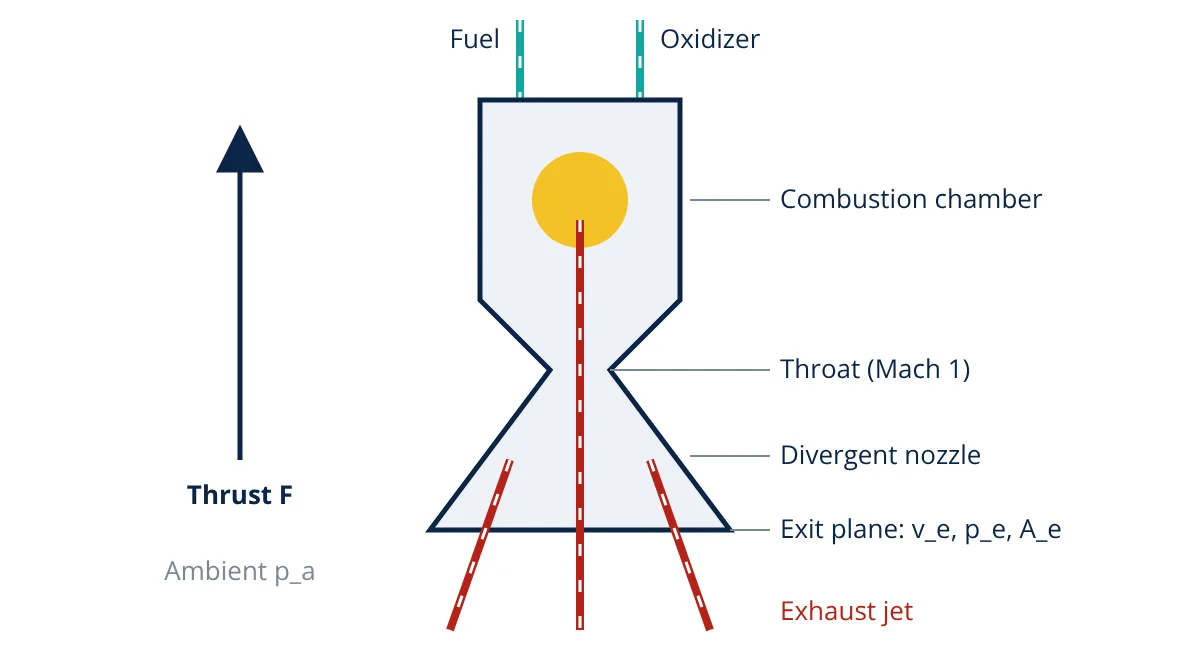
A rocket is a momentum machine. Inside the combustion chamber, propellants react and release chemical energy as hot, high pressure gas. The gas expands through a convergent divergent nozzle (also called a de Laval nozzle), which converts thermal energy into directed kinetic energy. The gas leaves at high velocity, and the rate of change of its momentum is the thrust on the vehicle.
Two ideas from basic mechanics are enough to understand it:
- Newton’s second law: force equals the rate of change of momentum. Pushing a mass flow ṁ out at velocity v_e needs a force ṁ v_e on the gas.
- Newton’s third law: the gas pushes back on the engine with an equal and opposite force. That reaction is thrust.
Because the rocket carries its own oxidizer, it does not need atmospheric air, unlike the air breathing engines compared in turbojet vs turbofan vs turboprop. This is why rockets work in a vacuum.
How the nozzle accelerates the gas
The chamber gas is hot (often around 3000 K or more in chemical engines) and at high pressure, but moving slowly. In the convergent section the flow speeds up as the area falls. At the narrowest point, the throat, the flow reaches the local speed of sound (Mach 1). Beyond the throat, supersonic gas behaves the opposite way to subsonic gas: it keeps accelerating as the area increases. The divergent section therefore expands the gas further, lowering its pressure and temperature and raising its velocity. These area and velocity relations come from compressible flow theory, an extension of the energy ideas in the Bernoulli equation and the laws of thermodynamics.
The ratio of exit area to throat area is the expansion ratio. A larger ratio expands the gas to a lower exit pressure p_e. The nozzle is ideally expanded when p_e equals the ambient pressure p_a. Sea level engines use smaller expansion ratios, while upper stage engines use very large bells because the outside pressure is near zero.
The rocket propulsion thrust equation
The general thrust equation from Sutton and Biblarz and the NASA Glenn guide is:
- ṁ v_e is the momentum thrust, from the mass flow rate and exit velocity.
- (p_e − p_a) A_e is the pressure thrust, from the difference between exit pressure and ambient pressure acting on the exit area.
If the nozzle is over expanded (p_e below p_a, common at sea level for engines optimised for altitude), the pressure term is negative and reduces thrust. In a vacuum, p_a is zero and the pressure term adds to thrust, which is why vacuum thrust is higher than sea level thrust for the same engine.
It is convenient to combine both terms into one effective exhaust velocity c:
Specific impulse
Specific impulse I_sp measures how efficiently an engine uses propellant. It is the thrust per unit weight flow rate of propellant, expressed in seconds:
where g₀ = 9.80665 m/s² is standard gravity. A higher I_sp means more impulse from each kilogram of propellant. As rough guides from Sutton and Biblarz, solid motors are typically in the range of about 250 to 300 s, liquid oxygen with kerosene is around 300 to 350 s, and liquid oxygen with liquid hydrogen reaches about 450 s in vacuum. NASA lists the RS-25 hydrogen engine at about 452 s in vacuum. Electric thrusters reach thousands of seconds but produce very small thrust.
The rocket equation
The Tsiolkovsky rocket equation links the velocity change Δv of a vehicle to its exhaust velocity and mass ratio, ignoring gravity and drag:
where m₀ is initial mass (with propellant) and m_f is final mass (after burn). Two lessons follow:
- Δv grows only with the logarithm of the mass ratio, so each extra unit of velocity costs a growing amount of propellant.
- Doubling c doubles Δv for the same mass ratio, which is why high I_sp propellants matter so much for upper stages.
This is also the reason for staging: dropping empty tanks and engines improves the mass ratio of the stages that follow. Real launches also lose velocity to gravity and to aerodynamic drag.
- Given
- A liquid rocket engine at sea level with propellant mass flow ṁ = 250 kg/s, exit velocity v_e = 2900 m/s, exit pressure p_e = 70 kPa, ambient pressure p_a = 101.325 kPa and exit area A_e = 1.2 m². The vehicle has initial mass 150000 kg, of which 100000 kg is propellant.
- Find
- Thrust, specific impulse, burn time and ideal Δv.
- Assumptions
- Steady flow, constant ṁ and sea level conditions throughout the burn; gravity and drag losses ignored in Δv.
- Solution
- Momentum thrust = 250 × 2900 = 725000 N
Pressure thrust = (70000 − 101325) × 1.2 = −37590 N
F = 725000 − 37590 = 687410 N
I_sp = 687410 ÷ (250 × 9.80665) = 280.4 s
Burn time = 100000 ÷ 250 = 400 s
c = 687410 ÷ 250 = 2749.6 m/s
m_f = 150000 − 100000 = 50000 kg
Δv = 2749.6 × ln(150000 ÷ 50000) = 2749.6 × 1.0986 = 3020.8 m/s - Answer
- F ≈ 687 kN, I_sp ≈ 280 s, burn time 400 s, ideal Δv ≈ 3.02 km/s
- Limitations
- In a real ascent p_a falls with altitude, so thrust and I_sp rise during the burn. Gravity and drag losses reduce the actual velocity gain well below the ideal value.
Key formulas for rocket propulsion
| Quantity | Formula | Symbols and units |
|---|---|---|
| Thrust | F = ṁ v_e + (p_e − p_a) A_e | F in N, ṁ in kg/s, v_e in m/s, p in Pa, A_e in m² |
| Effective exhaust velocity | c = F ÷ ṁ | c in m/s |
| Specific impulse | I_sp = F ÷ (ṁ g₀) = c ÷ g₀ | I_sp in s, g₀ = 9.80665 m/s² |
| Rocket equation | Δv = c ln(m₀ ÷ m_f) | m₀ initial mass, m_f final mass, both in kg |
| Burn time (constant flow) | t_b = m_p ÷ ṁ | m_p propellant mass in kg, t_b in s |
Types of rocket engines
- Solid rocket motors: fuel and oxidizer are premixed in a solid grain cast inside the case. They are simple, storable and give high thrust, but once lit they are hard to throttle or stop. Used for boosters and missiles.
- Liquid bipropellant engines: fuel and oxidizer are stored in separate tanks and fed to the chamber by pressurised tanks or turbopumps. They can be throttled, shut down and often restarted, and give higher I_sp. Examples include kerosene with liquid oxygen and liquid hydrogen with liquid oxygen.
- Monopropellant thrusters: a single propellant such as hydrazine decomposes over a catalyst. They are simple and used for small attitude control thrusters on spacecraft, part of the propulsion subsystem described in satellite subsystems.
- Hybrid rockets: a solid fuel grain with a liquid or gaseous oxidizer. They can be throttled and are safer to handle than solids, but have lower performance than liquid engines.
- Electric propulsion: ion and Hall effect thrusters accelerate charged propellant with electric fields. Very high I_sp, very low thrust, suited to long orbit raising and deep space missions.
Cooling and materials
Chamber gas is hotter than most metals can survive, so engines are cooled. Regenerative cooling passes fuel through channels in the chamber and nozzle walls before injection, which also preheats the propellant. Other methods include film cooling, ablative liners that char away in a controlled manner, and radiation cooled nozzle extensions made from high temperature alloys or composites. High strength, heat resistant materials are discussed in aircraft materials.
Rocket propulsion interview and viva questions
- Why does a rocket work in a vacuum? It carries its own oxidizer and produces thrust by pushing on its own exhaust, so it needs no surrounding air. Thrust is slightly higher in a vacuum because ambient pressure is zero.
- What are the two terms in the rocket thrust equation? Momentum thrust ṁ v_e from the exhaust mass flow, and pressure thrust (p_e − p_a) A_e from the pressure difference at the nozzle exit.
- Why is the nozzle convergent divergent? Subsonic gas accelerates in a converging passage and reaches Mach 1 at the throat; supersonic gas then accelerates further in a diverging passage.
- What does specific impulse tell you? It is thrust per unit weight flow of propellant, in seconds, and measures propellant efficiency. Higher I_sp gives more Δv from the same propellant mass.
- Why are launch vehicles staged? The rocket equation depends on the mass ratio, so discarding empty tanks and engines improves the mass ratio of the later stages and increases total Δv.
Frequently asked questions
How does a rocket produce thrust in a vacuum with nothing to push against?
A rocket does not push against the surrounding air. It pushes on its own exhaust. The engine accelerates propellant mass rearward, and by Newton's third law the exhaust pushes the rocket forward. In fact thrust is slightly higher in a vacuum, because there is no ambient pressure acting against the nozzle exit area.
What is the difference between thrust and specific impulse?
Thrust is the force the engine produces, measured in newtons. Specific impulse is thrust divided by the weight flow rate of propellant, measured in seconds. Thrust tells you how hard the engine pushes, while specific impulse tells you how efficiently it uses propellant. A high thrust engine can have a low specific impulse, and the reverse.
Why do rockets use multiple stages?
The rocket equation shows that velocity change depends on the logarithm of the mass ratio. Carrying empty tanks and engines to orbit wastes propellant. Staging drops this dead mass once its propellant is used, so each later stage starts with a better mass ratio and the vehicle reaches a higher final velocity than a single stage could.
References
- G. P. Sutton and O. Biblarz, Rocket Propulsion Elements, 9th ed., Wiley, 2017
- NASA Glenn Research Center, Beginner's Guide to Rockets: Rocket Thrust Equation and Specific Impulse
- J. D. Mattingly, Elements of Propulsion: Gas Turbines and Rockets, 2nd ed., AIAA, 2006
- R. D. Zucker and O. Biblarz, Fundamentals of Gas Dynamics, 3rd ed., Wiley, 2019
- NASA, Space Launch System RS-25 Core Stage Engine fact sheet, Marshall Space Flight Center
Get one engineering email a week
New articles, worked examples and study notes every week. Free, no spam, unsubscribe any time.