Fire Classes and Suitable Extinguishing Agents
Fire classes group fires by the type of fuel so the right extinguishing agent can be chosen. Under the European system (EN 2): Class A ordinary combustible solids (wood, paper, textiles); Class B flammable liquids (petrol, oils, solvents); Class C flammable gases; Class D combustible metals (magnesium, sodium, lithium); and Class F cooking oils and fats. Electrical fires involving live equipment are treated separately. The US (NFPA 10) uses Class C for electrical and Class K for cooking oils. Main agents are water, foam, dry powder, CO₂, wet chemical, clean agents and special Class D powders.
Using the wrong extinguisher can make a fire worse: water on burning oil or live electrical equipment can be deadly. Knowing fire classes is therefore basic safety knowledge for everyone, and essential for engineers designing fire protection for buildings, plants and vehicles.
The fire triangle and tetrahedron
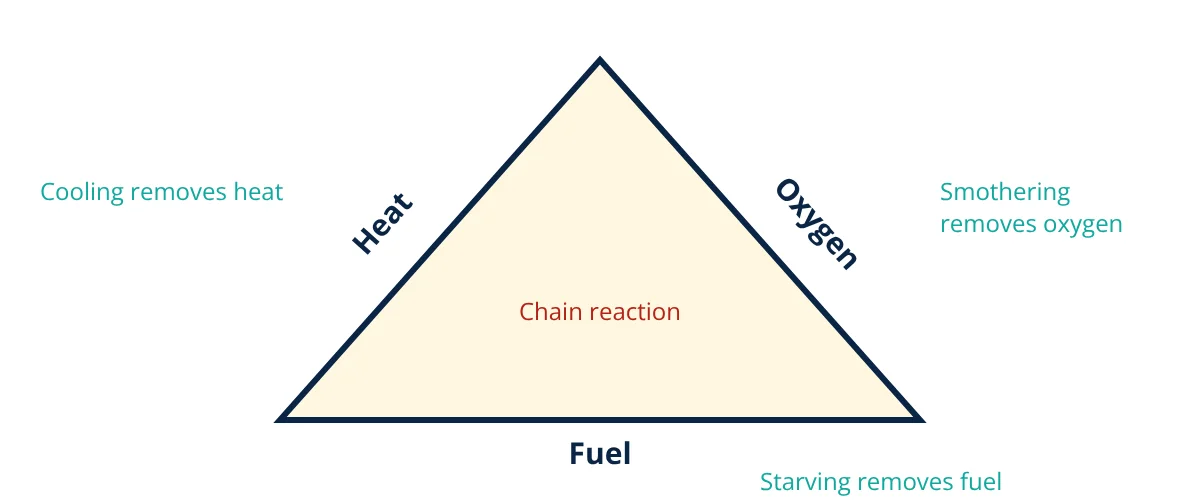
A fire needs three things: fuel, heat and oxygen. A fourth element, the chemical chain reaction, sustains flaming combustion, giving the fire tetrahedron. Extinguishing agents work by removing one or more elements:
- Cooling removes heat (water, wet chemical).
- Smothering separates fuel from oxygen (foam, CO₂, fire blankets).
- Starving removes fuel (shutting off a gas valve).
- Chemical inhibition breaks the chain reaction (dry powder, clean agents).
The fire classes in detail
Class A: ordinary combustible solids
Wood, paper, cardboard, textiles, many plastics and rubber. These materials burn with glowing embers deep in the fuel. Water is the best agent, cooling the fuel and penetrating it; foam and ABC dry powder also work. Water mist and sprinklers are common fixed systems.
Class B: flammable liquids
Petrol, diesel, solvents, paints, alcohols, lubricating oils. Burning occurs at the liquid surface. Use foam (AFFF or fluorine free foams, with alcohol resistant types for polar solvents), dry powder or CO₂. Never use a water jet, which spreads the burning liquid.
Class C: flammable gases (EU)
LPG, natural gas, hydrogen, acetylene. The first and most important action is to isolate the gas supply. Extinguishing a gas flame without stopping the flow can allow an explosive cloud to build up and re-ignite. Dry powder can knock down the flame if needed for escape; water spray cools nearby equipment.
Class D: combustible metals
Magnesium, aluminium powder, titanium, sodium, potassium, lithium. These burn at very high temperatures and react violently with water, and sometimes with CO₂. Use special Class D dry powders (such as sodium chloride or graphite based) or dry sand, applied gently to smother the fire.
Class F (EU) / Class K (US): cooking oils and fats
Deep fat fryers in commercial kitchens reach temperatures where oils auto-ignite. Wet chemical extinguishers spray a potassium salt solution that reacts with the hot fat (saponification), forming a soapy crust that seals the surface and cools it. Fire blankets suit small pans.
Electrical fires
Fires involving energised equipment. De-energise the supply first if safe to do so. Use CO₂ or clean agents, which are non-conductive and leave no residue, or dry powder. Water and foam should not be used on live equipment unless the extinguisher is tested and rated for electrical use at the relevant voltage. Electrical protection such as circuit breakers and correct earthing reduce the risk of such fires.
Extinguisher types and fire classes
| Extinguisher | Colour band (EN 3 / UK) | A | B | C | D | F/K | Electrical |
|---|---|---|---|---|---|---|---|
| Water | Red | Yes | No | No | No | No | No |
| Foam (AFFF) | Cream | Yes | Yes | No | No | No | Only if tested |
| ABC dry powder | Blue | Yes | Yes | Yes | No | No | Yes |
| CO₂ | Black | No | Yes | No | No | No | Yes |
| Wet chemical | Yellow | Yes (some) | No | No | No | Yes | No |
| Class D powder | Blue | No | No | No | Yes | No | No |
| Clean agent | Varies | Some | Yes | No | No | No | Yes |
In the EU, extinguisher bodies are red with a coloured label or band; colour schemes differ by country.
Fixed suppression systems
Beyond portable extinguishers, buildings and plants use:
- Sprinklers: heat activated heads that discharge water over a fire, the most effective life safety system in buildings.
- Water mist and deluge systems: for turbines, transformers, conveyors and process units.
- Foam systems: for fuel storage tanks, bund areas and aircraft hangars.
- Gaseous systems: CO₂ (unoccupied spaces), inert gases and chemical clean agents for data centres, control rooms and archives.
- Kitchen hood wet chemical systems.
These are usually triggered by fire detectors or by heat sensitive heads.
- Given
- A small engineering workshop has: wooden pallets and cardboard stock, a parts washer using flammable solvent, an electrical distribution board, a magnesium machining cell, and a staff kitchen with a small deep fryer.
- Find
- Suitable portable extinguishers for each hazard.
- Assumptions
- Extinguishers supplement, not replace, alarms and evacuation; staff are trained.
- Solution
- Pallets and cardboard (Class A): water or foam
Solvent parts washer (Class B): foam or CO₂
Distribution board (electrical): CO₂
Magnesium machining (Class D): special Class D powder and dry sand; no water or CO₂
Kitchen fryer (Class F/K): wet chemical and a fire blanket - Answer
- Provide water or foam for general areas, CO₂ near electrical panels, foam or CO₂ near solvents, Class D powder at the magnesium cell and wet chemical in the kitchen, each clearly signed
- Limitations
- Quantities, ratings and positions must follow local regulations and a fire risk assessment.
Using an extinguisher safely
Remember PASS: Pull the pin, Aim at the base of the fire, Squeeze the handle, Sweep side to side. Only tackle small fires, keep an escape route behind you, raise the alarm first, and leave immediately if the fire grows. Inspect extinguishers regularly and service them as required by NFPA 10, BS 5306 or IS 2190.
Fire classes in risk assessment
Identifying fire classes present in each area is part of a fire risk assessment, together with ignition sources, people at risk and existing controls, often ranked with a risk matrix. In process plants, fire scenarios also come out of HAZOP studies, and protection is designed as one of several layers.
Frequently asked questions
Why must water never be used on an oil or cooking fat fire?
Water is denser than oil and sinks, then flashes to steam instantly at the hot surface. The rapid expansion throws burning oil out of the container, creating a fireball and spreading the fire. Burning cooking oil needs a wet chemical extinguisher or fire blanket, and flammable liquids need foam, dry powder or CO₂.
What is the difference between European and US fire classes?
Both use A for ordinary solids, B for flammable liquids and D for metals. Europe (EN 2) uses C for flammable gases and F for cooking oils, and treats electrical fires separately. The USA (NFPA 10) uses C for energised electrical equipment and K for cooking oils, and includes flammable gases in Class B.
Can a CO₂ extinguisher be used on people?
No. CO₂ discharges at very low temperature and can cause cold burns, and in confined spaces it displaces oxygen. To extinguish burning clothing, use the stop, drop and roll method, a fire blanket or water. CO₂ extinguishers should also be used with care in small rooms because of asphyxiation risk.
References
- EN 2:1992+A1:2004, Classification of fires
- NFPA 10, Standard for Portable Fire Extinguishers, 2022 ed.
- EN 3-7, Portable fire extinguishers: Characteristics, performance requirements and test methods
- IS 15683:2018, Portable Fire Extinguisher: Performance and Construction, Specification, BIS
- NFPA, Fire Protection Handbook, 21st ed.
Get one engineering email a week
New articles, worked examples and study notes every week. Free, no spam, unsubscribe any time.