Battery Energy Storage Systems Explained
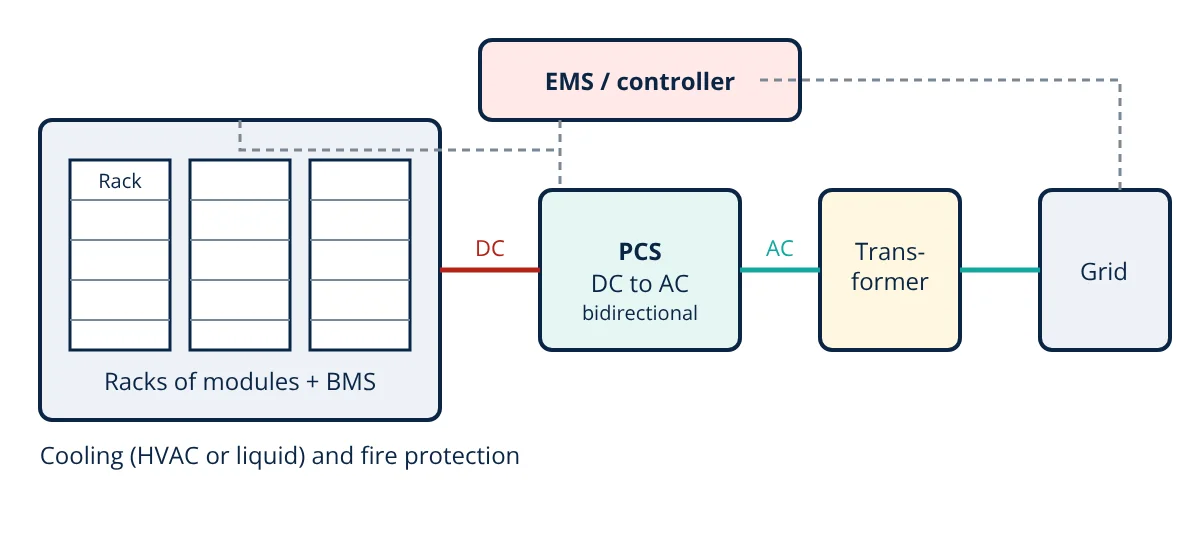
Battery energy storage systems (BESS) store electrical energy in rechargeable batteries and release it when needed. A BESS combines battery cells grouped into modules and racks, a battery management system (BMS) that protects and balances them, a power conversion system (PCS) of bidirectional inverters, an energy management system (EMS) that decides when to charge and discharge, plus cooling, fire protection and transformers. Systems are rated by power (MW) and energy (MWh). Uses include solar shifting, peak shaving, frequency regulation, backup power and microgrids.
Electricity must be generated at the same moment it is used. As solar and wind provide more of our power, storage becomes essential to balance supply and demand. Batteries are now the fastest growing form of grid storage, ranging from a few kWh in homes to several GWh in utility plants.
How a BESS is built
Battery cells, modules and racks
Cells are connected in series and parallel into modules, and modules into racks or strings reaching DC voltages of about 1000 to 1500 V. Large systems are delivered in containers of around 3 to 5 MWh each.
Battery management system (BMS)
The BMS monitors cell voltages, currents and temperatures; estimates state of charge (SoC) and state of health (SoH); balances cells; and opens contactors to protect against overvoltage, undervoltage, overcurrent and overtemperature.
Power conversion system (PCS)
Bidirectional inverters convert DC from the batteries to AC for the grid and AC back to DC for charging. Grid forming inverters can also set voltage and frequency, which is vital for microgrids and weak grids. The power electronics work on the same switching principles as a buck converter and inverter bridges.
Energy management system (EMS)
The EMS is the brain: it receives market prices, forecasts, grid operator signals and site load data and schedules charging and discharging to meet the application’s goals.
Balance of plant
Thermal management (air conditioning or liquid cooling) keeps cells in their ideal range, typically about 15 to 35 °C. Fire detection, gas detection, explosion venting and suppression systems address the risk of thermal runaway. Transformers, switchgear, protection relays and SCADA complete the plant.
Battery chemistries
| Chemistry | Strengths | Limitations | Typical use |
|---|---|---|---|
| Lithium iron phosphate (LFP) | Safe, long life, low cost, no cobalt | Lower energy density | Most grid and home storage |
| Lithium NMC | High energy density | Higher cost, less thermally stable | EVs, some stationary |
| Lead acid | Cheap, recyclable, mature | Short cycle life, heavy | UPS, small off-grid |
| Sodium-ion | Abundant materials, good low temperature | Lower energy density, emerging | Grid storage, budget EVs |
| Flow batteries (vanadium) | Very long cycle life, power and energy scale separately | Lower efficiency, bulky | Long duration storage |
Key ratings
- Power (MW): maximum charge or discharge rate.
- Energy (MWh): storage capacity. Energy divided by power gives duration, typically 1 to 4 hours for lithium systems.
- Round trip efficiency: energy out divided by energy in, about 85 to 90% AC to AC for lithium-ion.
- Depth of discharge (DoD): the share of capacity used; limiting DoD extends life.
- C-rate: current relative to capacity; 0.5C means a full charge or discharge in 2 hours.
- Cycle life and degradation: capacity fades with cycles and calendar time.
The usable energy needed for a given load is:
- Given
- A factory wants to cut its evening peak by supplying 500 kW for 3 hours from a battery charged by its solar system. Usable depth of discharge is 90% and discharge efficiency (battery to AC) is 94%.
- Find
- The nominal battery energy and the minimum power rating.
- Assumptions
- Ignore degradation over life; add margin separately in practice.
- Solution
- Energy delivered = 500 kW × 3 h = 1500 kWh
E_nominal = 1500 ÷ (0.90 × 0.94) = 1500 ÷ 0.846 = 1773 kWh
Power rating = 500 kW at the AC side; C-rate = 500 ÷ 1773 ≈ 0.28C - Answer
- About 1.8 MWh nominal capacity with at least a 500 kW PCS, which is an easy 0.3C duty for LFP cells
- Limitations
- Add 10 to 20% for end of life capacity fade, and check charging energy is available from the solar system each day.
Applications of battery energy storage systems
- Solar and wind shifting: store midday solar for the evening peak; smooth fast variations from solar PV systems and wind turbines.
- Frequency regulation: batteries respond within milliseconds, faster than any power station, to stabilise grid frequency.
- Peak shaving and demand charge reduction for industrial and commercial users.
- Energy arbitrage: charge when prices are low, discharge when high.
- Backup power and resilience: keep critical loads running during outages.
- Transmission and distribution deferral: relieve congested lines instead of upgrading them.
- EV charging support: buffer the grid connection at fast charging sites, as discussed in EV charging levels and connectors.
Battery energy storage systems at home and in industry
Home systems of about 5 to 20 kWh pair with rooftop solar and a hybrid inverter, storing daytime surplus for the evening and providing backup during outages. Commercial and industrial systems of a few hundred kWh to several MWh mainly cut demand charges, support EV charging and improve power quality. Utility systems of tens to thousands of MWh provide grid services and shift renewable energy at scale. The building blocks are the same; the control strategy and revenue model differ.
Degradation and life
Batteries lose capacity through cycling and with time. High temperature, high state of charge held for long periods, deep cycles and high currents all speed up ageing. Operators manage this by keeping cells cool, limiting the usable state of charge window, and planning augmentation, adding new modules after some years to restore the contracted energy capacity. Recycling recovers lithium, nickel, cobalt, copper and aluminium at end of life.
Safety
Lithium-ion cells can enter thermal runaway if damaged, overcharged or overheated: internal reactions release heat and flammable gases, which can spread to neighbouring cells. Safety relies on quality cells, a robust BMS, good thermal design, spacing between units, gas detection, deflagration venting, and fire protection designed to standards such as NFPA 855 and tested under UL 9540A. Emergency response plans and training for local fire services are also part of good practice.
Battery storage turns variable renewable output into dependable power and is now a core building block of modern electricity systems.
Frequently asked questions
What is the difference between MW and MWh in a battery system?
MW is the power rating: how fast the system can charge or discharge. MWh is the energy capacity: how much it can store. A 50 MW / 200 MWh system can deliver 50 MW for about 4 hours. The ratio of energy to power is called the duration.
Why is LFP used for most grid batteries?
Lithium iron phosphate (LFP) cells are cheaper, more thermally stable and longer lived than nickel based lithium-ion chemistries such as NMC, and they avoid cobalt and nickel. Their lower energy density matters little in stationary systems where weight and space are less critical.
How long do battery storage systems last?
Typical lithium-ion grid batteries are designed for 10 to 20 years or several thousand full cycles, with capacity gradually fading. Warranties often guarantee about 60 to 80% of original capacity at end of life. Life depends on temperature, depth of discharge, cycling rate and state of charge management.
References
- IEC 62933 series, Electrical energy storage (EES) systems
- IEC 62619, Safety requirements for secondary lithium cells and batteries for use in industrial applications
- NFPA 855, Standard for the Installation of Stationary Energy Storage Systems
- UL 9540 and UL 9540A, Energy Storage Systems and Equipment, and Test Method for Evaluating Thermal Runaway Fire Propagation
- IEA, Batteries and Secure Energy Transitions, International Energy Agency, 2024
Get one engineering email a week
New articles, worked examples and study notes every week. Free, no spam, unsubscribe any time.