Energy Audit: Types and Steps
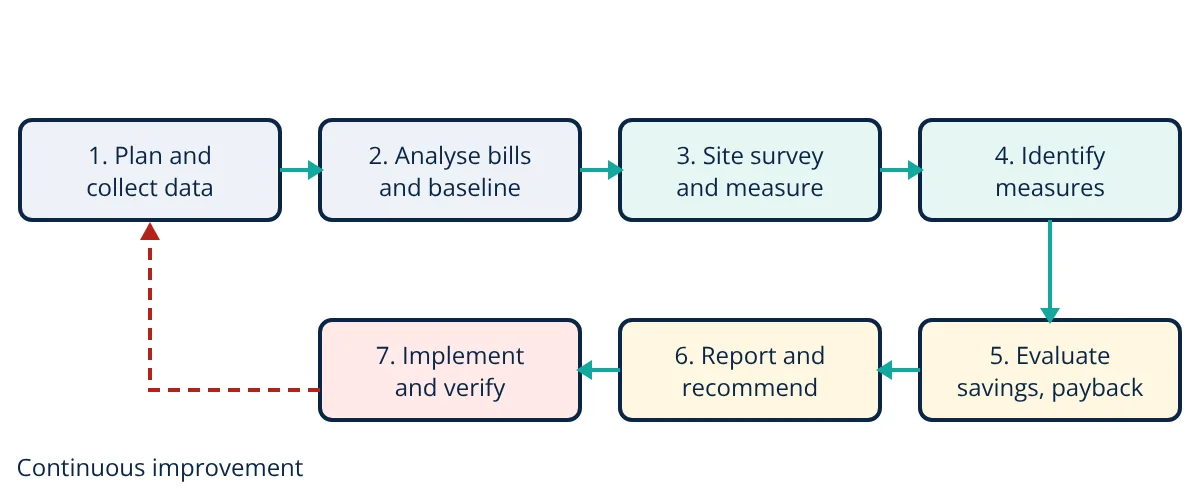
An energy audit is a systematic study of how a building, plant or process uses energy, to find where it is wasted and how to save it. The main types are a walk-through (preliminary) audit, a detailed (general) audit and an investment grade audit. The steps are: plan and collect data, analyse bills and baseline, site survey and measurement, identify savings measures, evaluate costs, savings and payback, report and recommend, then implement and verify savings.
Energy is one of the largest controllable costs in industry and commercial buildings. An energy audit turns vague concern about bills into a clear list of actions with costs, savings and paybacks. It is also the first step toward an energy management system such as ISO 50001, and for large consumers in many countries it is a legal requirement.
Types of energy audit
Walk-through (preliminary) audit
A short visit, often one or two days, with a review of energy bills and a tour of the site. It identifies obvious waste and low cost measures and estimates savings roughly. ASHRAE calls this Level 1.
Detailed (general) audit
A thorough study of major energy systems with measurements, load profiles and an energy balance. It quantifies savings and costs for each measure with reasonable accuracy, typically within about ±20%. ASHRAE Level 2.
Investment grade (comprehensive) audit
An in depth engineering analysis for capital intensive projects, with detailed modelling, quotes from suppliers and risk analysis, suitable for financing decisions and energy performance contracts. ASHRAE Level 3.
| Type | Duration | Depth | Accuracy of savings | Typical output |
|---|---|---|---|---|
| Walk-through | Hours to days | Bills and visual survey | Rough | Quick wins, need for further study |
| Detailed | Weeks | Measurements, energy balance | About ±20% | Ranked list of measures with payback |
| Investment grade | Weeks to months | Engineering design, modelling | About ±10% | Bankable project proposals |
Energy audit steps
1. Plan and collect data
Agree scope, objectives and boundaries with management. Collect at least 12 to 36 months of electricity, fuel and water bills, production data, equipment lists, drawings, operating hours and any existing meter data.
2. Analyse bills and set a baseline
Break down consumption by energy type and month; study tariff structure, maximum demand charges and power factor penalties. Relate energy use to production or floor area to form energy performance indicators, such as kWh per tonne or kWh per m² per year. Regression against production or degree days gives a baseline for measuring future savings.
3. Site survey and measurement
Inspect major energy users and measure their actual performance with portable instruments:
- Power and harmonics analysers on motors, transformers and feeders.
- Ultrasonic or clamp on flow meters on water, steam and compressed air lines.
- Thermal cameras for insulation losses, hot spots and steam traps.
- Flue gas analysers for boiler and furnace combustion efficiency.
- Lux meters for lighting, data loggers for temperature and humidity.
- Ultrasonic leak detectors for compressed air systems.
4. Identify energy saving measures
Typical opportunities include:
- Motors and drives: high efficiency motors and variable speed drives on pumps and fans, where affinity laws give large savings at reduced flow. See induction motor working principle.
- Compressed air: fixing leaks, lowering pressure, recovering compressor heat.
- Pumps and fans: right sizing, trimming impellers, removing throttling, as in centrifugal pump systems.
- Boilers and steam: combustion tuning, condensate return, steam trap repair, insulation.
- HVAC and refrigeration: setpoint changes, free cooling, efficient chillers and controls.
- Lighting: LED retrofits, daylight and occupancy controls.
- Heat recovery between hot and cold streams, as in pinch analysis.
- Renewable supply: rooftop solar PV systems and storage.
5. Evaluate savings and payback
For each measure, estimate energy and cost savings, implementation cost and financial indicators:
Larger projects use net present value and internal rate of return.
- Given
- A 55 kW cooling water pump runs 8000 h per year at full speed, with flow throttled by a valve. Measurements show the process needs only 75% of design flow. A variable speed drive costs 6000 (in local currency units, with electricity at 0.12 per kWh).
- Find
- Annual savings and simple payback when the pump runs at 75% speed instead of throttling.
- Assumptions
- Measured input power is 55 kW; affinity law power ∝ speed³; 5% drive losses; static head negligible.
- Solution
- Power at 75% speed = 55 × 0.75³ = 55 × 0.422 = 23.2 kW; with drive losses ≈ 24.4 kW
Savings = (55 − 24.4) × 8000 = 244 800 kWh per year
Cost saving = 244 800 × 0.12 = 29 376 per year
Payback = 6000 ÷ 29 376 = 0.20 years ≈ 2.5 months - Answer
- About 245 MWh and 29 400 per year saved, with a payback of under three months
- Limitations
- Systems with high static head save less than the pure cube law suggests; measure before and after to verify.
6. Report and recommend
The audit report summarises the energy baseline, findings and a prioritised list of measures, grouped as no cost, low cost and capital projects, with savings, costs, paybacks, risks and an implementation plan. A clear executive summary helps management approve actions.
7. Implement and verify
Install measures, then measure and verify savings against the baseline, often following the IPMVP protocol, adjusting for production and weather. Results feed the next audit cycle and the organisation’s energy management system.
Common energy audit mistakes
- Relying on nameplate ratings instead of measured loads, which often overstates savings.
- Ignoring how equipment interacts, for example counting savings twice from both a new chiller and reduced cooling load.
- Recommending measures without checking production constraints, maintenance capability or safety.
- Skipping measurement and verification, so savings are never proven and momentum is lost.
Making the energy audit count
The best audits combine accurate measurements with practical knowledge of how the site really runs, involve operators and maintenance staff, and lead to an ongoing programme of metering, targets and reviews under ISO 50001. Many sites also pair efficiency with on-site generation and storage, such as battery energy storage to cut peak demand charges and a microgrid for resilience.
Frequently asked questions
How much can an energy audit save?
Savings depend on the facility, but audits of industrial and commercial sites commonly identify opportunities worth 10 to 30% of energy cost, many with paybacks under two or three years. Low or no cost measures such as fixing compressed air leaks, adjusting setpoints and switching off idle equipment often give quick savings.
Who can carry out an energy audit?
A qualified energy auditor or energy manager, internal or external. Many countries certify auditors; for example, India's Bureau of Energy Efficiency certifies energy auditors and makes audits mandatory for designated energy intensive consumers. ISO 50002 sets requirements for audit quality.
What is the difference between an energy audit and ISO 50001?
An energy audit is a one time or periodic assessment that finds savings opportunities. ISO 50001 is a management system standard that builds continuous improvement into an organisation, with policies, targets, monitoring and regular reviews. Audits are often one input to an ISO 50001 system.
References
- ISO 50002:2014, Energy audits: Requirements with guidance for use
- ISO 50001:2018, Energy management systems: Requirements with guidance for use
- ASHRAE Standard 211, Standard for Commercial Building Energy Audits
- Bureau of Energy Efficiency, Guide Books for National Certification Examination for Energy Managers and Energy Auditors, India
- EVO, International Performance Measurement and Verification Protocol (IPMVP)
Get one engineering email a week
New articles, worked examples and study notes every week. Free, no spam, unsubscribe any time.