Carnot Cycle: Efficiency and PV Diagram
The Carnot cycle is an ideal reversible heat engine cycle made of two isothermal and two adiabatic processes between a hot reservoir at TH and a cold reservoir at TL. It sets the maximum possible efficiency of any engine between those temperatures, η = 1 − TL/TH, with both temperatures in kelvin.
The Carnot cycle, proposed by the French engineer Sadi Carnot in 1824, answers a basic question: how much of the heat supplied to an engine can ever become work? No real engine follows it, yet every steam plant, gas turbine and refrigerator is judged against it. This article explains the four processes, the P-V and T-s diagrams, the efficiency formula and how to use it, building on the laws of thermodynamics.
What is the Carnot cycle?
A heat engine takes heat QH from a high temperature source, converts part of it to net work W and rejects the rest, QL, to a low temperature sink. The second law of thermodynamics (Kelvin Planck statement) says QL can never be zero.
The Carnot cycle is the engine cycle that wastes nothing beyond what the second law demands. It uses a working fluid, often pictured as an ideal gas in a piston and cylinder, and every process is internally and externally reversible:
- Heat is exchanged only while the fluid is at the reservoir temperature, so there is no heat transfer across a finite temperature difference.
- There is no friction, no unrestrained expansion and no mixing.
- Each process is quasi-static, so the fluid passes through equilibrium states that can be drawn as a line on a property diagram.
Because the cycle is reversible, it can also run backwards as a refrigerator or heat pump.
The four processes of the Carnot cycle
For a heat engine the cycle runs in this order:
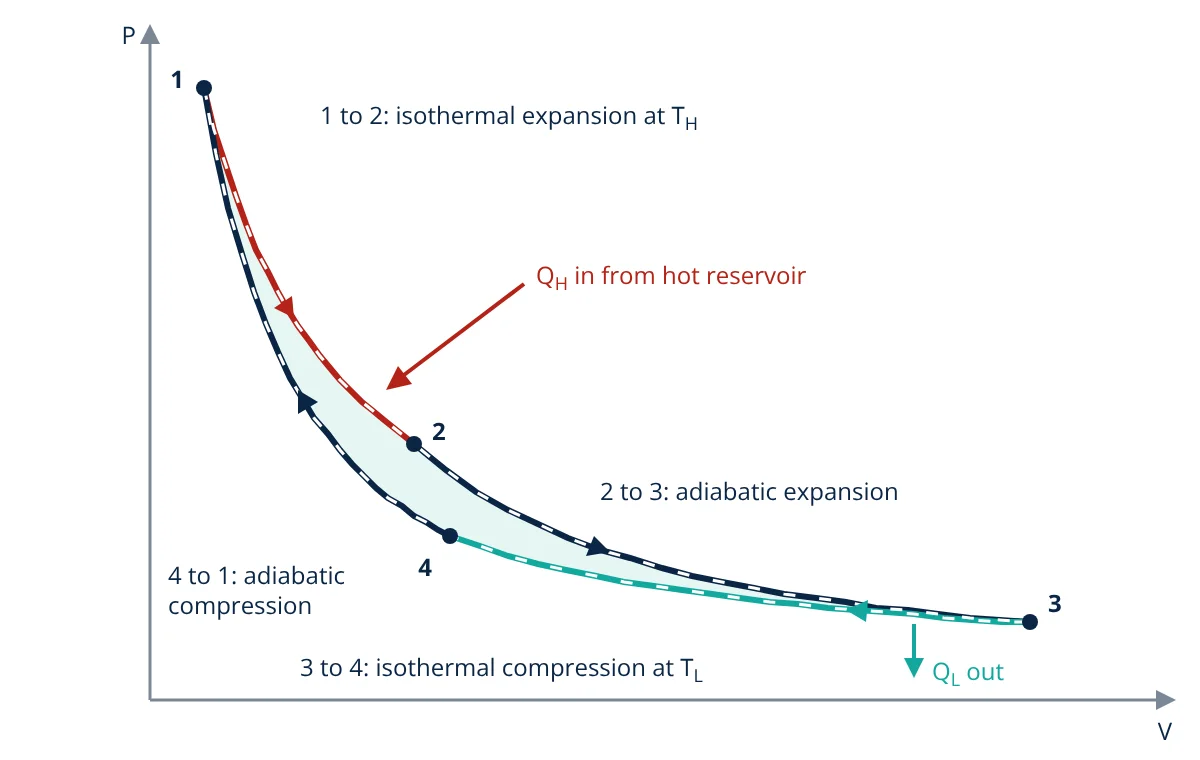
- Process 1 to 2, reversible isothermal expansion at TH. The cylinder head touches the hot reservoir. The gas expands slowly and does work, while heat QH flows in to keep its temperature at TH.
- Process 2 to 3, reversible adiabatic expansion. The cylinder is insulated. The gas keeps expanding and doing work, and its temperature falls from TH to TL. There is no heat transfer, so entropy stays constant (isentropic).
- Process 3 to 4, reversible isothermal compression at TL. The cylinder touches the cold reservoir. The piston compresses the gas, and heat QL flows out to keep the temperature at TL.
- Process 4 to 1, reversible adiabatic compression. The cylinder is insulated again. Compression raises the gas temperature from TL back to TH, and the cycle closes.
Carnot cycle on the P-V and T-s diagrams
On a P-V diagram the isotherms of an ideal gas follow PV = constant, so they are rectangular hyperbolas. The adiabats follow PV^γ = constant, where γ is the ratio of specific heats (about 1.4 for air). At any point the slope of an adiabat is γ times the slope of the isotherm through it, so the adiabats are always steeper. The four curves enclose a thin, curved four sided shape traced clockwise. The enclosed area is the net work done per cycle, because net work equals the integral of P dV around the cycle.
On a T-s diagram the same cycle is a rectangle. The two isotherms are horizontal lines at TH and TL, and the two reversible adiabats are vertical lines of constant entropy. The area under line 1 to 2 is QH, the area under line 3 to 4 is QL, and the rectangle between them is the net work. This picture shows clearly why the efficiency depends only on the two temperatures: widening the rectangle in entropy changes QH and W in the same proportion.
Carnot efficiency derivation
For an ideal gas the internal energy depends only on temperature, so during an isothermal process the heat transferred equals the work. For mass m and gas constant R:
For the two reversible adiabats, TV^(γ−1) is constant, which gives:
The logarithms cancel, so QL/QH = TL/TH, and the thermal efficiency is:
The result does not depend on the working fluid. Kelvin used exactly this ratio to define the thermodynamic temperature scale, which is why TH and TL must always be absolute temperatures.
Carnot principles
Two statements, proved from the second law, follow from the cycle:
- The efficiency of an irreversible heat engine is always less than that of a reversible engine operating between the same two reservoirs.
- All reversible heat engines operating between the same two reservoirs have the same efficiency.
So 1 − TL/TH is a hard ceiling. To raise it, either raise TH (limited by materials such as turbine blade alloys) or lower TL (limited by the ambient air or cooling water, the natural sink). This is why power stations, described in generation, transmission and distribution, push steam and gas temperatures as high as their metals allow.
Why no real engine uses the Carnot cycle
- Speed: reversible isothermal heat transfer needs an infinitely small temperature difference, so it takes infinite time. Real heat exchangers need a finite difference, as covered in modes of heat transfer.
- Low net work: for a gas the P-V loop is very narrow, so the net work is small compared with the gross expansion and compression work. Small friction losses would wipe it out.
- Vapour cycles: a Carnot cycle inside the wet steam dome would need a compressor handling a two phase mixture and a turbine handling very wet steam, both of which are impractical. Engineers use the Rankine cycle instead.
Real cycles such as Rankine, Brayton, Otto and Diesel are compared with Carnot efficiency at the same temperature limits. Large slow speed engines such as the two stroke marine diesel engine reach high efficiency for a real engine, but still well below the Carnot value for their peak gas temperature.
Worked example: Carnot engine efficiency
- Given
- A Carnot engine receives 500 kJ of heat per cycle from a reservoir at 527 °C and rejects heat to surroundings at 27 °C.
- Find
- The thermal efficiency, the net work per cycle and the heat rejected per cycle.
- Assumptions
- All processes reversible; reservoir temperatures constant; steady cyclic operation.
- Solution
- TH = 527 + 273 = 800 K; TL = 27 + 273 = 300 K
η = 1 − 300/800 = 1 − 0.375 = 0.625
W = η × QH = 0.625 × 500 = 312.5 kJ
QL = QH − W = 500 − 312.5 = 187.5 kJ
Check: QH/TH = 500/800 = 0.625 kJ/K and QL/TL = 187.5/300 = 0.625 kJ/K, so the entropy change of the cycle is zero, as expected for a reversible cycle. - Answer
- η = 62.5%, W = 312.5 kJ per cycle, QL = 187.5 kJ per cycle
- Limitations
- This is an upper limit. A real engine between the same temperatures has lower efficiency because of friction, finite temperature differences and other irreversibilities.
Reversed Carnot cycle: refrigerator and heat pump
Run in reverse (counterclockwise on the P-V diagram), the cycle absorbs QL from the cold space, takes in net work and rejects QH to the warm surroundings. Its performance is expressed as a coefficient of performance (COP), which can be greater than 1:
These are the highest COP values any refrigerator or heat pump can reach between TL and TH. A practical machine such as the vapour compression refrigeration cycle gets closer to them when the temperature lift is small.
Key formulas for the Carnot cycle
| Quantity | Formula | Symbols and units |
|---|---|---|
| Thermal efficiency | η = 1 − TL/TH | TH, TL = hot and cold reservoir temperatures in K |
| Net work | W = QH − QL = η × QH | W, QH, QL in kJ per cycle or kW for a rate |
| Heat ratio | QL/QH = TL/TH | Valid for reversible cycles only |
| Isothermal heat (ideal gas) | QH = m R TH ln(V2/V1) | m in kg, R in kJ/kg K, V in m³ |
| Adiabatic relation | T V^(γ−1) = constant | γ = cp/cv, about 1.4 for air |
| Refrigerator COP | COP_R = TL/(TH − TL) | Dimensionless |
| Heat pump COP | COP_HP = TH/(TH − TL) | Dimensionless, COP_HP = COP_R + 1 |
Carnot cycle interview and viva questions
- Name the four processes of the Carnot cycle. Reversible isothermal expansion at TH, reversible adiabatic expansion, reversible isothermal compression at TL and reversible adiabatic compression back to the start.
- Why are the adiabats steeper than the isotherms on a P-V diagram? An isotherm follows PV = constant and an adiabat follows PV^γ = constant, so the adiabat slope is γ times the isotherm slope at the same point.
- What shape does the Carnot cycle have on a T-s diagram? A rectangle: two horizontal isotherms at TH and TL joined by two vertical isentropic lines, with the enclosed area equal to the net work.
- Does Carnot efficiency depend on the working fluid? No. All reversible engines between the same two reservoirs have the same efficiency, 1 − TL/TH.
- How can Carnot efficiency be increased? By raising the source temperature TH or lowering the sink temperature TL, since only the ratio TL/TH matters.
Frequently asked questions
Why is the Carnot cycle the most efficient heat engine cycle?
All four processes are reversible, so no entropy is generated inside the cycle. The second law then shows that no engine working between the same two reservoirs can have a higher efficiency, and every reversible engine between them has the same efficiency, 1 minus TL/TH.
Why must temperatures be in kelvin in the Carnot efficiency formula?
The formula comes from the ratio of absolute temperatures, QL/QH = TL/TH, which defines the thermodynamic (Kelvin) temperature scale. Using degrees Celsius gives a wrong ratio and can even give negative or infinite results.
Can a real engine run on the Carnot cycle?
Not in practice. Isothermal heat transfer needs an infinitely small temperature difference, so it is infinitely slow, and the gas cycle encloses very little net work for its size, so friction would consume most of it. The Carnot cycle is used as an upper limit and a benchmark.
References
- Y. A. Cengel and M. A. Boles, Thermodynamics: An Engineering Approach, 9th ed., McGraw-Hill
- M. J. Moran, H. N. Shapiro, D. D. Boettner and M. B. Bailey, Fundamentals of Engineering Thermodynamics, 9th ed., Wiley
- P. K. Nag, Engineering Thermodynamics, 6th ed., McGraw-Hill Education
- G. F. C. Rogers and Y. R. Mayhew, Engineering Thermodynamics: Work and Heat Transfer, 4th ed., Longman
Get one engineering email a week
New articles, worked examples and study notes every week. Free, no spam, unsubscribe any time.