Types of Maintenance: Breakdown, Preventive and Predictive
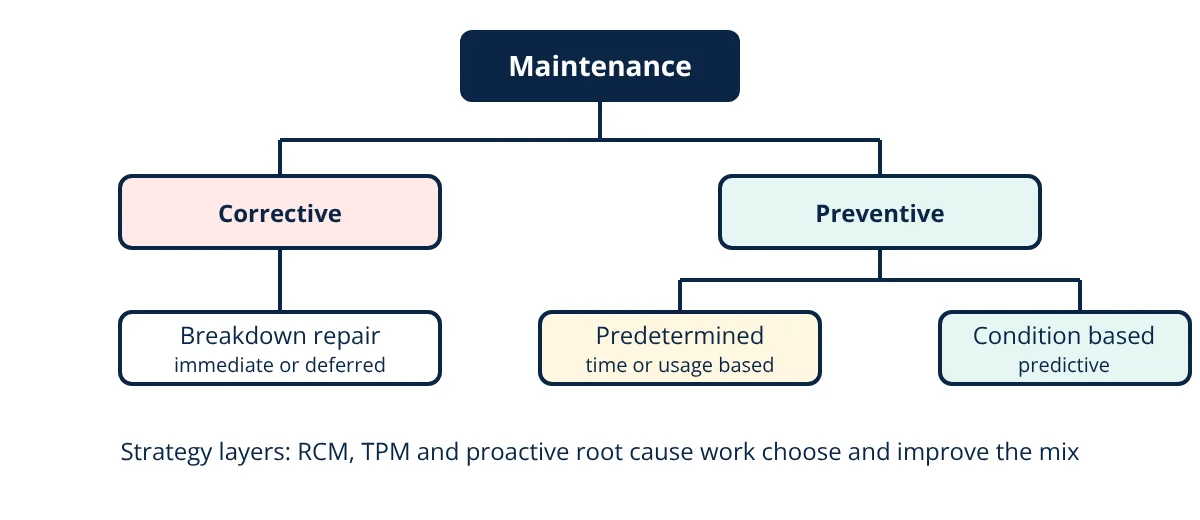
The main types of maintenance are: breakdown (reactive or corrective) maintenance, where equipment is repaired after it fails; preventive maintenance, done at fixed time or usage intervals to reduce the chance of failure; predictive (condition based) maintenance, where equipment condition is monitored and work is done when deterioration is detected; and proactive maintenance, which removes root causes of failure. Programmes such as reliability centred maintenance (RCM) and total productive maintenance (TPM) combine these strategies to maximise availability at the lowest total cost.
Maintenance keeps machines, plants and buildings working safely and efficiently. Its cost can be a large share of operating budgets, but poor maintenance costs far more through lost production, quality problems, safety incidents and shortened equipment life. Choosing the right type of maintenance for each asset is a key engineering decision. EN 13306 defines the standard terminology used below.
1. Breakdown (corrective) maintenance
Equipment runs until it fails, then it is repaired or replaced.
- When it makes sense: low cost, non-critical items with no safety impact, redundancy available, or failures that are random and cannot be predicted, such as light bulbs or small fans.
- Advantages: no planning or monitoring cost; parts used to the end of life.
- Disadvantages: unplanned downtime, emergency labour and spare parts costs, secondary damage, safety and quality risks. Studies commonly find reactive repairs cost several times more than planned work.
2. Preventive (time based) maintenance
Tasks are scheduled at fixed intervals of calendar time or usage: hours, cycles or kilometres. Examples include oil changes every 2000 hours, filter replacement every quarter, and annual overhauls.
- When it makes sense: wear out failures with predictable life, such as belts, filters, lubricants and some seals; regulatory inspections such as boilers and lifts.
- Advantages: fewer breakdowns, planned work and parts, simple to manage with a computerised maintenance management system (CMMS).
- Disadvantages: parts may be replaced while still good, intrusive work can introduce faults, and random failures are not prevented.
3. Predictive (condition based) maintenance
Equipment condition is monitored, and work is triggered when measurements show deterioration. Common techniques:
- Vibration analysis for rotating machinery (imbalance, misalignment, bearing faults).
- Infrared thermography for electrical connections, bearings and insulation.
- Oil analysis for wear metals, contamination and lubricant condition, linked to types of lubrication.
- Ultrasound for leaks, bearing lubrication and electrical discharge.
- Motor current and insulation testing, such as the insulation resistance test.
- Process data such as pressure, flow and temperature trends.
Modern systems use online sensors, the industrial IoT and machine learning, as explained in predictive maintenance with machine learning.
- Advantages: work is done only when needed, failures are caught early, parts and downtime are planned.
- Disadvantages: investment in sensors, software and skilled analysts; not all failure modes give a warning.
4. Proactive maintenance and RCM
Proactive maintenance targets the root causes of failure, such as misalignment, contamination, poor lubrication or design weaknesses, so that failures do not occur. Reliability centred maintenance (RCM) is a structured process (SAE JA1011) that analyses each asset’s functions, failure modes and consequences (often using FMEA) to choose the most effective task for each failure mode: condition monitoring, scheduled restoration or replacement, failure finding, redesign, or run to failure.
5. Total productive maintenance (TPM)
TPM engages operators in autonomous maintenance: daily cleaning, inspection, lubrication and tightening, so small problems are found early. It adds planned maintenance, focused improvement, training, early equipment management and safety. Progress is measured with overall equipment effectiveness (OEE):
Types of maintenance compared
| Feature | Breakdown | Preventive | Predictive |
|---|---|---|---|
| Trigger | Failure | Time or usage | Measured condition |
| Downtime | Unplanned | Planned | Planned, minimal |
| Parts usage | Full life | Often replaced early | Close to full life |
| Upfront cost | Lowest | Medium | Highest |
| Total cost for critical assets | Highest | Medium | Lowest when applied well |
| Best for | Cheap, non-critical items | Predictable wear | Critical, monitorable assets |
Availability
Equipment availability depends on how often it fails and how quickly it is repaired:
where MTBF is mean time between failures and MTTR is mean time to repair, explained further in MTBF, MTTR and availability.
- Given
- A packaging line runs 6000 hours per year. Under breakdown maintenance it fails every 300 hours on average, with repairs taking 8 hours. A predictive programme is expected to raise MTBF to 900 hours and, because repairs are planned, cut MTTR to 3 hours. Lost production costs 2000 per hour of downtime.
- Find
- Availability and annual downtime cost before and after.
- Assumptions
- Failures spread evenly; downtime counted only for repairs.
- Solution
- Before: A = 300 ÷ 308 = 97.4%; failures = 6000 ÷ 300 = 20; downtime = 160 h; cost = 320 000
After: A = 900 ÷ 903 = 99.7%; failures ≈ 6.7; downtime = 20 h; cost = 40 000 - Answer
- Availability rises from 97.4% to 99.7%, and downtime cost falls by about 280 000 per year, which can fund the monitoring programme
- Limitations
- Programme cost, false alarms and remaining random failures must be included in a full business case.
Maintenance planning and the CMMS
Whatever the strategy, good planning makes maintenance efficient. A computerised maintenance management system holds the asset register, task lists, schedules, work orders, spare parts and history. Planners prepare job packages with procedures, parts, tools and permits before work starts, so technicians spend their time on the job rather than waiting or searching. Work is scheduled to fit production windows, and history data feeds reliability analysis of repeat failures.
Choosing among the types of maintenance
The goal is not the most advanced strategy everywhere but the right one for each asset.
Start with an asset criticality ranking based on safety, environmental, production and cost consequences. Apply predictive and proactive strategies to critical assets, preventive tasks where wear is predictable, and run to failure where consequences are minor. Track results with KPIs such as MTBF, MTTR, availability, OEE, planned maintenance percentage and maintenance cost per unit produced, and improve continuously. A balanced mix supports smooth production planning and control and keeps machines such as CNC machines running reliably.
Frequently asked questions
Which type of maintenance is best?
No single type is best for all equipment. Critical assets with detectable failure warnings suit predictive maintenance; items that wear out predictably suit preventive replacement; cheap, non-critical items with redundancy can be run to failure. Reliability centred maintenance chooses the right strategy for each failure mode.
What is the difference between preventive and predictive maintenance?
Preventive maintenance is time or usage based: tasks are done at fixed intervals, such as every 2000 hours, whether needed or not. Predictive maintenance is condition based: equipment is monitored with vibration, temperature, oil analysis or other measurements, and work is done only when the condition shows deterioration.
What is TPM?
Total productive maintenance is a Japanese approach that involves operators in basic maintenance such as cleaning, inspection and lubrication (autonomous maintenance), alongside planned maintenance, training and continuous improvement, with the goal of zero breakdowns, zero defects and zero accidents. It uses OEE as a key measure.
References
- EN 13306:2017, Maintenance: Maintenance terminology
- J. Moubray, Reliability-Centered Maintenance, 2nd ed., Industrial Press
- S. Nakajima, Introduction to TPM: Total Productive Maintenance, Productivity Press, 1988
- R. K. Mobley, An Introduction to Predictive Maintenance, 2nd ed., Butterworth-Heinemann
- ISO 55000:2024, Asset management: Vocabulary, overview and principles
Get one engineering email a week
New articles, worked examples and study notes every week. Free, no spam, unsubscribe any time.