Circular Economy Principles for Engineers
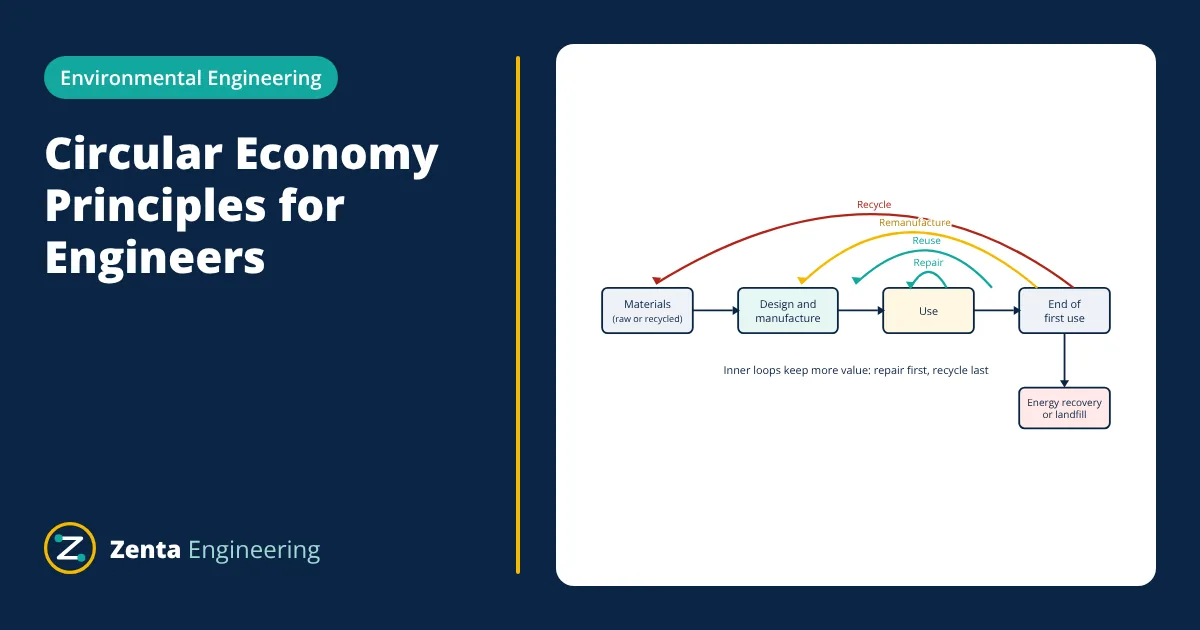
Circular economy principles replace the linear “take, make, waste” model with systems that keep materials and products in use at their highest value. The Ellen MacArthur Foundation summarises three principles: eliminate waste and pollution, circulate products and materials at their highest value, and regenerate nature. For engineers this means designing for durability, repair, modularity, disassembly and recycling, choosing safe and recyclable materials, and supporting loops such as maintenance, reuse, refurbishment, remanufacturing and recycling, with the inner, shorter loops preferred.
Modern industry extracts around 100 billion tonnes of materials each year, and only a small share is cycled back into use. Rising resource prices, supply risks for critical minerals, waste volumes and climate goals are pushing companies and governments towards circular approaches. Engineers make many of the decisions that lock in whether a product can be repaired, reused or recycled, so circular thinking is now part of good engineering practice.
Linear vs circular economy
In a linear economy, raw materials are extracted, made into products, used for a period and thrown away. Value leaks out at every stage. In a circular economy, products and materials circulate in loops, and waste from one process becomes input for another.
The core circular economy principles
1. Design out waste and pollution
Most of a product’s environmental impact is decided at the design stage. Engineers can:
- Use less material through optimised geometry and lightweighting, checked with tools such as finite element analysis.
- Avoid toxic substances that block safe recycling or composting.
- Use mono-materials or compatible materials that are easier to recycle.
- Eliminate unnecessary packaging and process scrap.
2. Keep products and materials in use
The value retention loops, from most to least preferred, are:
- Maintain and prolong: robust design, preventive maintenance and lubrication, software updates.
- Reuse and redistribute: second hand markets, sharing and leasing.
- Refurbish: restore to good working condition with cosmetic and functional repairs.
- Remanufacture: disassemble, inspect, replace worn parts and rebuild to as new specification with a warranty; common for engines, gearboxes, pumps, toner cartridges and medical devices.
- Recycle: recover materials, ideally in closed loops that keep quality high, for example aluminium cans back into cans.
Each inner loop preserves more embedded energy, labour and capital than the outer ones.
3. Regenerate natural systems
Use renewable energy and materials, return biological nutrients safely to soil through composting and anaerobic digestion, and support restoration of ecosystems.
Design strategies for engineers
- Design for durability: quality materials, generous factor of safety for wear parts, protection against corrosion and fatigue.
- Design for repair and maintenance: accessible fasteners, standard parts, diagnostic ports, spare part availability and repair manuals.
- Modularity: upgradeable modules, so an obsolete or failed part can be replaced without scrapping the whole product.
- Design for disassembly: screws and snap fits instead of glue, fewer material types, clear material marking.
- Design for remanufacturing: cores that survive disassembly, wear surfaces that can be restored.
- Design for recycling: separable materials, avoiding coatings and additives that contaminate recycling streams.
Circular business models
- Product as a service: customers pay for performance, for example lighting, compressed air or tyres per km, while the manufacturer keeps ownership and an incentive to make durable products.
- Take back and leasing schemes that return products for remanufacture.
- Sharing platforms that raise utilisation.
- Industrial symbiosis: one plant’s by-products become another’s raw materials, such as fly ash in cement, waste heat for neighbouring industries, or treated wastewater for cooling.
Measuring circularity
Common indicators include recycled content, recycling rate, product lifetime, utilisation, and the Material Circularity Indicator. A simple material circularity rate for a product is:
Circular options should always be checked with life cycle assessment, because more loops do not always mean lower impact if, for example, long transport or energy intensive reprocessing is needed.
- Given
- An industrial pump weighs 120 kg. A remanufacturing programme reuses the cast iron casing (70 kg) and replaces the impeller, shaft, seals and bearings (50 kg) with new parts containing 40% recycled steel. Producing a kg of new cast iron or steel emits about 2.0 kg CO₂e; remanufacturing work adds 15 kg CO₂e per pump.
- Find
- The material circularity rate of the remanufactured pump and its approximate material carbon footprint compared with a new pump.
- Assumptions
- Recycled steel emits 0.5 kg CO₂e per kg; reused casing has no new material emissions.
- Solution
- Circular mass = 70 (reused) + 0.40 × 50 (recycled) = 90 kg; C = 90 ÷ 120 = 75%
New pump: 120 × 2.0 = 240 kg CO₂e
Remanufactured: 30 kg virgin × 2.0 + 20 kg recycled × 0.5 + 15 = 60 + 10 + 15 = 85 kg CO₂e - Answer
- 75% circular material and about 85 kg CO₂e versus 240 kg CO₂e, a saving of about 65%
- Limitations
- Simplified factors; a full LCA would add manufacturing, transport and use phase energy, which for pumps dominates lifetime impact.
Circular economy principles in practice
Examples across engineering sectors show what is possible. Construction projects reuse steel sections and precast elements and crush concrete into recycled aggregate. Electronics makers offer modular phones and take back laptops for refurbishment. Industrial equipment makers remanufacture motors, gearboxes and pumps, often at a fraction of the cost and energy of new units. Chemical plants recover solvents and catalysts. Water utilities turn sewage sludge into biogas and fertiliser.
Challenges
Barriers include low prices of virgin materials, complex multi-material products, lack of collection infrastructure, quality concerns about recycled or remanufactured goods, and regulations that treat used products as waste. Policies such as extended producer responsibility, eco-design rules, right to repair laws and digital product passports, together with standards such as ISO 59004, are helping to overcome them.
Applying circular economy principles connects naturally with solid waste management, where the waste hierarchy sets the same priorities, and with the reuse of treated water and sludge from the activated sludge process.
Frequently asked questions
Is the circular economy the same as recycling?
No. Recycling is one part, and usually not the most valuable. The circular economy first aims to design out waste, then keep products and components in use through sharing, repair, refurbishment and remanufacturing, which preserve more of the energy and labour embedded in them. Recycling recovers materials when products can no longer be used.
What are technical and biological cycles?
In the Ellen MacArthur Foundation's model, technical cycles cover materials such as metals and plastics that are kept in circulation through maintenance, reuse, remanufacturing and recycling. Biological cycles cover renewable materials such as food and wood that can safely return to the soil through composting or anaerobic digestion after cascading uses.
Can every product be fully circular?
Not completely. Some losses are unavoidable because materials degrade, mix or disperse, and recycling uses energy. The goal is to slow, narrow and close material loops as far as is practical and beneficial, checking with life cycle assessment that circular options really lower environmental impact.
References
- Ellen MacArthur Foundation, Towards the Circular Economy, Vol. 1, 2013
- W. R. Stahel, The Circular Economy, Nature, 531, 435-438, 2016
- N. M. P. Bocken et al., Product design and business model strategies for a circular economy, Journal of Industrial and Production Engineering, 2016
- ISO 59004:2024, Circular economy: Vocabulary, principles and guidance for implementation
- European Commission, A new Circular Economy Action Plan, COM(2020) 98
Get one engineering email a week
New articles, worked examples and study notes every week. Free, no spam, unsubscribe any time.