Environmental Impact Assessment: Process and Steps
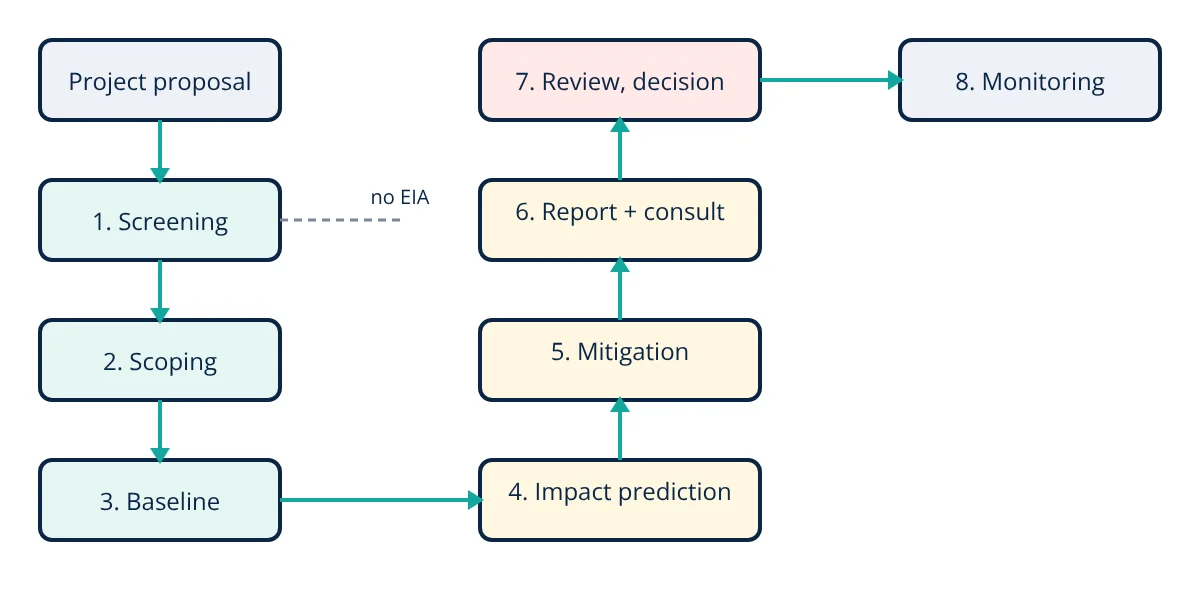
An environmental impact assessment (EIA) is a formal process for identifying, predicting and evaluating the likely environmental and social effects of a proposed project before a decision is made to approve it. The main steps are screening (does the project need an EIA?), scoping (which issues matter?), baseline studies, impact prediction and evaluation, mitigation and alternatives, public consultation, the EIA report, review and decision, and monitoring and follow-up through an Environmental Management Plan.
Large projects such as power plants, mines, highways, factories and dams can change air quality, water resources, ecosystems and communities for decades. EIA makes sure these effects are understood and reduced at the planning stage, when changing the design or location is still possible and cheap. It began with the US National Environmental Policy Act of 1969 and is now required by law in most countries.
Objectives of an environmental impact assessment
- Provide decision makers with information on environmental consequences.
- Promote better project design, location and technology choices.
- Avoid, minimise, mitigate or compensate adverse impacts.
- Give affected communities a voice through consultation.
- Set conditions and monitoring for construction and operation.
Step 1: screening
Screening decides whether a project needs a full EIA, a limited assessment or none. Most laws list project types and thresholds, for example thermal power plants above a certain capacity, mines above a certain area, or industrial estates. In India, the EIA Notification 2006 classifies projects as Category A (appraised centrally) or Category B (appraised by state authorities).
Step 2: scoping
Scoping identifies the key issues, alternatives, study area and methods so that effort focuses on what matters. It usually involves the regulator, experts and sometimes the public, and produces terms of reference (ToR) for the study.
Step 3: baseline studies
The existing environment is described so that changes can be predicted and measured:
- Air: ambient concentrations of PM10, PM2.5, SO₂, NOx, CO and others, plus meteorology.
- Noise: day and night levels at sensitive receptors.
- Water: surface and groundwater quality and quantity, hydrology and drainage.
- Land and soil: land use, soil quality, geology, seismicity.
- Ecology: flora, fauna, protected areas and species.
- Socio-economic: population, livelihoods, health, cultural heritage, infrastructure.
Baseline monitoring typically covers at least one season, often longer.
Step 4: impact prediction and evaluation
Impacts are predicted for construction, operation and decommissioning:
- Air dispersion models such as AERMOD estimate ground level concentrations from stack emissions.
- Noise propagation models, hydrological and groundwater models, traffic studies and ecological assessments.
- Social impact assessment for displacement, employment and community health.
Each impact is rated by magnitude, extent, duration, reversibility and likelihood, and compared with standards and the sensitivity of receptors. Tools include checklists, matrices (such as the Leopold matrix), network diagrams and GIS overlays. Cumulative impacts with other projects in the area are also considered.
A simple significance score can combine magnitude and sensitivity:
where M is impact magnitude and R is receptor sensitivity, each scored, for example, from 1 to 5.
- Given
- A proposed cement plant’s dust emissions are predicted to add 12 µg/m³ to annual PM10 at a nearby village where the baseline is 45 µg/m³. The national annual standard is 60 µg/m³. Magnitude is scored 3 of 5 and village sensitivity 4 of 5.
- Find
- The predicted concentration, compliance, and the significance score.
- Assumptions
- Contributions add linearly; scores above 12 are treated as significant requiring mitigation.
- Solution
- Predicted PM10 = 45 + 12 = 57 µg/m³, below 60 µg/m³ but leaving only 3 µg/m³ headroom
S = 3 × 4 = 12, at the threshold of significance - Answer
- 57 µg/m³ complies but the impact is significant; mitigation such as high efficiency electrostatic precipitators, enclosed conveyors and a green belt should reduce the increment
- Limitations
- Model uncertainty and future projects in the area could push concentrations over the standard; continuous monitoring is required.
Step 5: mitigation and alternatives
For dust sources like the plant in the example, typical controls include electrostatic precipitators or bag filters on stacks and covered storage for fugitive dust.
The mitigation hierarchy applies: avoid impacts (for example by choosing another site or route), minimise them (cleaner technology, pollution controls, timing of works), restore affected areas, and offset residual impacts (compensatory afforestation, biodiversity offsets). Alternatives, including the no project option, are compared.
Step 6: EIA report and public consultation
The EIA report (or Environmental Impact Statement) documents the project, baseline, impacts, mitigation, alternatives and an Environmental Management Plan (EMP) with responsibilities, budgets and monitoring. A non-technical summary helps the public understand it. Public hearings and written comments allow affected people and stakeholders to raise concerns, which must be addressed in the final report.
Step 7: review and decision
An expert committee or authority reviews the report for adequacy and decides whether to grant environmental clearance, usually with conditions such as emission limits, monitoring, green belts or community programmes, or to reject the project.
Step 8: monitoring and follow-up
After approval, compliance with conditions is monitored through periodic reports, inspections and continuous systems such as CEMS for stack emissions. Follow-up checks whether predictions were accurate and mitigation works, so that management can adapt.
EIA for engineering projects
For engineers, EIA is not just paperwork. It shapes plant layout, stack heights, pollution control choices, water sourcing, effluent treatment, traffic routes and construction methods. Design teams supply emission rates, water balances, noise data and waste quantities, and the EIA team feeds back limits that the design must meet. Early cooperation avoids late redesign and approval delays.
Strengths and limitations of EIA
Good practice standards such as IFC Performance Standard 1 are widely used by lenders and add requirements for stakeholder engagement, grievance mechanisms and management systems.
EIA improves decisions, transparency and project design. Its weaknesses can include poor quality baseline data, consultants paid by the proponent, limited consideration of cumulative impacts, and weak follow-up after approval. Strategic environmental assessment (SEA) applies similar thinking at the level of policies, plans and programmes, and life cycle assessment complements EIA by looking at impacts across the whole supply chain rather than one site.
Frequently asked questions
Which projects need an environmental impact assessment?
It depends on national law. Typically large or potentially polluting projects such as power plants, refineries, mines, highways, ports, large dams, chemical plants and major construction need a full EIA. Many countries list project types and size thresholds; projects below them may need only a simpler assessment or none.
How long does an EIA take?
A full EIA commonly takes about 6 to 18 months, mainly because baseline studies need data across at least one season and public consultation and review take time. Simpler projects may complete faster, while very complex ones can take several years.
What is an Environmental Management Plan?
An Environmental Management Plan (EMP) is the part of the EIA that sets out how each mitigation measure will be implemented, by whom, when and at what cost, along with monitoring parameters and reporting. It turns the commitments in the EIA into actions during construction and operation.
References
- C. Wood, Environmental Impact Assessment: A Comparative Review, 2nd ed., Prentice Hall
- J. Glasson and R. Therivel, Introduction to Environmental Impact Assessment, 5th ed., Routledge
- EIA Notification, 2006 (as amended), Ministry of Environment, Forest and Climate Change, India
- Directive 2011/92/EU as amended by Directive 2014/52/EU on the assessment of the effects of certain public and private projects on the environment
- IFC Performance Standard 1: Assessment and Management of Environmental and Social Risks and Impacts, 2012
Get one engineering email a week
New articles, worked examples and study notes every week. Free, no spam, unsubscribe any time.