Grain Storage Structures and Silos: Types and Design
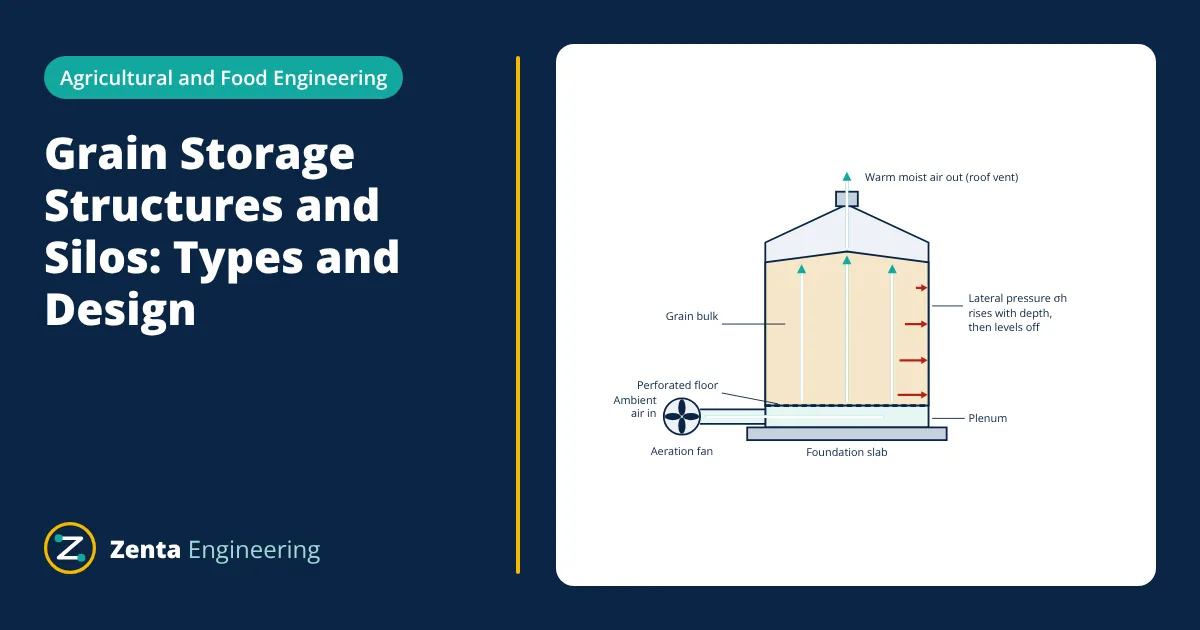
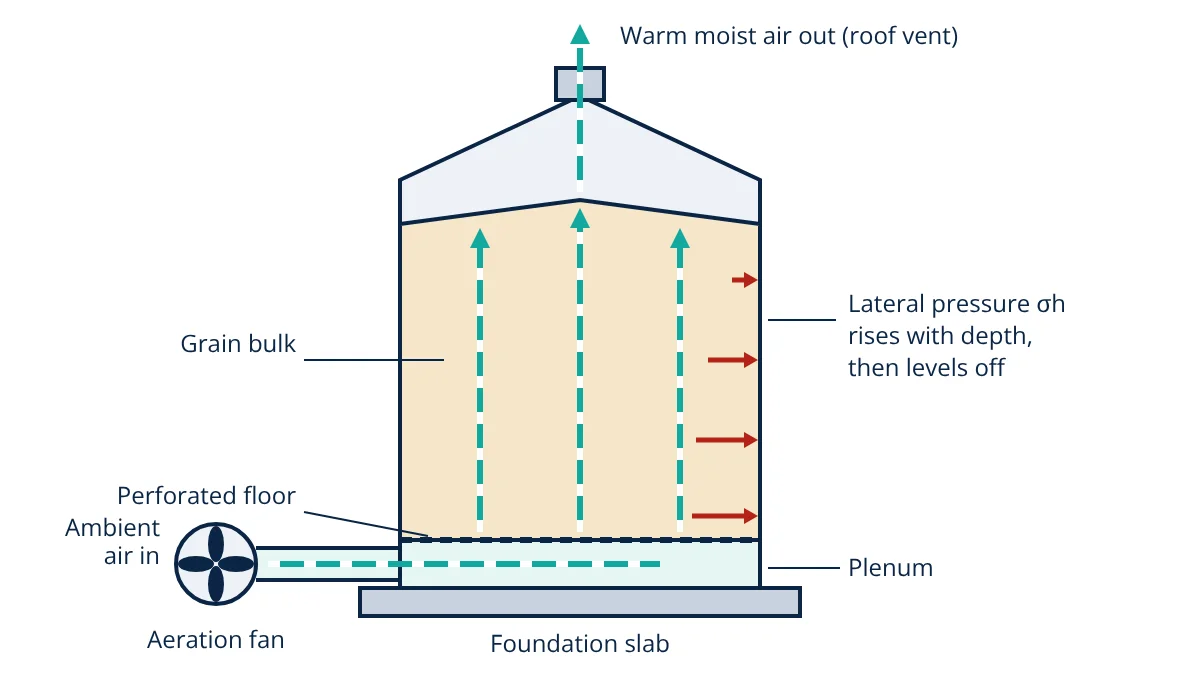
Grain storage is the holding of dried grain in structures that protect it from moisture, insects, rodents, heat and mould until use. Structures range from bags in warehouses to steel bins and concrete silos. Silo walls are designed for Janssen pressures, which level off with depth because wall friction carries part of the grain weight.
Grain storage starts after drying. A store can only keep grain at the quality it went in with, so grain should reach a safe moisture first, typically 12 to 14% wet basis for cereals (see grain drying methods). The structure then has to keep water and pests out and keep the grain cool and at a uniform temperature. Tall bins and silos must also carry the large and unusual loads that a granular solid puts on their walls.
What grain storage has to control
Stored grain is a living, respiring mass. Moisture, temperature and oxygen decide how fast insects, mites and fungi grow in it. Warm, damp grain respires faster, which releases more heat and water, so a small damp patch can turn into a hot spot that spreads. Good storage keeps grain dry, cool and sealed against rain, ground moisture, condensation, insects, rodents and birds. Monitoring with temperature cables lets the operator find heating before it becomes visible spoilage.
Types of grain storage structures
| Structure | Typical use | Main features |
|---|---|---|
| Traditional stores (mud, wood, bamboo or brick bins) | Household and village level | Low cost, local materials; protection depends on sealing and upkeep |
| Bag storage in warehouses | Procurement, trade, food reserves | Flexible, easy to inspect and fumigate under sheets; slow handling, high labour |
| Covered and plinth storage | Temporary outdoor bag stacks | Raised plinth against ground moisture, waterproof covers against rain |
| Hermetic bags and cocoons | Smallholders, seed, reserves | Airtight; respiration lowers oxygen and raises carbon dioxide, which kills insects |
| Steel bins | Farms and cooperatives | Corrugated galvanised walls, perforated floor for aeration, mechanical handling |
| Steel and concrete silos | Elevators, mills, ports | Large capacity, fully mechanised, need structural design for grain loads |
Bulk storage in bins and silos takes less labour and suits mechanical handling and aeration. Bag storage keeps lots separate and needs little capital, which is why both are used side by side.
Bins and silos: shallow and deep
Design codes such as IS 9178, IS 4995 and EN 1991-4 classify containers by geometry rather than by name. In a shallow bin the plane of rupture of the grain meets the top surface before it reaches the wall, and lateral pressure is found with Rankine earth pressure theory, much as for a retaining wall. In a deep bin the plane of rupture meets the wall, and wall friction becomes important, so Janssen theory is used. ASABE EP545 covers loads on shallow storage structures and ANSI/ASAE EP433 covers loads in bins.
The ratio of lateral to vertical pressure, k, links the two pressures. For a cohesionless grain with internal friction angle φ, Rankine’s active value is:
EP433 uses a fixed value of k = 0.5 for free flowing grain.
Grain pressure in a silo: the Janssen equation
Janssen considered a thin horizontal slice of grain in a vertical bin. Its weight is balanced by the change in vertical pressure across the slice and by friction on the wall, where wall friction equals the wall friction coefficient μ times the lateral pressure. Solving the force balance gives the vertical pressure at depth z below the grain surface:
Lateral pressure on the wall and wall friction per unit area follow from σv:
Here R is the hydraulic radius, the cross section area divided by its perimeter, which is D/4 for a circular bin. Near the surface the pressure rises almost like a liquid, but deeper down the exponential term shrinks and the pressure levels off at ρgR/(μk). That limit depends on diameter, not height. The friction load that does not reach the floor goes into the walls as vertical compression, which is why tall steel silo walls can buckle as well as burst.
These are static filling pressures. During discharge, eccentric emptying or with mass flow, wall pressures can exceed Janssen values, and EP433, IS 9178 and EN 1991-4 add overpressure factors or patch loads for this. Concrete silos are then reinforced against hoop tension using the same pressures, and the foundations must carry the full grain weight, a task covered in types of foundations.
Mass flow and funnel flow
The way grain leaves a silo affects quality and loads, and Jenike described two flow patterns. In funnel flow only a central channel above the outlet moves, while grain near the walls stays put until the end. The first grain in can be the last out, and fines collect in the stagnant zones. In mass flow all of the grain moves whenever any is drawn off, so the first grain in is the first out. Mass flow needs a steep, smooth hopper and gives more uniform residence time, but it produces higher wall pressures at the transition between the cylinder and hopper. Most flat bottom farm bins run in funnel flow.
Aeration and temperature control in grain storage
Grain is a poor conductor of heat. In cold weather the grain near the walls cools while the centre stays warm. Air rises through the warm centre and sinks along the cold walls, and moisture carried by this convection condenses in the cooler grain near the top centre, where crusting and mould start. In hot weather the pattern reverses and moisture collects lower down.
Aeration stops this. A fan pushes ambient air into a plenum under a perforated floor, and the air rises through the grain and leaves through roof vents. A cooling front moves through the bulk in the direction of airflow, and the fan must run until the front has passed right through the grain. Suction systems pull air downward instead. Aeration airflow is much lower than drying airflow, so it cools grain but does not dry it.
Temperature cables hung in the bulk show whether the cooling front has passed and warn of hot spots. Cold, chilled or controlled atmosphere storage builds on the same idea of slowing biological activity, and the refrigeration side is covered in cold storage design basics.
- Given
- A steel silo of diameter D = 6 m is filled with wheat to a depth of 20 m. Bulk density ρ = 780 kg/m³, lateral pressure ratio k = 0.5, wall friction coefficient μ = 0.4, g = 9.81 m/s².
- Find
- The static vertical pressure, lateral wall pressure and wall friction at the base of the cylinder, and the share of grain weight carried by the floor.
- Assumptions
- Janssen theory with constant k and μ; level grain surface; static filling, no discharge overpressure; flat floor.
- Solution
- Hydraulic radius R = D ÷ 4 = 1.5 m
Limiting pressure ρgR ÷ (μk) = 780 × 9.81 × 1.5 ÷ (0.4 × 0.5) = 57 389 Pa
Exponent μkz ÷ R = 0.2 × 20 ÷ 1.5 = 2.667, so e^(−2.667) = 0.0695
Vertical pressure σv = 57 389 × (1 − 0.0695) = 53 401 Pa ≈ 53.4 kPa
Lateral pressure σh = 0.5 × 53.4 = 26.7 kPa
Wall friction τ = 0.4 × 26.7 = 10.7 kPa
Hydrostatic comparison ρgz = 780 × 9.81 × 20 = 153.0 kPa
Floor area A = π × 6² ÷ 4 = 28.27 m², floor load = 53 401 × 28.27 = 1510 kN
Grain mass = 28.27 × 20 × 780 = 441 t, weight = 4327 kN
Floor share = 1510 ÷ 4327 = 0.35 - Answer
- σv ≈ 53.4 kPa, σh ≈ 26.7 kPa and τ ≈ 10.7 kPa at the base. The floor carries about 35% of the 441 t of wheat and the walls carry about 65% through friction.
- Limitations
- Real design uses the k, μ and density values and the overpressure factors in the governing code (EP433, IS 9178 or EN 1991-4), which also cover hopper loads, eccentric discharge and thermal effects.
At the base, the vertical pressure is about one third of the hydrostatic value. Wall design for a tall silo is then a problem in steel sections or reinforced concrete, checked by limit state design.
Key formulas for grain storage loads
| Quantity | Formula | Symbols and units |
|---|---|---|
| Hydraulic radius | R = A ÷ U = D ÷ 4 (circular) | A = cross section area in m², U = perimeter in m, D = diameter in m |
| Rankine pressure ratio | k = (1 − sin φ) ÷ (1 + sin φ) | φ = angle of internal friction of grain |
| Janssen vertical pressure | σv = ρgR ÷ (μk) × (1 − e^(−μkz ÷ R)) | ρ = bulk density in kg/m³, g in m/s², z = depth below surface in m, σv in Pa |
| Lateral wall pressure | σh = k × σv | Pa |
| Wall friction | τ = μ × σh | μ = grain on wall friction coefficient, τ in Pa |
| Limiting pressure | σv at great depth = ρgR ÷ (μk) | Pa |
Grain storage interview and viva questions
- Why does pressure in a deep silo not increase linearly with depth? Wall friction supports part of each layer’s weight, so the Janssen vertical pressure rises with depth and approaches a limit of ρgR divided by μk.
- What is the hydraulic radius of a circular silo? It is the cross section area divided by the perimeter, which equals D/4.
- How do shallow and deep bins differ in design? In a shallow bin the plane of rupture meets the grain surface and Rankine theory is used; in a deep bin it meets the wall and Janssen theory is used.
- What is the difference between mass flow and funnel flow? In mass flow all grain moves during discharge and the first in is first out; in funnel flow only a central channel moves and grain near the walls stays stagnant.
- Why is stored grain aerated? Aeration cools the grain and keeps its temperature uniform, which prevents convection driven moisture migration and slows insects and mould; it does not dry the grain.
Frequently asked questions
What is the difference between a bin and a silo?
Both are vertical containers for bulk grain. In common use a bin is a smaller, often corrugated steel structure on a farm, while a silo is a taller steel or reinforced concrete structure at elevators and terminals. Design codes separate them by geometry instead, into shallow and deep bins, because the wall pressure theory changes with the height to diameter ratio.
Why is the pressure at the bottom of a silo less than the hydrostatic value?
Grain is a granular solid, not a liquid. Friction between the grain and the wall carries part of the weight of every layer, so the vertical pressure grows more slowly with depth and approaches a limiting value. The Janssen equation describes this, and for tall silos the walls can carry most of the grain weight.
Does aeration dry stored grain?
No. Aeration uses a low airflow to cool the grain and keep its temperature uniform, which stops moisture migration and slows insects and mould. Drying needs much higher airflow or heated air. Grain should be dried to a safe moisture before it goes into storage.
References
- ANSI/ASAE EP433, Loads Exerted by Free-Flowing Grain on Bins, American Society of Agricultural and Biological Engineers
- ASABE EP545, Loads Exerted by Free-Flowing Grain on Shallow Storage Structures, American Society of Agricultural and Biological Engineers
- IS 9178 (Part 1):1979 Criteria for Design of Steel Bins for Storage of Bulk Materials, Part 1 General Requirements and Assessment of Loads, Bureau of Indian Standards
- IS 4995 (Part 1):1974 Criteria for Design of Reinforced Concrete Bins for the Storage of Granular and Powdery Materials, Part 1 General Requirements and Assessment of Bin Loads, Bureau of Indian Standards
- EN 1991-4:2006 Eurocode 1, Actions on Structures, Part 4: Silos and Tanks, CEN
- D. B. Brooker, F. W. Bakker-Arkema and C. W. Hall, Drying and Storage of Grains and Oilseeds, Van Nostrand Reinhold, 1992
- D. S. Jayas, N. D. G. White and W. E. Muir (eds.), Stored-Grain Ecosystems, Marcel Dekker, 1995
- FAO, Grain Storage Techniques: Evolution and Trends in Developing Countries, Agricultural Services Bulletin 109, 1994
- A. W. Jenike, Storage and Flow of Solids, Bulletin 123, Utah Engineering Experiment Station, 1964
- H. A. Janssen, Versuche über Getreidedruck in Silozellen, Zeitschrift des Vereines deutscher Ingenieure, Vol. 39, 1895
Get one engineering email a week
New articles, worked examples and study notes every week. Free, no spam, unsubscribe any time.