Grain Drying Methods and Dryer Types
Grain drying is the removal of moisture from harvested grain to a safe storage level, typically 12 to 14% wet basis for cereals, to prevent mould, insects, heating and mycotoxins. Methods range from sun drying and natural air drying in bins to low and high temperature mechanical drying in batch, recirculating and continuous flow dryers.
Cereals and pulses are often harvested above safe storage moisture, either because they are cut early to reduce field losses or because harvest coincides with wet weather. Drying is the most important post-harvest operation for maintaining grain quality and value. Poor drying causes large losses in many regions, and mycotoxin contamination is a serious food safety risk.
Moisture content and equilibrium
Wet basis moisture:
where m_w is water mass and m_d dry matter mass. Grain exchanges moisture with surrounding air until it reaches its equilibrium moisture content (EMC), which depends on air temperature and relative humidity. Drying works only when the air’s EMC is below the grain moisture. Heating air lowers its relative humidity and therefore the EMC, increasing drying capacity.
The water to remove when drying from initial moisture M₁ to final moisture M₂ (wet basis) is:
Safe storage moisture (approximate)
| Grain | Safe moisture for storage up to about 1 year (wet basis) |
|---|---|
| Wheat | About 12 to 13% |
| Maize (corn) | About 13% |
| Paddy rice | About 13 to 14% |
| Sorghum | About 12 to 13% |
| Soybeans | About 11 to 12% |
| Pulses | About 12 to 14% |
Lower moisture and cooler temperatures are needed for longer storage or hot climates.
Grain drying methods
1. Sun drying
Grain is spread in thin layers on concrete floors, tarpaulins or roads and turned regularly. It is cheap and still common for smallholders. Disadvantages are dependence on weather, contamination by dust, stones and animals, rewetting by rain or dew, losses to birds and rodents, and uneven drying. Solar dryers with covers and ventilation improve speed and hygiene.
2. Natural air and low temperature drying
Unheated or slightly heated air (a few degrees above ambient) is blown through grain stored in a bin with a perforated floor. A drying front moves slowly upward over days or weeks. This method gives excellent quality and uses little energy but needs suitable weather, sufficient airflow (typically 1 to 3 m³/min per tonne) and good management to prevent spoilage in the top layer before the front reaches it.
3. High temperature drying
Air heated to about 50 to 100 °C or more passes through grain in a dryer, removing moisture quickly. Grain is then cooled before storage. High temperature drying handles large volumes and wet harvests, but uses much more energy and can cause stress cracks if temperatures or drying rates are too high.
Types of mechanical dryers
- In-bin dryers: grain dried in the storage bin with heated or unheated air, sometimes with stirring augers to reduce overdrying at the bottom.
- Flat bed batch dryers: a layer of grain on a perforated floor with hot air from below; simple and common for paddy in Asia.
- Recirculating batch dryers: grain circulates between a drying section and a tempering bin, giving uniform, gentle drying for rice and seed.
- Continuous flow dryers:
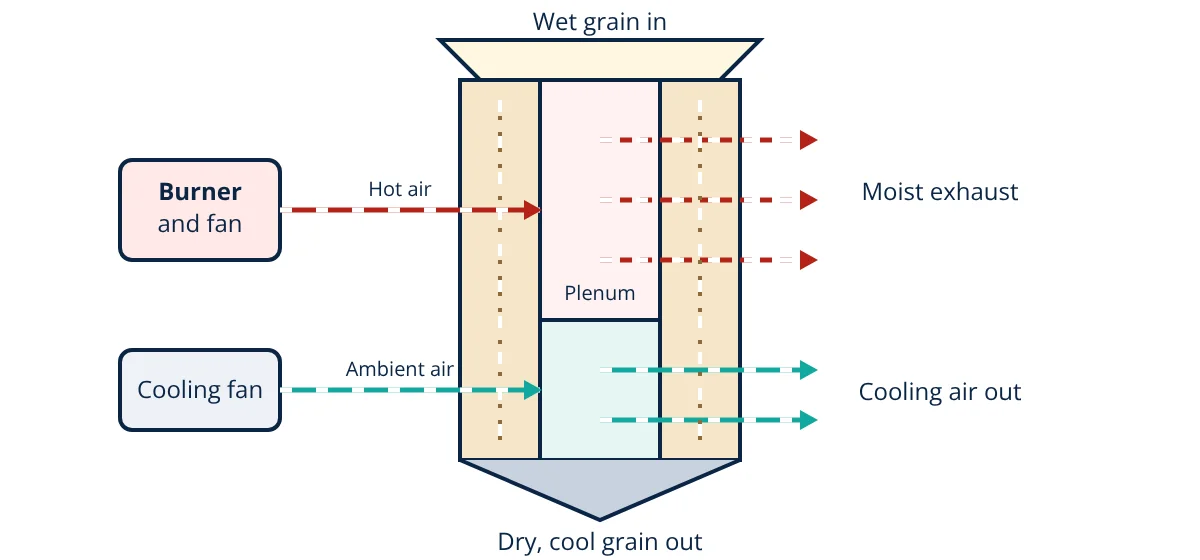
- Cross flow: air passes across grain columns; simple but drying is uneven across the column.
- Mixed flow: grain flows over alternating inlet and outlet air ducts; more uniform, gentle drying with better energy use.
- Counter flow: air flows upward against downward moving grain; efficient use of heat.
- Tower and column dryers for large elevators and grain terminals.
Energy and quality
Drying energy depends on water removed, air temperature, airflow, ambient conditions and heat recovery. Typical high temperature dryers use about 4 to 7 MJ per kg of water evaporated, compared with the latent heat of about 2.4 MJ/kg. Recirculating exhaust air, insulation, heat exchangers and controls that stop drying at the target moisture reduce consumption.
Quality depends on maximum grain temperature, drying rate and cooling. Tempering (resting grain between drying passes) lets moisture redistribute inside kernels and reduces cracking, which is critical for paddy rice.
- Given
- A farmer harvests 20 tonnes of maize at 22% moisture (wet basis) and must dry it to 14% for storage. The dryer uses 5 MJ per kg of water removed. Diesel has an energy content of about 36 MJ per litre and the burner efficiency is included in the dryer figure.
- Find
- The water to remove, final grain mass and diesel needed.
- Assumptions
- No dry matter losses; all energy from diesel.
- Solution
- Water removed = 20 000 × (22 − 14) ÷ (100 − 14) = 20 000 × 8 ÷ 86 = 1860 kg
Final mass = 20 000 − 1860 = 18 140 kg
Energy = 1860 × 5 = 9300 MJ
Diesel = 9300 ÷ 36 ≈ 258 litres - Answer
- About 1.86 t of water removed, leaving 18.1 t of dry maize, using roughly 260 litres of diesel
- Limitations
- Actual energy use varies with weather and dryer type; electricity for fans adds to the total.
Key formulas for grain drying
| Quantity | Formula | Symbols and units |
|---|---|---|
| Wet basis moisture | M_wb = m_w ÷ (m_w + m_d) × 100% | m_w = water mass, m_d = dry matter mass, both in kg |
| Water to remove | m_water = m_1 × (M_1 − M_2) ÷ (100 − M_2) | m_1 = initial grain mass in kg, M_1 and M_2 = initial and final moisture in % wet basis |
| Final grain mass | m_2 = m_1 − m_water | kg |
| Drying energy | E = m_water × specific energy | E in MJ, specific energy about 4 to 7 MJ per kg of water for high temperature dryers |
Measurement and control
Accurate moisture meters, regularly checked against oven tests, are essential. Continuous dryers use grain temperature sensors and online moisture sensors to adjust discharge rate automatically. In bins, temperature cables detect hot spots that signal spoilage. Good temperature measurement and airflow control protect quality and save energy.
Choosing grain drying methods
Small farms in sunny dry seasons can rely on improved sun or solar drying. Medium farms often use flat bed or recirculating batch dryers. Large farms and cooperatives use continuous flow and in-bin systems. Whatever the method, dry promptly after harvest, avoid overdrying, which wastes energy and lowers sale weight, cool grain before storage, and monitor stored grain. Dried grain then moves to storage or processing, and many products later pass through cold storage or food processing lines governed by HACCP principles.
Grain drying interview and viva questions
- What is equilibrium moisture content? It is the moisture content at which grain stops exchanging water with the surrounding air, and it depends on air temperature and relative humidity; drying works only when the air’s EMC is below the grain moisture.
- Why does heating the drying air increase drying capacity? Heating lowers the air’s relative humidity and therefore its EMC, so the air can take up more moisture from the grain.
- What is tempering and why is it used for paddy? Tempering rests grain between drying passes so moisture redistributes inside the kernels, which reduces stress cracks and broken rice during milling.
- How do cross flow and counter flow dryers differ? In a cross flow dryer air passes across the grain columns, which is simple but uneven, while in a counter flow dryer air moves upward against downward moving grain for efficient heat use.
- Why should grain not be overdried? Overdrying wastes energy and lowers the sale weight of the grain without improving storage safety beyond the target moisture.
Frequently asked questions
Why must grain be dried before storage?
Grain harvested at high moisture respires, heats and supports mould and insect growth, which reduces quality, can produce mycotoxins such as aflatoxin, and causes spoilage. Drying to a safe storage moisture, typically around 12 to 14% wet basis for cereals depending on temperature and storage period, slows these processes.
What is the difference between wet basis and dry basis moisture?
Wet basis moisture is the mass of water divided by the total mass of the wet grain; dry basis is water divided by the mass of dry matter only. Grain trade and storage use wet basis. For example, 20% wet basis equals 25% dry basis.
Why is high drying temperature bad for seed and rice?
Excessive temperature and rapid drying cause stress cracks in kernels, which leads to broken rice during milling, lower test weight, and reduced germination in seed. Seed is usually dried below about 40 to 43 °C and paddy is dried gently in stages with tempering periods.
References
- D. S. Jayas, N. D. G. White and W. E. Muir (eds.), Stored-Grain Ecosystems, Marcel Dekker
- C. W. Hall, Drying and Storage of Agricultural Crops, AVI Publishing
- ASABE D245.6, Moisture Relationships of Plant-Based Agricultural Products
- FAO, Grain Storage Techniques: Evolution and Trends in Developing Countries, Agricultural Services Bulletin 109
- K. J. Chua and S. K. Chou, Low-cost drying methods for developing countries, Trends in Food Science and Technology, 2003
Get one engineering email a week
New articles, worked examples and study notes every week. Free, no spam, unsubscribe any time.