Cold Storage Refrigeration Design Basics
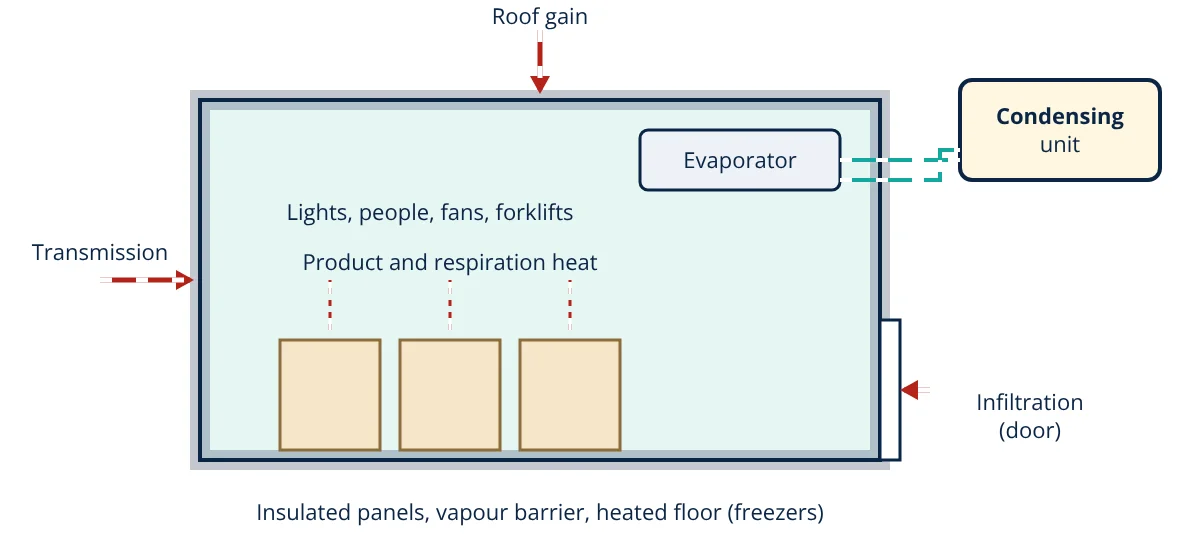
Cold storage is an insulated, refrigerated enclosure that holds perishable products at controlled low temperature and humidity to slow respiration, microbial growth and deterioration. Design sets storage conditions for the product, then sums transmission, product, respiration, infiltration and internal heat loads, and sizes a vapour compression refrigeration system to remove that heat with a safety margin.
Post-harvest losses of fruits and vegetables can be very large where cold chains are weak. Cold storage extends shelf life from days to weeks or months, stabilises prices and lets farmers sell when markets are favourable. It is also essential for frozen foods, dairy and vaccines. Good engineering design keeps product quality high while controlling energy use, which is the largest operating cost.
Storage conditions
| Product | Temperature | Relative humidity | Typical storage life |
|---|---|---|---|
| Apples | −1 to 4 °C | 90 to 95% | 3 to 8 months (longer in CA) |
| Potatoes (table) | 4 to 7 °C | 95 to 98% | 5 to 10 months |
| Onions | 0 °C | 65 to 70% | 6 to 8 months |
| Mangoes | 13 °C | 85 to 90% | 2 to 3 weeks |
| Bananas (green) | 13 to 14 °C | 90 to 95% | 1 to 4 weeks |
| Milk | 0 to 4 °C | n/a | 1 to 2 weeks |
| Frozen foods | −18 to −25 °C | n/a | Months |
Data from the USDA Agriculture Handbook 66 and ASHRAE. Chilling sensitive produce is damaged below its safe temperature even though it is above freezing. Ethylene producing products should not be stored with ethylene sensitive ones.
The insulated enclosure
Modern cold rooms use insulated sandwich panels with polyurethane (PUF) or PIR cores, typically 80 to 150 mm for chillers and 150 to 200 mm for freezers, with steel facings. Key details:
- Vapour barrier on the warm side to prevent moisture entering insulation and freezing.
- Floor insulation and underfloor heating in freezers to prevent ground frost heave.
- Insulated doors with strip curtains, air curtains or rapid roll doors, and anterooms to reduce infiltration.
- Pressure relief valves in freezers to prevent panel damage from pressure changes.
Refrigeration load calculation
The total load is the sum of several components:
Transmission through each surface:
Product cooling (sensible heat above freezing):
plus latent heat of freezing and sensible heat below freezing for frozen products. Respiration heat from live produce is taken from tables, often 10 to 100 W per tonne depending on product and temperature. Infiltration depends on door openings and air exchanges. Internal loads include lights, people, forklifts, evaporator fan motors and defrost heat. A safety factor of about 10% is commonly added, and the refrigeration plant is sized to remove the daily load in about 16 to 20 hours of running.
- Given
- A potato cold room holds 100 t of potatoes. Wall, roof and floor area is 600 m² with U = 0.25 W/m²K; outside 35 °C, inside 4 °C. Daily intake is 10 t of potatoes cooled from 25 °C to 4 °C within 24 hours (c_p = 3.6 kJ/kgK). Respiration heat is about 20 W per tonne at storage temperature. Infiltration and internal loads are estimated at 6 kW.
- Find
- The total refrigeration load and the plant capacity with a 10% safety factor and 20 hours of running per day.
- Assumptions
- Steady conditions; respiration of the daily intake included in the 100 t.
- Solution
- Transmission = 0.25 × 600 × 31 = 4650 W = 4.65 kW
Product = 10 000 × 3.6 × 21 ÷ 86 400 = 8.75 kW
Respiration = 100 × 20 = 2000 W = 2.0 kW
Infiltration and internal = 6.0 kW
Total = 21.4 kW; with 10% factor = 23.5 kW
Plant capacity = 23.5 × 24 ÷ 20 = 28.2 kW - Answer
- Average load about 23.5 kW; select refrigeration equipment of about 28 kW (about 8 TR)
- Limitations
- Detailed design uses hourly weather, door usage and product loading schedules; pull-down at initial loading may need more capacity.
Key formulas for cold storage
| Quantity | Formula | Symbols and units |
|---|---|---|
| Total refrigeration load | Q_total = Q_trans + Q_product + Q_resp + Q_infil + Q_internal | All terms in W or kW |
| Transmission gain | Q_trans = U × A × ΔT | U in W/m²K, A = surface area in m², ΔT = outside minus inside temperature in K |
| Product cooling | Q_product = m × c_p × ΔT ÷ t | m in kg, c_p in kJ/kgK, ΔT in K, t = cooling time in s, Q in kW |
| Respiration heat | Q_resp = product mass × respiration rate | Mass in t, rate in W per tonne (often 10 to 100 W/t) |
| Plant capacity | Q_plant = 1.1 × Q_total × 24 ÷ running hours | 10% safety factor, running time about 16 to 20 h per day |
Refrigeration system
Most cold stores use vapour compression refrigeration, explained in the vapour compression refrigeration cycle:
- Compressors: reciprocating, scroll or screw types.
- Condensers: air cooled, water cooled or evaporative.
- Expansion devices: thermostatic or electronic expansion valves.
- Evaporators (unit coolers): fans blow room air over finned coils. A small temperature difference between air and refrigerant (about 4 to 6 K for produce) keeps humidity high.
- Refrigerants: ammonia for large industrial plants, CO₂ in transcritical or cascade systems, and HFC or low GWP HFO blends in smaller units, chosen with safety standards such as ISO 5149.
- Defrost: electric, hot gas or water defrost removes ice from coils in rooms below about 2 °C.
Layout and product handling
A well planned cold store has a receiving area with weighbridge or scales, sorting and grading, pre-cooling, storage chambers sized for different products and temperatures, and a dispatch area, ideally with insulated loading docks and seals so trucks can load without exposing the room to outside air. Racking or crates stacked on pallets must leave gaps along walls and between stacks so air can circulate. Product temperature should be checked at receiving and before dispatch, and stock rotated on a first in, first out basis.
Controls and monitoring
Controllers maintain temperature with thermostats and pressure controls, schedule defrosts, and log data. Temperature and humidity sensors spread through the room, alarms for high temperature or power failure, and remote monitoring protect stock. Good temperature measurement and calibrated data loggers are required for food safety audits under HACCP principles.
Energy efficiency in cold storage
Insulation quality, door management, efficient compressors with variable speed drives, floating head pressure control, evaporative condensers, LED lighting, and heat recovery can cut energy use significantly. In rural areas, solar powered cold rooms with thermal storage (ice or phase change materials) support farmers without reliable grid power. Proper stacking with air gaps ensures cold air reaches all produce, and pre-cooling produce soon after harvest, for example in forced air pre-coolers, greatly improves storage life.
Cold storage interview and viva questions
- What are the main components of a cold storage refrigeration load? Transmission through walls, roof and floor, product cooling, respiration heat from live produce, air infiltration, and internal loads from lights, people, fans, forklifts and defrost.
- Why is a vapour barrier fitted on the warm side of the insulation? It prevents moisture from entering the insulation and freezing there, which would damage the panels and reduce their insulating value.
- Why do evaporators for produce use a small air to refrigerant temperature difference? A difference of about 4 to 6 K removes less moisture from the air as frost, so relative humidity stays high and produce loses less weight.
- Why is the plant sized to remove the daily load in 16 to 20 hours? Running for less than 24 hours leaves time for defrost and gives reserve capacity, which is why the daily load is divided by the running hours.
- Why are chilling sensitive crops stored above 10 °C? Crops such as bananas, mangoes and tomatoes are damaged below their safe temperature even though it is above freezing, so they are held at about 10 to 13 °C.
Frequently asked questions
What temperature should a cold store be kept at?
It depends on the product. Chilled stores for many fruits and vegetables run at about 0 to 4 °C, but chilling sensitive crops such as bananas, mangoes and tomatoes need about 10 to 13 °C. Potatoes are stored at about 2 to 4 °C for seed or 8 to 12 °C for processing. Frozen foods are typically held at −18 °C or colder.
Why is humidity important in cold storage?
Fresh produce is mostly water and loses weight and quality by transpiration if the air is too dry. Most fruits and vegetables keep best at about 85 to 95% relative humidity. Evaporators with large surface areas and small temperature differences help maintain high humidity by reducing moisture removed as frost.
What is controlled atmosphere storage?
Controlled atmosphere (CA) storage lowers oxygen and raises carbon dioxide in gas tight rooms, slowing respiration and ripening. Apples, for example, can be stored for many months in CA at around 1 to 3% oxygen. It requires gas tight construction, nitrogen generators or scrubbers and continuous gas monitoring.
References
- ASHRAE Handbook: Refrigeration, Chapters on Refrigerated Facilities and Commodity Storage Requirements, 2022
- USDA Agriculture Handbook 66, The Commercial Storage of Fruits, Vegetables, and Florist and Nursery Stocks, 2016
- W. F. Stoecker, Industrial Refrigeration Handbook, McGraw-Hill
- National Centre for Cold-chain Development (NCCD), Technical Standards and Protocol for the Cold-chain in India
- ISO 5149-1:2014, Refrigerating systems and heat pumps: Safety and environmental requirements
Get one engineering email a week
New articles, worked examples and study notes every week. Free, no spam, unsubscribe any time.