Modulation Techniques: AM, FM and Digital Modulation

Modulation techniques place information onto a high frequency carrier wave by varying its amplitude, frequency or phase. Analogue modulation includes AM (amplitude), FM (frequency) and PM (phase), used for radio broadcasting. Digital modulation maps bits to discrete carrier states: ASK, FSK, PSK and QAM, which combines amplitude and phase. Higher order schemes such as 256-QAM carry more bits per symbol but need a better signal to noise ratio.
Modulation is at the heart of every radio, TV, mobile phone, Wi-Fi router, satellite link and modem. It is the technique that lets many signals share the airwaves and travel long distances through noisy channels.
Why modulate?
- Antenna size: an efficient antenna is around a quarter wavelength long. A 3 kHz audio signal has a wavelength of 100 km; a 100 MHz carrier has 3 m.
- Frequency sharing: each station or channel uses its own carrier frequency, so many can coexist.
- Noise and range: suitable modulation improves resistance to noise and interference.
- Channel matching: the signal is shaped to fit the medium, whether radio, copper or optical fibre.
A carrier is a sine wave:
Modulation varies A_c, f_c or φ according to the message.
Analogue modulation
Amplitude modulation (AM)
The carrier amplitude follows the message signal. The modulation index m is the ratio of message peak to carrier peak and should stay at or below 1 to avoid distortion. A message with maximum frequency f_m produces two sidebands, so AM bandwidth is 2f_m. AM is simple to demodulate with an envelope detector but wastes power in the carrier and is sensitive to noise. It is used in medium wave and shortwave broadcasting and aviation radio. Variants such as single sideband (SSB) save bandwidth and power.
Frequency modulation (FM)
The carrier frequency shifts above and below its centre in proportion to the message amplitude, while the amplitude stays constant. The peak frequency shift is the deviation Δf. Bandwidth is estimated by Carson’s rule:
FM broadcast uses Δf = 75 kHz and audio up to 15 kHz, giving about 180 kHz, within the 200 kHz channel spacing. FM resists amplitude noise well and is used for FM radio, two way radio and older TV sound.
Phase modulation (PM)
The carrier phase varies with the message. PM and FM are closely related; PM is mainly important as the basis of digital phase shift keying.
Digital modulation
Digital schemes transmit symbols, each representing one or more bits. With M possible symbols, each carries log₂M bits.
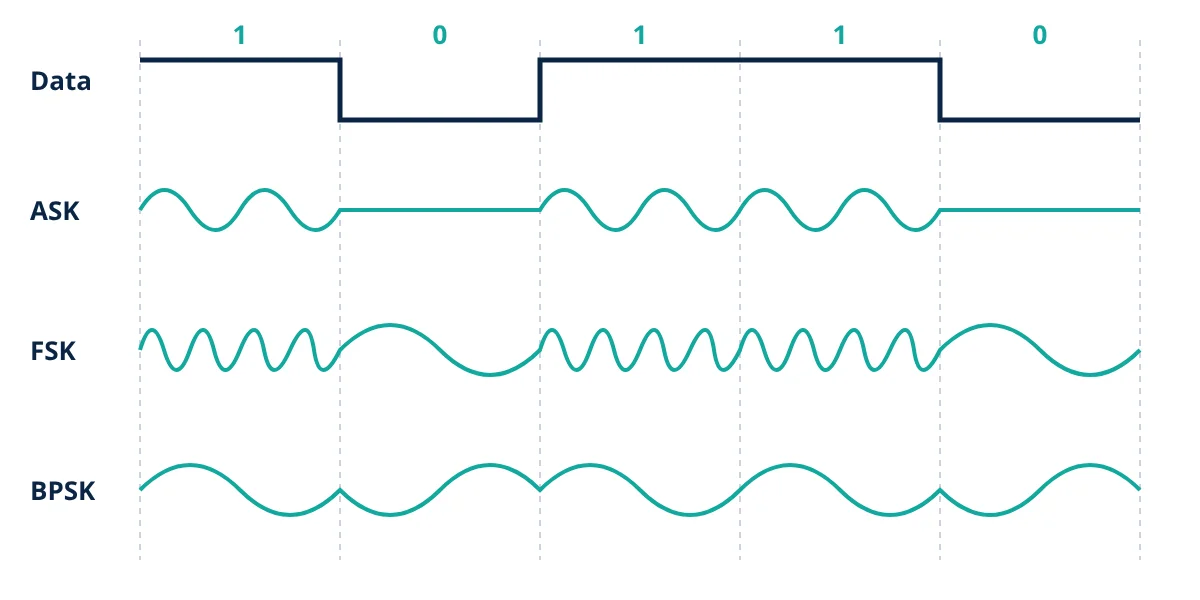
- ASK (amplitude shift keying): bits change the amplitude; on off keying (OOK) is the simplest form, used in optical fibre links and simple remote controls. Sensitive to noise.
- FSK (frequency shift keying): bits select between frequencies. Robust and simple; used in HART on 4 to 20 mA loops, Bluetooth (as GFSK) and many low power radios.
- PSK (phase shift keying): bits select the carrier phase. BPSK uses 2 phases (1 bit per symbol); QPSK uses 4 phases (2 bits). Very robust, used in satellite links and GPS.
- QAM (quadrature amplitude modulation): combines amplitude and phase on two carriers 90° apart. 16-QAM carries 4 bits per symbol, 64-QAM 6, 256-QAM 8, 1024-QAM 10 and 4096-QAM 12. Used in Wi-Fi, cable modems, DSL and 5G.
A constellation diagram plots each symbol as a point by its in-phase (I) and quadrature (Q) components. More points packed into the same space are closer together, so noise more easily pushes one into its neighbour, causing errors.
Modern systems use adaptive modulation: they switch between QPSK, 16-QAM, 64-QAM and higher orders as signal quality changes. OFDM splits data across many closely spaced subcarriers, each modulated with QAM, to cope with multipath reflections.
Comparison of digital schemes
| Scheme | Bits per symbol | Noise robustness | Typical use |
|---|---|---|---|
| BPSK | 1 | Very high | Satellites, GPS, weak signals |
| QPSK | 2 | High | Satellite TV, LTE and 5G control channels |
| 16-QAM | 4 | Medium | Mobile data, microwave links |
| 64-QAM | 6 | Lower | Wi-Fi, cable, LTE and 5G data |
| 256-QAM | 8 | Low | Wi-Fi 5, 5G, DOCSIS |
| 1024-QAM | 10 | Very low | Wi-Fi 6, DOCSIS 3.1 |
- Given
- A link transmits 2 million symbols per second (2 Mbaud). Compare QPSK and 64-QAM. Separately, an FM transmitter has deviation 5 kHz and maximum audio frequency 3 kHz.
- Find
- The bit rate for each digital scheme, and the FM bandwidth.
- Assumptions
- No coding overhead; Carson’s rule for FM.
- Solution
- QPSK: log₂4 = 2 bits per symbol; 2 × 2 = 4 Mbit/s
64-QAM: log₂64 = 6 bits per symbol; 2 × 6 = 12 Mbit/s
FM: B = 2(5 + 3) = 16 kHz - Answer
- QPSK gives 4 Mbit/s and 64-QAM gives 12 Mbit/s in the same bandwidth; the FM signal needs about 16 kHz
- Limitations
- 64-QAM needs a much higher signal to noise ratio than QPSK; error correction coding reduces the useful bit rate.
The Shannon limit
Shannon’s theorem sets the maximum error free capacity of a channel of bandwidth B with signal to noise ratio S/N:
Modern modulation and coding come within a fraction of a decibel of this limit. It explains why higher data rates need either more bandwidth or a cleaner signal.
Modulation techniques and noise
The quality of a digital link is measured by the bit error rate (BER), the fraction of bits received wrongly. BER depends on the energy per bit compared with the noise density, written Eb/N0. For a BER of one error in a million bits, BPSK and QPSK need about 10.5 dB, while 16-QAM needs roughly 14.5 dB and 64-QAM around 19 dB. Each step up in order therefore demands a stronger or cleaner signal. Forward error correction codes such as LDPC and turbo codes add redundant bits that let the receiver correct many errors, trading some throughput for a large gain in robustness.
Choosing a technique
Choose robust, low order schemes (BPSK, QPSK, FSK) for long range, low power or noisy links such as satellites, IoT sensors and industrial HART signals. Use high order QAM with OFDM where the signal is strong and spectrum is scarce, such as Wi-Fi, cellular data and cable networks. Modulation operates at the physical layer of the OSI model, beneath every protocol above it.
Frequently asked questions
Why is modulation needed?
Baseband signals such as audio or data have low frequencies that cannot be radiated efficiently by practical antennas, and many users would interfere if they all transmitted at the same frequencies. Modulation shifts the information onto a high frequency carrier, allowing small antennas, frequency sharing between many channels, and better noise performance.
Why does FM sound better than AM?
Most noise and interference changes a signal's amplitude. An FM receiver uses a limiter that removes amplitude variations and recovers information from frequency only, so much of the noise is rejected. FM broadcast also uses a wider bandwidth, which allows better audio fidelity, at the cost of using more spectrum.
What does 256-QAM mean?
It is quadrature amplitude modulation with 256 distinct symbols, each a unique combination of amplitude and phase. Since 2^8 = 256, each symbol carries 8 bits. Higher orders carry more bits per symbol but need a cleaner signal, so systems switch to lower orders when the signal to noise ratio falls.
References
- S. Haykin and M. Moher, Communication Systems, 5th ed., Wiley
- B. Sklar, Digital Communications: Fundamentals and Applications, 2nd ed., Prentice Hall
- J. G. Proakis and M. Salehi, Digital Communications, 5th ed., McGraw-Hill
- C. E. Shannon, A Mathematical Theory of Communication, Bell System Technical Journal, 1948
Get one engineering email a week
New articles, worked examples and study notes every week. Free, no spam, unsubscribe any time.