Thermoplastics vs Thermosets: Differences and Uses
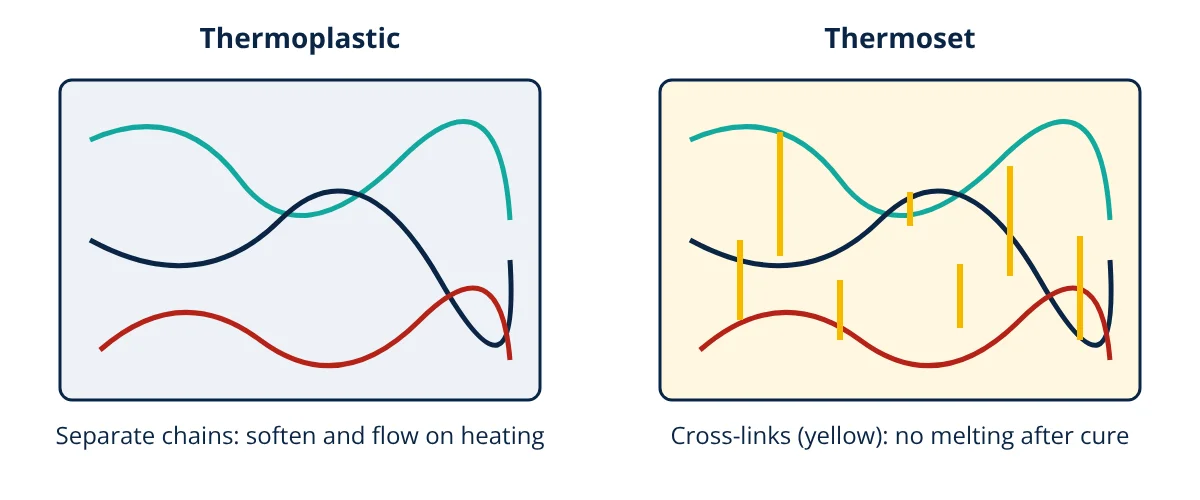
In thermoplastics vs thermosets, the key difference is molecular structure. Thermoplastics have long, separate polymer chains held by weak forces, so they soften when heated and harden when cooled, repeatedly. They can be remelted, reshaped and recycled; examples are polyethylene, polypropylene, PVC, nylon, PET and polycarbonate. Thermosets start as liquid resins or soft compounds that cure irreversibly into a cross-linked 3D network. Once cured, they do not melt, but char or decompose; examples are epoxy, phenolic, polyester and polyurethane foams. Thermosets offer better heat, creep and chemical resistance; thermoplastics offer toughness, fast processing and recyclability.
Plastics are everywhere in engineering, from pipes and cable insulation to car parts, circuit boards and aircraft structures. Choosing the right polymer family affects processing method, cost, performance at temperature, and what happens at end of life.
Molecular structure
Thermoplastics may be amorphous (chains randomly tangled, such as polycarbonate, PMMA and polystyrene, often transparent) or semi-crystalline (regions of ordered chains, such as polyethylene, polypropylene, nylon and PEEK, with better chemical and fatigue resistance). Their key temperatures are the glass transition temperature (Tg), where amorphous regions change from glassy to rubbery, and for semi-crystalline polymers, the melting temperature (Tm).
Thermosets are formed by a curing reaction, triggered by heat, catalysts, hardeners or UV light, that links chains together. Higher cross-link density gives higher stiffness, Tg and heat resistance but lower toughness.
Processing
Thermoplastics are supplied as pellets or sheets and processed by melting, shaping and cooling:
- Injection moulding for complex parts in high volume.
- Extrusion for pipes, profiles, films and cable insulation.
- Blow moulding for bottles and tanks; thermoforming for trays and panels.
- 3D printing, especially FDM, as in 3D printing technologies.
- Welding by hot plate, ultrasonic or laser methods; scrap can be reground.
Thermosets are shaped while still liquid or uncured, then cured in the mould:
- Compression and transfer moulding of phenolic and melamine compounds.
- Reaction injection moulding (RIM) of polyurethanes.
- Composite processes: hand lay-up, resin transfer moulding, filament winding, pultrusion and autoclave curing of prepregs for glass and carbon fibre parts.
- Casting and potting of epoxy and polyurethane for electronics and electrical insulation.
Cycle times for thermosets are usually longer because of curing, and scrap cannot be remelted.
Thermoplastics vs thermosets: comparison
| Feature | Thermoplastics | Thermosets |
|---|---|---|
| Structure | Linear or branched chains, no cross-links | Cross-linked 3D network |
| Effect of heat | Soften, melt; reversible | Do not melt; char or decompose |
| Processing | Melt, shape, cool; fast cycles | Shape then cure; slower |
| Recyclability | Can be remelted and recycled | Difficult; mostly downcycled |
| Heat resistance | Lower to medium (high for PEEK, PEI) | Generally higher |
| Creep resistance | Lower | Higher |
| Toughness and impact | Often high | Often lower, more brittle |
| Chemical resistance | Varies; some swell in solvents | Generally good |
| Weldability | Yes | No (bonded instead) |
| Examples | PE, PP, PVC, PET, ABS, PC, nylon, PEEK | Epoxy, phenolic, polyester, vinyl ester, melamine, PU foam |
Common examples and uses
Thermoplastics:
- Polyethylene (PE): pipes, tanks, films, cable insulation.
- Polypropylene (PP): car bumpers, containers, living hinges, chemical tanks.
- PVC: pipes, window frames, cable sheaths.
- Polyamide (nylon): gears, bearings, cable ties, fibres.
- Polycarbonate: safety glazing, lenses, housings.
- PEEK: aerospace, medical and high temperature parts.
Thermosets:
- Epoxy: adhesives, coatings, PCB laminates, carbon fibre composites.
- Phenolic: electrical switchgear parts, brake linings, heat resistant handles.
- Unsaturated polyester and vinyl ester: glass fibre boats, tanks, pipes, panels.
- Polyurethane: rigid insulation foams, flexible foams, coatings.
- Silicone rubber and vulcanised rubbers: seals, gaskets, hoses.
Temperature limits
A useful guide is the heat deflection temperature (HDT) or continuous use temperature. Many commodity thermoplastics are limited to roughly 60 to 100 °C, engineering thermoplastics to about 100 to 150 °C, and high performance ones such as PEEK to around 250 °C. Many thermosets maintain properties at 150 to 200 °C or more, and phenolics resist fire well.
Stiffness can be compared using the specific modulus E/ρ, as for other engineering materials:
- Given
- A housing for an electrical switch must survive a continuous 130 °C environment, resist arcing and flame, and hold metal contacts without creeping. Volume is 50 000 parts per year. Candidates: polypropylene (continuous use about 100 °C), nylon 66 with glass fibre (about 120 to 140 °C), and phenolic moulding compound (about 150 to 180 °C).
- Find
- A suitable material family.
- Assumptions
- Typical published continuous use temperatures; no recycling requirement.
- Solution
- Polypropylene: below the 130 °C requirement, reject
Glass filled nylon 66: close to the limit; creep at 130 °C under contact load is a concern
Phenolic: margin above 130 °C, excellent creep, arc and flame resistance, suitable for compression or transfer moulding at this volume - Answer
- A thermoset phenolic compound is the safest choice; a high temperature thermoplastic such as PPS or PBT-GF could be evaluated if recyclability matters
- Limitations
- Final selection needs data sheets, UL flammability ratings, prototype testing and cost comparison.
Design tips for plastic parts
Design rules differ from metals. Keep wall thickness uniform to avoid sink marks and warping in moulded thermoplastics, add ribs rather than thick sections for stiffness, use generous radii to reduce stress concentration, and allow draft angles for mould release. Remember that polymer properties depend strongly on temperature, time and humidity: long term loads cause creep, so design with creep modulus data rather than short term values.
Sustainability considerations
Thermoplastics are easier to recycle mechanically, though contamination, mixed grades and additives limit recycling in practice. Thermosets and their composites are hard to recycle, but they often have long service lives, such as wind turbine blades and pipes. Bio-based polymers, recycled content, design for disassembly and chemical recycling are growing areas, linked to circular economy principles.
Choosing between thermoplastics vs thermosets
Choose thermoplastics for high volume, fast moulding, toughness, weldability and recyclability. Choose thermosets for high temperature, dimensional stability under load, electrical and fire performance, and as matrices for high performance fibre composites. In many products both appear together, for example a thermoplastic housing around an epoxy potted circuit board.
Frequently asked questions
Can thermosets be recycled?
Not by remelting, because their cross-linked network does not melt. They can be ground and used as filler, burned for energy recovery, or treated by chemical or thermal processes such as pyrolysis to recover fibres from composites. New recyclable thermosets with reversible bonds (vitrimers) are being developed.
Is rubber a thermoplastic or a thermoset?
Conventional vulcanised rubber is a lightly cross-linked elastomer, so it behaves like a thermoset: it does not melt. Thermoplastic elastomers (TPEs), such as SEBS and TPU, behave rubbery at room temperature but can be melted and moulded like thermoplastics.
Which is stronger, a thermoplastic or a thermoset?
It depends on the specific polymers. Thermosets such as epoxies are generally stiffer, harder and more heat and creep resistant, which is why they are used as matrices in high performance composites. Engineering thermoplastics such as PEEK and polyamides can be tougher and more impact resistant.
References
- W. D. Callister Jr. and D. G. Rethwisch, Materials Science and Engineering: An Introduction, 10th ed., Wiley
- A. B. Strong, Plastics: Materials and Processing, 3rd ed., Pearson
- J. A. Brydson, Plastics Materials, 7th ed., Butterworth-Heinemann
- ISO 1043-1, Plastics: Symbols and abbreviated terms, Part 1: Basic polymers and their special characteristics
Get one engineering email a week
New articles, worked examples and study notes every week. Free, no spam, unsubscribe any time.