Database Normalization: 1NF, 2NF and 3NF Explained
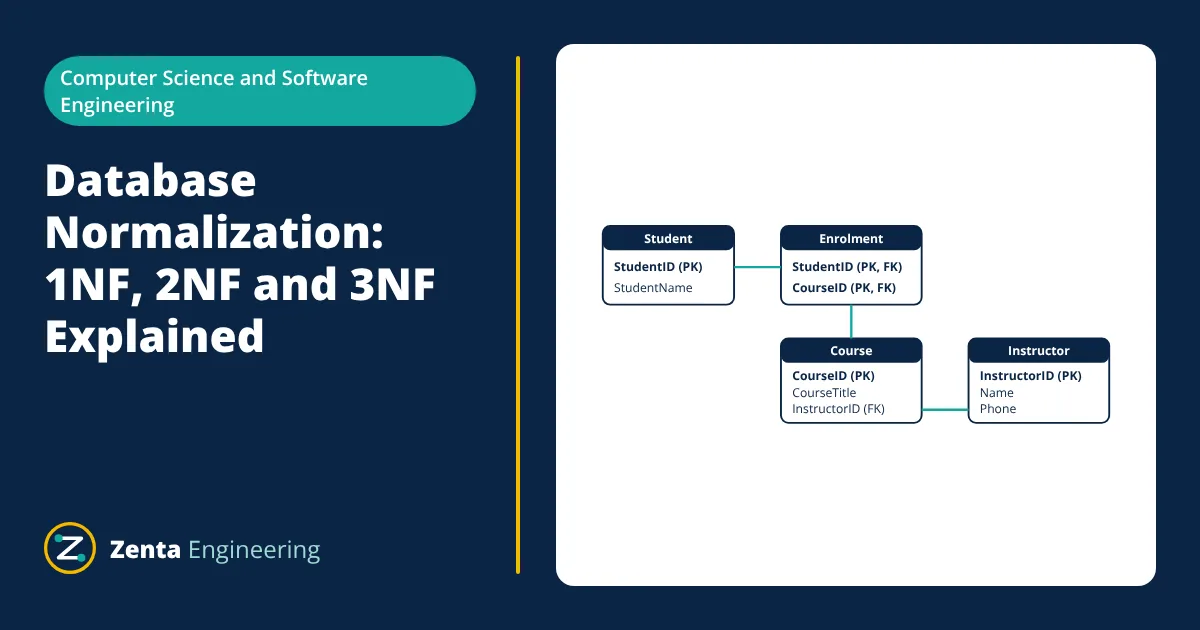
Database normalization organises relational tables so that each fact is stored in exactly one place. It removes redundancy and the update, insert and delete anomalies it causes. 1NF requires atomic values and no repeating groups. 2NF removes attributes that depend on only part of a composite key. 3NF removes attributes that depend on other non-key attributes. Most transactional databases are designed to 3NF or BCNF.
A relational database stores data in tables of rows and columns. Poor table design repeats the same information in many rows, so a single change must be made in many places and mistakes creep in. Normalization, introduced by Edgar Codd in the early 1970s, is a set of rules for splitting tables so that data stays consistent.
The problem: anomalies
Consider a single table for course enrolments:
| StudentID | StudentName | CourseID | CourseTitle | Instructor | InstructorPhone |
|---|---|---|---|---|---|
| 101 | Asha | CS201 | Data Structures | Rao | 4411 |
| 101 | Asha | CS205 | Databases | Mehta | 4420 |
| 102 | Vikram | CS201 | Data Structures | Rao | 4411 |
This design causes three anomalies:
- Update anomaly: if Rao’s phone changes, every row for CS201 must change; missing one leaves inconsistent data.
- Insertion anomaly: a new course cannot be recorded until a student enrols in it.
- Deletion anomaly: if Vikram and Asha drop CS201, the fact that Rao teaches it disappears.
Key concepts
- Functional dependency (X → Y): the value of X determines the value of Y. CourseID → CourseTitle means each course ID has exactly one title.
- Candidate key: a minimal set of attributes that uniquely identifies a row. One is chosen as the primary key.
- Composite key: a key made of more than one attribute, such as (StudentID, CourseID).
- Prime attribute: an attribute that is part of some candidate key.
- Partial dependency: a non-prime attribute depends on part of a composite key.
- Transitive dependency: a non-prime attribute depends on another non-prime attribute, which depends on the key.
First normal form (1NF)
A table is in 1NF when:
- Every column holds atomic (indivisible) values, not lists or sets.
- There are no repeating groups of columns such as Course1, Course2, Course3.
- Each row is unique, identified by a key.
A row storing “CS201, CS205” in one Courses column violates 1NF. The fix is one row per student and course, as in the table above, with key (StudentID, CourseID).
Second normal form (2NF)
A table is in 2NF when it is in 1NF and every non-prime attribute depends on the whole of every candidate key, not just part of it. 2NF only matters for tables with composite keys.
In the enrolment table, StudentName depends only on StudentID, and CourseTitle, Instructor and InstructorPhone depend only on CourseID. These partial dependencies are removed by splitting into Student, Course and Enrolment tables.
Third normal form (3NF)
A table is in 3NF when it is in 2NF and no non-prime attribute depends transitively on the key; that is, non-key attributes depend on the key, the whole key and nothing but the key.
In the Course table, CourseID → Instructor and Instructor → InstructorPhone, so the phone depends on the key only through Instructor. Moving instructors to their own table removes this transitive dependency.
Boyce-Codd normal form (BCNF) and beyond
BCNF strengthens 3NF: for every non-trivial functional dependency X → Y, X must be a superkey. It handles rare cases with overlapping candidate keys that 3NF allows. 4NF deals with multivalued dependencies, and 5NF with join dependencies; they matter in specialised designs.
- Given
- The original enrolment table with functional dependencies StudentID → StudentName; CourseID → CourseTitle, Instructor; Instructor → InstructorPhone.
- Find
- A 3NF design and how it fixes the update anomaly.
- Assumptions
- Each course has one instructor; each instructor has one phone; instructor names are replaced by an InstructorID key.
- Solution
- 1NF: one row per (StudentID, CourseID); already satisfied
2NF: remove partial dependencies into Student(StudentID, StudentName) and Course(CourseID, CourseTitle, InstructorID), keeping Enrolment(StudentID, CourseID)
3NF: remove the transitive dependency into Instructor(InstructorID, Name, Phone) - Answer
- Four tables: Student, Enrolment, Course and Instructor. Rao’s phone is now stored once, so changing it is a single row update
- Limitations
- Queries that need all the details must now join tables; indexes on the key columns keep those joins fast.
Normalization and keys in SQL
In SQL, each normalized table becomes a CREATE TABLE statement with a PRIMARY KEY, and each relationship becomes a FOREIGN KEY constraint that references the parent table. The database then refuses an enrolment for a course that does not exist, or the deletion of a course that still has enrolments, unless a cascade rule says otherwise. This makes the design rules enforceable rather than just documented.
Denormalization: when to break the rules
Joins have a cost. Reporting databases, data warehouses (star schemas) and caches often store repeated data on purpose to answer queries faster. The usual approach is to design a normalized source of truth first and denormalize copies for specific read patterns, accepting the extra work to keep them in sync.
Database normalization tips in practice
- Identify entities (things) and their relationships before creating tables.
- Give every table a primary key and declare foreign keys so the database enforces integrity.
- Use surrogate keys (such as an auto-incrementing ID) where natural keys may change.
- Index foreign key columns used in joins, keeping Big O costs of lookups low.
- Name tables and columns consistently, and document the meaning and units of each column.
- Use constraints (NOT NULL, UNIQUE, CHECK) so the database rejects invalid data instead of relying on application code alone.
- Review the design whenever a new requirement adds attributes: ask which entity each new attribute really describes, and place it there.
- Test schema changes and queries with realistic data as part of software testing.
Databases normally sit behind an application layer that exposes data through a REST API, and good normalization makes that API simpler because each resource maps to clean, consistent tables. The way rows are stored and scanned in memory links back to arrays vs linked lists.
Frequently asked questions
Why do we normalize a database?
To store each fact once. This prevents update, insertion and deletion anomalies, keeps data consistent, and reduces storage of repeated values. A normalized design is also easier to change as requirements grow.
Is a higher normal form always better?
Not always. Third normal form or BCNF is the usual target for transactional systems. Read-heavy reporting systems and data warehouses often denormalize deliberately, storing some repeated data to avoid many joins and speed up queries.
What is the difference between 3NF and BCNF?
In 3NF, every non-key attribute must depend only on keys, but a dependency whose left side is not a key is still allowed if its right side is part of some candidate key. BCNF removes that exception: the left side of every non-trivial functional dependency must be a superkey. Most 3NF tables are already in BCNF.
References
- E. F. Codd, A Relational Model of Data for Large Shared Data Banks, Communications of the ACM, 1970
- R. Elmasri and S. B. Navathe, Fundamentals of Database Systems, 7th ed., Pearson
- A. Silberschatz, H. F. Korth and S. Sudarshan, Database System Concepts, 7th ed., McGraw-Hill
- C. J. Date, An Introduction to Database Systems, 8th ed., Pearson
Get one engineering email a week
New articles, worked examples and study notes every week. Free, no spam, unsubscribe any time.

