Infusion Pump Working Principle and Types
An infusion pump is a medical device that delivers fluids, drugs or nutrients into a patient at a controlled flow rate. It works by positive displacement: a motor drives either peristaltic fingers that squeeze an administration set or a lead screw that pushes a syringe plunger, while sensors detect occlusion and air and trigger alarms.
An infusion pump replaces the guesswork of a gravity drip with a motor driven mechanism that moves a known volume of fluid for every step of the motor. Hospitals use infusion pumps for intravenous fluids, antibiotics, anaesthetic drugs, chemotherapy, insulin, pain relief and enteral feeding. For an engineer, the device combines a precise mechanical drive, pressure and air sensors, embedded software and a strict safety standard, IEC 60601-2-24, in one bedside unit.
Why an infusion pump is needed
In a gravity infusion, flow depends on the height of the bag above the patient, the resistance of the tubing and cannula, and the patient’s venous pressure. Any change in these alters the flow, and a roller clamp only sets it approximately. Webster’s Medical Instrumentation describes how infusion devices developed to give controlled delivery that does not depend on these variables.
Two device groups are defined in IEC 60601-2-24:
- Infusion controllers still use gravity as the driving force but regulate the flow, usually by counting drops and adjusting a clamp.
- Infusion pumps generate positive pressure themselves, so they can deliver a set rate against resistance.
Almost all modern hospital devices are pumps. In the United States an infusion pump is regulated as a Class II device under 21 CFR 880.5725, and its risk class under other systems is discussed in medical device classification.
Infusion pump working principle
Every infusion pump is a positive displacement machine. Unlike a centrifugal pump, which adds velocity and pressure to a fluid, a positive displacement pump traps a fixed volume and pushes it forward. The flow rate therefore depends on how fast the mechanism moves, not on the downstream pressure, as long as that pressure stays below the pump’s occlusion limit.
Peristaltic (volumetric) pumps
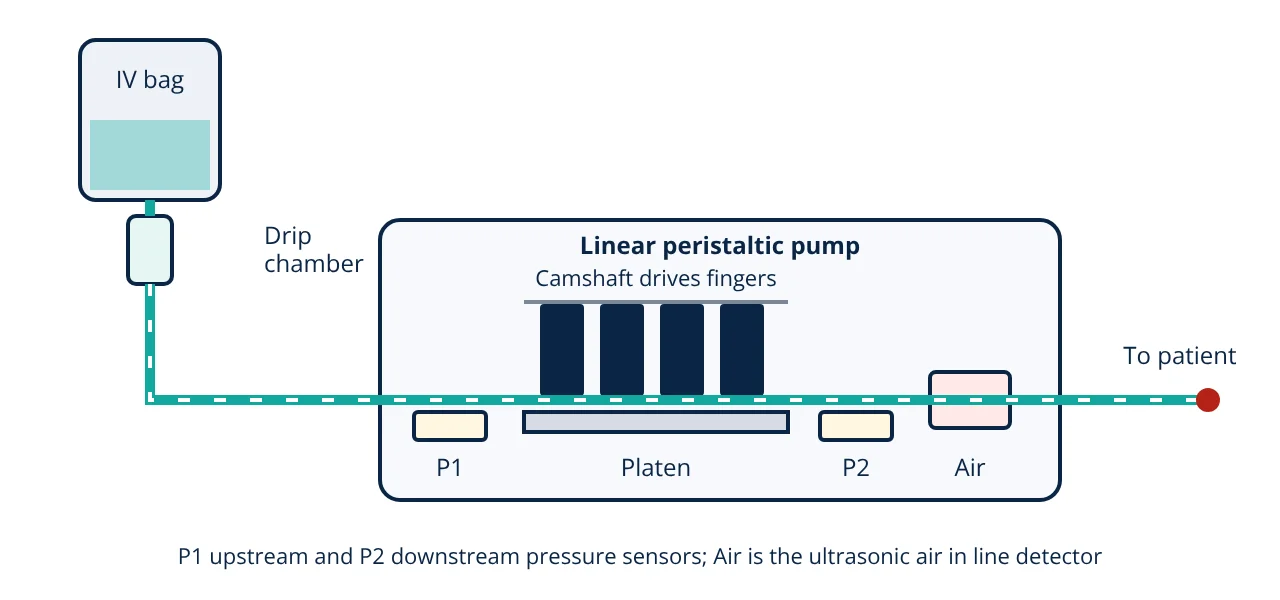
A volumetric pump uses a dedicated administration set with a pumping segment of flexible tubing. In a linear peristaltic design, a motor turns a camshaft that drives a row of fingers. The fingers press the tube against a fixed platen one after another, so at least one finger always seals the tube. The sealed pocket moves downstream like a wave, which prevents free flow and pushes a fixed volume on each cycle. A rotary peristaltic design does the same with rollers on a rotor squeezing a curved length of tube.
The volume per cycle depends on the internal diameter and elasticity of the tubing, which is why MHRA guidance stresses using only the administration sets specified for each pump.
Syringe pumps
A syringe pump holds a standard syringe in a clamp. A stepper motor turns a lead screw, and a half nut on the screw moves a pusher block that drives the plunger. The volume delivered is the plunger travel multiplied by the internal cross sectional area of the barrel. Because the pump must know that area, the user selects the syringe brand and size, or the pump identifies it. Syringe pumps suit small volumes and low rates, such as neonatal care and potent drugs, where smooth delivery matters. The choice of motor and drive is similar to the trade offs in servo vs stepper motors.
Operation step by step
- Prime and load: the set or syringe is primed to remove air, then loaded so the pumping segment or plunger is held in the mechanism. A free flow clamp stops uncontrolled flow when the door opens.
- Programme: the user enters rate, volume to be infused (VTBI) or a dose. Smart pumps check the entry against a drug library.
- Deliver: the controller sets the motor speed to give the required volume per hour, using the calibration for the set or syringe.
- Monitor: pressure sensors watch for occlusion, an air in line detector watches for bubbles, and the pump checks door, battery and end of infusion.
- Alarm and stop: on a fault the pump stops delivery and alarms. Some pumps relieve the downstream pressure after an occlusion so that a bolus is not pushed into the patient when the blockage clears.
Sensors, alarms and accuracy
- Downstream occlusion: a pressure sensor on the line after the pump detects a kinked line or blocked cannula. Many pumps allow the threshold to be set, and a lower threshold gives faster detection.
- Upstream occlusion: a sensor before the pump detects a closed clamp or empty container.
- Air in line: an ultrasonic sensor across the tube detects bubbles because air transmits ultrasound far worse than liquid.
- Syringe sensors: detect plunger position, syringe size and a near empty syringe.
IEC 60601-2-24:2012 specifies how accuracy is tested. Fluid output is weighed on a balance over time, and errors are plotted as a trumpet curve: maximum and minimum percentage flow error against observation windows from 2 to 31 minutes. Short windows show larger errors, which matter for drugs with short half lives. A start up curve shows how long the pump takes to reach the set rate. MHRA guidance notes that siphoning and head height changes can also alter delivery from syringe pumps, so the syringe should be secured and the pump kept near the patient’s level.
The FDA’s Infusion Pump Improvement Initiative of 2010 reported about 56,000 adverse event reports linked to infusion pumps from 2005 to 2009, and identified software defects, user interface problems and mechanical or electrical failures among the causes. That work led to stronger design and premarket requirements.
Types of infusion pumps
| Type | Mechanism | Typical use |
|---|---|---|
| Volumetric (large volume) | Linear or rotary peristaltic | IV fluids, antibiotics, blood products |
| Syringe pump | Lead screw on syringe plunger | Low rates, small volumes, neonatal and anaesthesia |
| PCA pump | Syringe or cassette with patient button and lockout | Patient controlled pain relief |
| Ambulatory pump | Small battery cassette or peristaltic | Home therapy, chemotherapy |
| Insulin pump | Miniature syringe drive | Continuous subcutaneous insulin |
| Enteral feeding pump | Rotary peristaltic | Nutrition through a feeding tube |
| Elastomeric device | Stretched balloon and flow restrictor, no motor | Disposable ambulatory infusion |
Equations for infusion pump flow
The basic relation is the volumetric flow rate:
For a syringe pump, the flow equals barrel area times plunger speed:
With a lead screw of pitch p and a stepper motor of N steps per revolution, the plunger speed sets the step rate:
- Given
- A syringe pump delivers 5 mL/h from a 50 mL syringe with an internal barrel diameter of 26.6 mm. The lead screw pitch is 1 mm and the stepper motor has 200 full steps per revolution.
- Find
- Plunger speed, motor step rate and time to empty a full syringe.
- Assumptions
- Rigid syringe, no slack, full steps, no back pressure effects. The diameter is an illustrative value; real barrels vary by brand.
- Solution
- A = π × 26.6² ÷ 4 = 555.7 mm²
Q = 5 mL/h = 5000 mm³/h
v = Q ÷ A = 5000 ÷ 555.7 = 9.0 mm/h
f = 9.0 × 200 ÷ 1 = 1799 steps per hour, about 0.5 steps per second
t = V ÷ Q = 50 ÷ 5 = 10 h - Answer
- The plunger moves about 9.0 mm/h, the motor takes about 1800 full steps per hour, and the syringe empties in 10 h.
- Limitations
- With only one step every two seconds, flow would arrive in small pulses, so real designs add gearing or microstepping. Start up slack and syringe compliance delay the steady rate, as shown by the IEC start up curve.
Key formulas for infusion pump flow
| Quantity | Formula | Symbols and units |
|---|---|---|
| Flow rate | Q = V ÷ t | V = volume in mL, t = time in h, Q in mL/h |
| Infusion time | t = V ÷ Q | t in h |
| Syringe barrel area | A = π d² ÷ 4 | d = internal diameter in mm, A in mm² |
| Syringe flow | Q = A × v | v = plunger speed in mm/h, 1 mL = 1000 mm³ |
| Motor step rate | f = v × N ÷ p | N = steps per revolution, p = lead screw pitch in mm |
| Flow error | e = (Q_measured − Q_set) ÷ Q_set × 100 | e in percent |
Advantages and limitations
Advantages: set rates largely independent of venous pressure and bag height, alarms for occlusion, air and end of infusion, event logs, and drug libraries that reduce programming errors.
Limitations: dependence on correct sets and syringes, start up delay at low rates, risk of programming error, occlusion alarms that take time at low rates because pressure builds slowly, and the need for regular preventive maintenance and accuracy testing by clinical engineering teams.
Infusion pump interview and viva questions
- Why is an infusion pump called a positive displacement device? It traps a fixed volume of fluid, in a tube pocket or a syringe barrel, and pushes it forward, so flow is set by mechanism speed rather than by pressure.
- How does a linear peristaltic pump prevent free flow? At least one finger always seals the tube against the platen, so fluid can only move when the fingers advance.
- What is a trumpet curve? It is the IEC 60601-2-24 plot of maximum and minimum flow error against observation window length, showing short term accuracy.
- Why must a syringe pump know the syringe brand and size? Flow equals barrel area times plunger speed, and the internal diameter differs between brands and sizes.
- Why can occlusion detection be slow at low rates? Downstream pressure rises only as fast as the pump pushes fluid into the blocked line, so reaching the alarm threshold takes longer at low flow.
Related reading
Frequently asked questions
What is the difference between an infusion pump and a gravity drip?
A gravity drip relies on the height of the bag above the patient and a roller clamp, so its flow changes with venous pressure, bag height and tubing. An infusion pump is a positive displacement device driven by a motor, so it delivers a set volume per hour and raises an alarm when it cannot, for example on occlusion or air in the line.
Why do syringe pumps take time to reach the set flow at very low rates?
At start up the drive must take up mechanical slack in the lead screw, the plunger seal and the syringe barrel before fluid moves at the steady rate. At very low rates this compliance takes a long time to overcome. IEC 60601-2-24 therefore includes a start up curve in its accuracy tests, and guidance from the MHRA advises priming the line with the pump to reduce the delay.
What is a smart pump?
A smart pump is an infusion pump with dose error reduction software. It holds a drug library with limits for each drug and care area, and warns the user or blocks programming when an entered rate or dose falls outside those limits. The FDA Infusion Pump Improvement Initiative identified programming errors as a major source of reported problems, which is the hazard this feature targets.
References
- IEC 60601-2-24:2012 Medical electrical equipment, Part 2-24: Particular requirements for the basic safety and essential performance of infusion pumps and controllers
- U.S. Food and Drug Administration, Infusion Pump Improvement Initiative (white paper), Center for Devices and Radiological Health, April 2010
- U.S. Code of Federal Regulations, 21 CFR 880.5725 Infusion pump
- Medicines and Healthcare products Regulatory Agency (MHRA), Infusion systems, Device Bulletin DB 2003(02), version 2.0, 2013
- J. G. Webster (ed.), Medical Instrumentation: Application and Design, 4th ed., Wiley, 2010
- J. D. Bronzino and D. R. Peterson (eds.), The Biomedical Engineering Handbook, 4th ed., Medical Devices and Human Engineering, CRC Press, 2015
Get one engineering email a week
New articles, worked examples and study notes every week. Free, no spam, unsubscribe any time.