Medical Device Classification and Regulation Basics
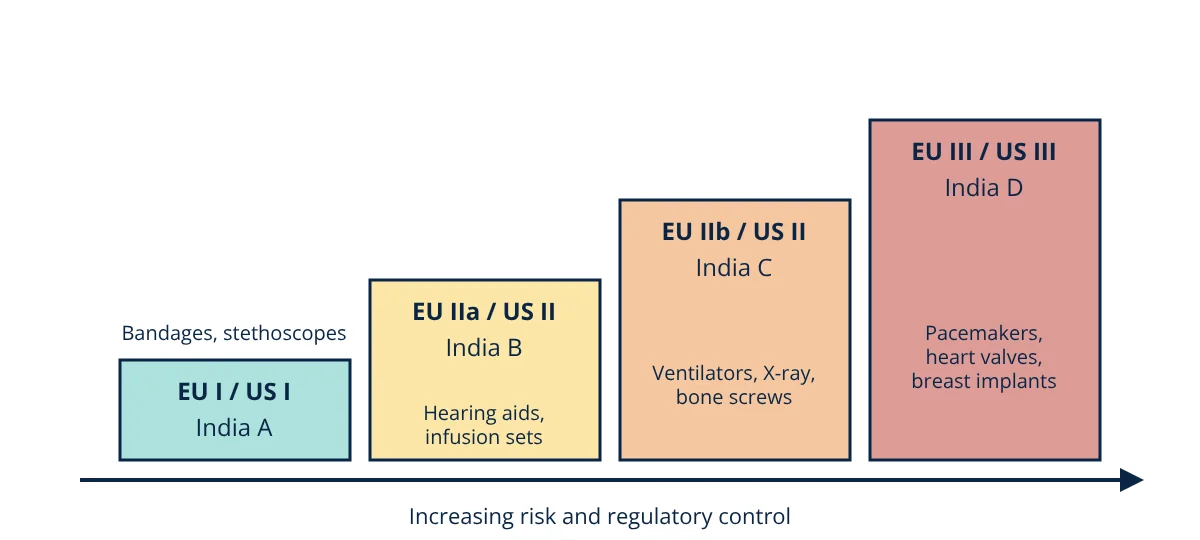
Medical device classification groups devices by risk to patients and users, which decides how strictly they are regulated before and after sale. The EU MDR uses Class I, IIa, IIb and III; the US FDA uses Class I, II and III; and India’s Medical Devices Rules 2017 use Class A, B, C and D, all rising in risk. Classification depends on intended purpose, duration of contact, invasiveness, whether the device is active or implantable, and the body part affected. Higher classes need more evidence, such as clinical data and third party review by a notified body or regulator, under quality systems such as ISO 13485 and risk management to ISO 14971.
Medical devices range from tongue depressors and bandages to pacemakers, MRI scanners, insulin pumps and diagnostic software. Regulating them all identically would either leave high risk devices under-controlled or bury simple products in paperwork. Risk based classification solves this, and it is the first regulatory decision any device developer must make, because it determines the whole route to market.
What counts as a medical device
A medical device is any instrument, apparatus, software, implant, material or other article intended by the manufacturer for a medical purpose, such as diagnosis, prevention, monitoring, treatment or alleviation of disease or injury, or for investigating or replacing anatomy or a physiological process, and which does not achieve its main effect by pharmacological, immunological or metabolic means (which would make it a drug). The intended purpose, as stated in labelling and marketing, is central.
Classification systems compared
| Risk | EU MDR | US FDA | India MDR 2017 | Typical examples |
|---|---|---|---|---|
| Low | Class I (incl. Is sterile, Im measuring, Ir reusable surgical) | Class I (often exempt from 510(k)) | Class A | Bandages, tongue depressors, wheelchairs |
| Low to moderate | Class IIa | Class II | Class B | Hearing aids, short term catheters, dental fillings |
| Moderate to high | Class IIb | Class II (some III) | Class C | Ventilators, infusion pumps, long term implants like bone screws |
| High | Class III | Class III | Class D | Pacemakers, heart valves, drug eluting stents |
In vitro diagnostic devices (IVDs), such as blood glucose meters and test kits, have separate rules, for example the EU IVDR with Classes A to D.
How medical device classification works in the EU
The EU MDR Annex VIII contains 22 rules grouped by device type:
- Non-invasive devices (Rules 1 to 4): mostly Class I unless they channel or store fluids for infusion, modify blood, or contact injured skin.
- Invasive devices (Rules 5 to 8): depends on whether invasion is through a body orifice or surgical, and on duration: transient (under 60 minutes), short term (60 minutes to 30 days) or long term (over 30 days). Implantable and long term devices are generally IIb or III; devices in contact with the heart, central circulatory system or central nervous system are Class III.
- Active devices (Rules 9 to 13): therapeutic devices delivering energy (IIa, IIb if potentially hazardous), diagnostic and monitoring devices, and software (Rule 11).
- Special rules (Rules 14 to 22): devices incorporating medicines, contraception, disinfection, nanomaterials, devices made with animal tissues, and others.
When several rules apply, the highest class applies.
United States
The FDA classifies devices into about 1700 generic types in 21 CFR. Routes to market:
- Class I: general controls; most are exempt from premarket notification.
- Class II: general and special controls; usually a 510(k) showing substantial equivalence to a legally marketed predicate device.
- Class III: premarket approval (PMA) with clinical evidence of safety and effectiveness.
- De Novo pathway for novel low to moderate risk devices with no predicate.
India
Under the Medical Devices Rules 2017, administered by CDSCO, devices are Classes A to D. Class A and B manufacturing licences are granted by state licensing authorities, while Classes C and D are licensed centrally, with notified bodies auditing quality systems for lower classes. Classification lists for each device category are published by CDSCO.
Conformity assessment and requirements
Higher classes need more:
- Quality management system to ISO 13485, including design controls.
- Risk management to ISO 14971, identifying hazards, estimating and controlling risks and monitoring after sale. Tools such as FMEA are widely used.
- Technical documentation: design, verification and validation, labelling.
- Electrical safety and EMC to the IEC 60601 series for medical electrical equipment, and IEC 62304 for software life cycle.
- Biocompatibility to ISO 10993 for materials contacting the body, see biomaterials.
- Clinical evaluation with clinical data, especially for Class IIb and III.
- Notified body or regulator review for all but the lowest classes.
- Post-market surveillance, vigilance reporting and periodic safety updates.
- Given
- Four products under the EU MDR: (A) a reusable stethoscope; (B) a single use hypodermic needle; (C) a hip joint replacement; (D) a standalone app that analyses smartphone camera images of skin lesions and indicates melanoma risk to guide referral decisions.
- Find
- The likely EU class of each.
- Assumptions
- Typical intended purposes; final classification requires checking all rules and guidance.
- Solution
- A: non-invasive, no special function: Rule 1, Class I
B: surgically invasive, transient use: Rule 6, Class IIa
C: implantable, long term, total joint replacement: Rule 8 places joint replacements in Class III
D: software providing information used for diagnostic decisions, where a wrong result could lead to serious deterioration: Rule 11, at least Class IIb - Answer
- Stethoscope Class I, hypodermic needle Class IIa, hip replacement Class III, melanoma app Class IIb or higher
- Limitations
- Intended purpose wording, MDCG guidance and borderline cases can change the class; consult the regulation and a notified body.
Practical tips for engineers
Define the intended purpose and indications precisely early in design, since changing them later can change the class. Build regulatory requirements into the design process from the start, keep a living risk management file, plan clinical evidence needs, and design for usability (IEC 62366), because many incidents come from use errors. Choosing a slightly narrower intended purpose can sometimes lower the class and shorten time to market, but claims must then match the labelling. Medical device classification is not paperwork at the end of a project: it shapes the whole development, from biopotential measurement front ends to prosthetic limbs and imaging systems.
Frequently asked questions
What decides a medical device's risk class?
Mainly the intended purpose and the risk to patients and users: how long the device is in contact with the body, whether it is invasive or implantable, whether it is active (powered), which organs it affects (for example the heart or central nervous system), and whether it delivers energy or medicines. Regulations set out rules that map these features to classes.
Is software a medical device?
Software is a medical device (SaMD) when its intended purpose is medical, such as diagnosing, monitoring or deciding treatment, without being part of hardware. For example, an app that analyses ECG data to detect atrial fibrillation is regulated, while a general fitness tracker app usually is not. Under the EU MDR, Rule 11 often places such software in Class IIa or higher.
What is ISO 13485?
ISO 13485 is the international quality management system standard for medical device manufacturers. It covers design control, risk management, supplier control, production, traceability, complaint handling and corrective actions. Certification to ISO 13485 is a central part of regulatory compliance in the EU, Canada, India and many other markets, and the US FDA's QMSR aligns with it.
References
- Regulation (EU) 2017/745 on medical devices (MDR), Annex VIII Classification Rules
- U.S. FDA, 21 CFR Parts 860 to 892 Device Classification, and 21 CFR Part 820 Quality Management System Regulation
- Medical Devices Rules, 2017, Central Drugs Standard Control Organisation (CDSCO), India
- ISO 13485:2016, Medical devices: Quality management systems, Requirements for regulatory purposes
- ISO 14971:2019, Medical devices: Application of risk management to medical devices
- IMDRF, Principles of Medical Devices Classification, GHTF/SG1/N77:2012
Get one engineering email a week
New articles, worked examples and study notes every week. Free, no spam, unsubscribe any time.