How Prosthetic Limbs Work: Body-Powered vs Myoelectric
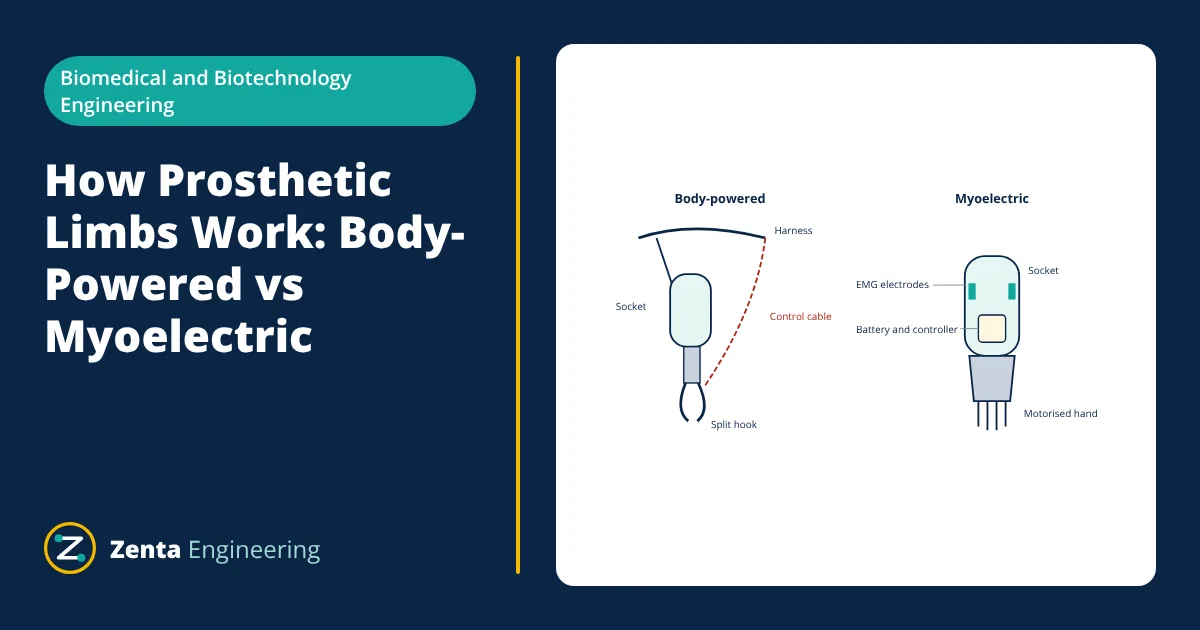
Prosthetic limbs replace missing arms or legs. Every prosthesis has a socket that fits the residual limb, a suspension system that holds it on, structural components (pylons, joints) and a terminal device (hand, hook or foot). Upper limb prostheses are mainly body-powered, where a harness and cable transfer shoulder movement to open or close a hook or hand, or myoelectric, where EMG sensors detect residual muscle signals that control battery powered motors. Lower limb prostheses use mechanical, hydraulic or microprocessor knees and energy storing feet. The best choice depends on amputation level, function needed, lifestyle, environment and cost.
Millions of people live with limb loss from trauma, vascular disease, diabetes, cancer or congenital differences. Modern prosthetics combine biomechanics, materials science, electronics and clinical care to restore mobility and independence. The field has advanced from wooden legs and hooks to carbon fibre feet, computer controlled knees and multi-articulating bionic hands.
Common components
- Socket: custom moulded interface between residual limb and prosthesis, often laminated carbon fibre or thermoplastic, with a soft liner. Socket fit is the single most important factor in comfort and use.
- Suspension: straps and harnesses, suction or vacuum sockets, pin lock liners or anatomical suspension over bony contours.
- Pylon and connectors: tubes and pyramid adapters that set length and alignment.
- Joints: wrist, elbow, knee and ankle units.
- Terminal device: hook, hand, specialised tools or foot.
- Cosmetic cover if desired.
Materials such as titanium, aluminium and carbon composites keep weight low, and the socket liner materials must be skin compatible, as discussed in biomaterials.
Upper limb prostheses
Body-powered prostheses
A figure of eight harness across the shoulders anchors a Bowden cable that runs to the terminal device. When the user moves the shoulders apart or flexes the shoulder, the cable pulls and opens (voluntary opening) or closes (voluntary closing) the hook or hand, which returns under spring or rubber band force. For above elbow users, the same cable can also flex the elbow.
- Strengths: durable, simple, lightweight, relatively low cost, tolerant of water, dust and heavy work, and gives proprioceptive feedback through cable tension.
- Limitations: harness can be uncomfortable, limited grip force, working envelope limited by body movement, less natural appearance.
Myoelectric prostheses
Surface electrodes in the socket pick up EMG signals from residual muscles, using the same principles as biopotential measurement. The controller amplifies, filters and rectifies the signal to obtain an envelope; when it crosses a threshold or proportional level, motors open or close the hand, rotate the wrist or bend the elbow.
-
Two site control: one muscle group opens, the other closes; co-contraction switches modes.
-
Proportional control: stronger contraction gives faster or stronger movement.
-
Pattern recognition: multiple electrodes and machine learning classify contraction patterns into different movements, using techniques related to supervised learning.
-
Multi-articulating hands move individual fingers for several grip patterns.
-
Strengths: no harness, natural appearance, strong grip (often over 100 N), wide working range, multiple grips.
-
Limitations: heavier, expensive, needs batteries and charging, sensitive to sweat, water and electrode contact, limited sensory feedback, more maintenance.
Hybrid and other options
Hybrid systems combine a body-powered elbow with a myoelectric hand. Passive prostheses restore appearance and allow pushing and holding. Activity specific devices serve sports, music or tools.
Upper limb options compared
| Feature | Body-powered | Myoelectric |
|---|---|---|
| Control | Harness and cable via body movement | EMG signals from residual muscles |
| Power source | User’s own muscles | Rechargeable battery |
| Grip force | Moderate, limited by user force | High, motor driven |
| Weight | Lighter | Heavier |
| Feedback | Cable tension gives some feel | Limited, research on sensory feedback |
| Durability in harsh environments | High | Lower, avoid water and dust |
| Cost | Lower | Much higher |
| Harness needed | Yes | No |
Lower limb prostheses
- Feet: solid ankle cushion heel (SACH), multiaxial feet, and energy storing and returning (ESR) carbon fibre feet that flex under load and spring back to assist push off. Powered ankles add active push off.
- Knees for above knee users: single axis, polycentric (four bar), hydraulic or pneumatic swing and stance control, and microprocessor controlled knees (MPKs) that adjust damping in real time from sensors, improving stability on stairs and slopes and reducing falls.
- Osseointegration: a titanium implant anchored in the bone connects directly to the prosthesis without a socket, improving control and comfort for some users.
- Given
- A myoelectric hand uses a 7.4 V, 2000 mAh battery. The hand draws an average of 0.25 A while moving and 0.01 A while idle. A typical user moves the hand for 5 seconds per grip, about 300 grips per day, and the device is on for 14 hours a day.
- Find
- Daily charge use and whether one battery lasts a day.
- Assumptions
- Usable battery capacity 80%; constant currents.
- Solution
- Moving time = 300 × 5 = 1500 s = 0.417 h; charge = 0.25 × 0.417 = 0.104 Ah
Idle time = 14 − 0.417 = 13.58 h; charge = 0.01 × 13.58 = 0.136 Ah
Total = 0.240 Ah = 240 mAh; usable capacity = 0.8 × 2000 = 1600 mAh - Answer
- The hand uses about 240 mAh per day, so one charge lasts several days at this usage
- Limitations
- High grip forces, cold temperatures, battery ageing and powered wrists or elbows increase consumption.
Fitting and rehabilitation
A prosthesis is a medical device fitted by a prosthetist within a team including physicians, therapists and the user. Steps include assessment, casting or 3D scanning, test sockets, alignment, training and follow-up. Many users stop wearing upper limb prostheses when comfort, weight or function do not meet their needs, so user centred design and training are critical. Devices must meet standards such as ISO 10328 for lower limb structural testing and the regulatory class requirements in medical device classification.
The future of prosthetic limbs
Research is advancing sensory feedback through vibration or nerve stimulation, osseointegrated and implanted electrode interfaces, targeted muscle reinnervation, powered ankles and knees, and low cost 3D printed prostheses for low resource settings. Each step brings prosthetic limbs closer to restoring natural, intuitive function.
Frequently asked questions
Which is better, a body-powered or a myoelectric prosthesis?
Neither is better for everyone. Body-powered prostheses are durable, lighter, cheaper, give some force feedback through the harness and work in wet and dirty conditions. Myoelectric prostheses need no harness, give a more natural appearance and greater grip force and can have multiple grip patterns, but are heavier, costlier and need charging and careful maintenance. Many users choose based on their job, lifestyle and funding.
How does a myoelectric hand know what to do?
Electrodes in the socket detect electromyography (EMG) signals from residual muscles when the user contracts them. The controller amplifies and processes these signals: in simple two site control, one muscle opens the hand and another closes it. Pattern recognition systems learn the user's muscle patterns to select different grips and movements.
What is targeted muscle reinnervation?
Targeted muscle reinnervation (TMR) is a surgical procedure that reroutes nerves that once controlled the missing limb to remaining muscles, for example in the chest or upper arm. When the user thinks of moving the missing hand, these muscles contract, giving extra, intuitive EMG control sites for a myoelectric prosthesis. It can also reduce nerve pain.
References
- D. G. Smith, J. W. Michael and J. H. Bowker (eds.), Atlas of Amputations and Limb Deficiencies, 3rd ed., American Academy of Orthopaedic Surgeons
- ISO 10328:2016, Prosthetics: Structural testing of lower-limb prostheses, Requirements and test methods
- WHO and ISPO, Standards for Prosthetics and Orthotics, World Health Organization, 2017
- E. Biddiss and T. Chau, Upper limb prosthesis use and abandonment: a survey of the last 25 years, Prosthetics and Orthotics International, 2007
- T. A. Kuiken et al., Targeted muscle reinnervation for real-time myoelectric control of multifunction artificial arms, JAMA, 2009
Get one engineering email a week
New articles, worked examples and study notes every week. Free, no spam, unsubscribe any time.

