Fiber Reinforced Composites: Types and Uses

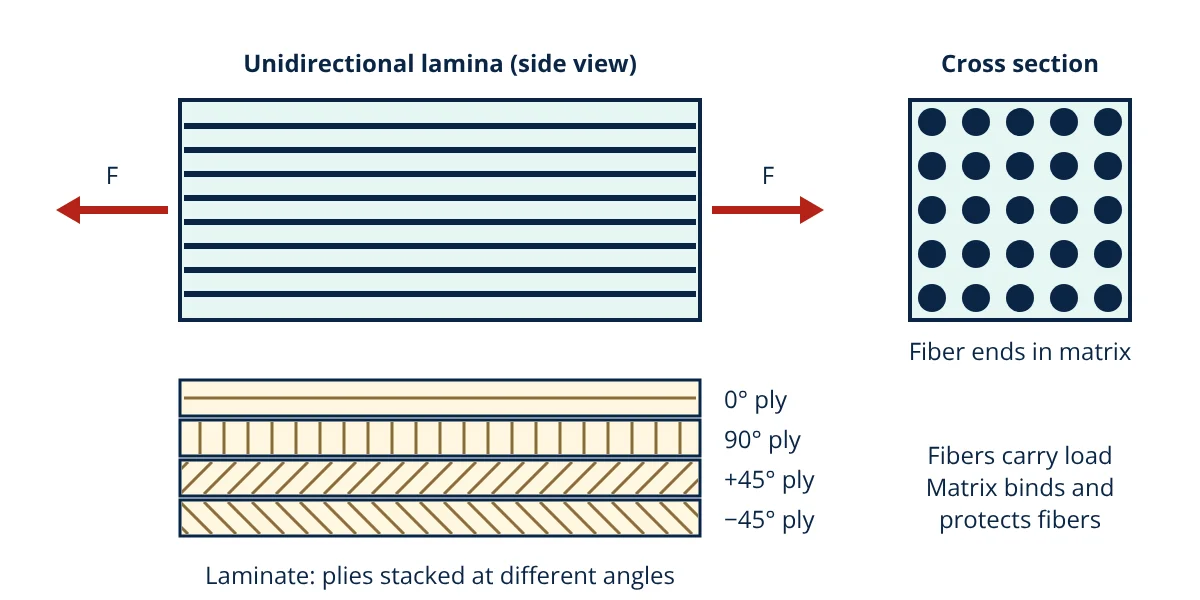
Fiber reinforced composites are materials made of strong, stiff fibers such as glass, carbon or aramid embedded in a matrix, usually a polymer resin. The fibers carry most of the load and the matrix holds them in place, transfers load between them and protects them, giving high strength and stiffness for low weight.
Fiber reinforced composites combine two materials with different weaknesses. A thin fiber is very strong in tension but cannot carry compression or shear, and a polymer resin is tough but soft. Bonded together, they give a material that can be stiffer than aluminium per unit weight and that resists corrosion.
They are used in aircraft skins, wind turbine blades, boat hulls, pipes, tanks, car body panels and sports equipment. Unlike metals, their properties depend on direction, so a composite part is designed together with its fiber layout.
How fiber reinforced composites work
A composite has three parts: the fibers, the matrix and the interface between them. When the part is loaded along the fibers, both stretch by the same amount, but the fibers are far stiffer, so they take almost all of the force.
The matrix has three jobs. It binds the fibers together, transfers load into them by shear at the interface, and protects them from abrasion, moisture and chemicals. A weak interface lets fibers pull out and lowers strength, which is why fibers are given a surface treatment or sizing before use.
Short fibers carry less load than continuous ones because stress builds up from each fiber end. Callister gives a critical fiber length below which the fiber cannot be loaded to its full strength.
Critical fiber length
The critical length is l_c = σ_f d ÷ (2 τ_c), where σ_f is the fiber tensile strength, d the fiber diameter and τ_c the shear strength of the fiber to matrix bond or of the matrix, whichever is lower. Fibers much longer than l_c behave as continuous fibers.
Types of fiber reinforced composites
Composites are grouped by the fiber material, the matrix material and the form of the reinforcement.
By fiber
E-glass is the most common reinforcement. It has a specific gravity of about 2.58, tensile strength of about 3.45 GPa and modulus of about 72.5 GPa (Callister). It is cheap and electrically insulating, and is used in boats, pipes, tanks, panels and wind turbine blades. S-glass has higher strength for more demanding parts.
Standard modulus PAN based carbon fiber has a specific gravity of about 1.78, tensile strength of about 3.8 to 4.2 GPa and modulus of about 230 GPa (Callister). High modulus grades reach 390 to 760 GPa. Carbon is used where stiffness and low weight matter most, such as aircraft structures and racing cars.
Carbon conducts electricity, so it causes galvanic corrosion of aluminium when the two touch in the presence of moisture.
Aramid fibers such as Kevlar 49 have a specific gravity of about 1.44, tensile strength of about 3.6 to 4.1 GPa and modulus of about 131 GPa (Callister). They are tough and resist impact, so they are used in ballistic protection, pressure vessels and parts that must survive impact. Their compressive strength is low.
Natural fibers such as flax, jute and hemp are lighter than glass but have lower, more variable properties and absorb moisture. They suit lightly loaded parts such as car interior panels.
By matrix
- Polymer matrix composites (PMC) are the most common. Thermoset matrices are polyester, vinyl ester and epoxy; epoxy gives the best properties and is standard in aerospace. Thermoplastic matrices include polypropylene, polyamide and PEEK. See thermoplastics vs thermosets for how the two behave.
- Metal matrix composites (MMC), such as aluminium reinforced with silicon carbide or boron fibers, keep strength at higher temperature than polymers.
- Ceramic matrix composites (CMC), such as silicon carbide fibers in a silicon carbide matrix, are used for very high temperatures. Here the fibers mainly raise fracture toughness.
By reinforcement form
- Continuous aligned (unidirectional) fibers give the highest strength and stiffness along one axis.
- Woven fabrics put fibers in two directions in a single layer and are easy to drape over curved moulds.
- Chopped or short random fibers, as in chopped strand mat and sheet moulding compound (SMC), give nearly equal properties in the plane at lower strength.
Parts made from continuous fibers are usually laminates: plies are stacked at chosen angles such as 0°, 90°, +45° and −45° so the part can carry tension, compression and shear in several directions.
How fiber reinforced composites are made
- Hand lay-up and spray-up: fabric or chopped fiber is placed in an open mould and wetted with resin. It suits boats and large low volume parts.
- Resin transfer moulding (RTM) and vacuum infusion: dry fiber preforms in a closed mould or under a vacuum bag are filled with resin.
- Prepreg and autoclave: fibers already impregnated with partly cured epoxy are laid up, bagged and cured under heat and pressure. This gives the high fiber content and low voids needed for aircraft parts.
- Filament winding: resin wetted fibers are wound onto a rotating mandrel to make pipes, tanks and pressure vessels.
- Compression moulding: SMC is pressed in heated metal moulds for high volume automotive panels.
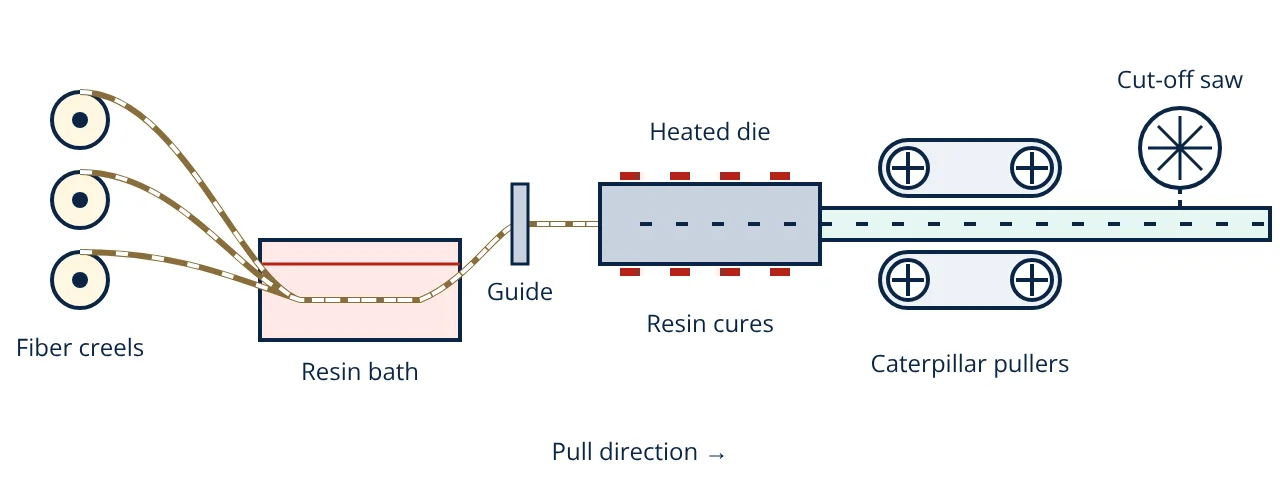
Pultrusion makes long straight profiles of constant cross section, such as rods, I-beams, channels and ladder rails. It runs continuously:
- Continuous fiber rovings and mats are pulled off creels.
- The fibers pass through a resin bath and are wetted out.
- A guide shapes the wet fibers close to the final profile.
- The bundle is pulled through a heated die, where the resin cures.
- Caterpillar pullers grip the cured profile and pull the whole line forward.
- A saw cuts the profile to length.
Rule of mixtures
For continuous aligned fibers loaded along their length, fibers and matrix strain equally (the isostrain condition). The composite modulus is then the volume weighted average:
Loaded across the fibers, fibers and matrix carry the same stress (the isostress condition), and the transverse modulus is much lower:
Density follows the same weighted average, ρ_c = ρ_f V_f + ρ_m V_m. The ratio of load carried by fibers to load carried by the matrix along the fibers is F_f ÷ F_m = E_f V_f ÷ (E_m V_m). These simple equations are the starting point of stress and strain analysis of laminates; properties are confirmed by coupon tests such as ASTM D3039.
- Given
- A unidirectional carbon fiber and epoxy lamina with fiber volume fraction 0.60. Carbon fiber: E_f = 230 GPa, density 1.78 g/cm³. Epoxy: E_m = 3.5 GPa, density 1.2 g/cm³. Steel for comparison: E = 200 GPa, density 7.85 g/cm³.
- Find
- Longitudinal and transverse modulus, composite density, the share of load carried by the fibers, and specific modulus compared with steel.
- Assumptions
- Perfect bonding, no voids (V_m = 0.40), linear elastic behaviour, load along the fibers for the longitudinal case.
- Solution
- E_cl = 230 × 0.60 + 3.5 × 0.40 = 139.4 GPa
1 ÷ E_ct = 0.60 ÷ 230 + 0.40 ÷ 3.5 = 0.1169, so E_ct = 8.55 GPa
ρ_c = 1.78 × 0.60 + 1.2 × 0.40 = 1.548 g/cm³
Fiber load share = 230 × 0.60 ÷ 139.4 = 0.99 - Answer
- E_cl ≈ 139 GPa along the fibers but only about 8.6 GPa across them; density about 1.55 g/cm³; the fibers carry about 99% of the load; specific modulus 139.4 ÷ 1.548 = 90.1 GPa per g/cm³ against 200 ÷ 7.85 = 25.5 for steel, about 3.5 times higher.
- Limitations
- The transverse formula is a lower bound and usually underestimates measured values. Real laminates contain voids, fiber misalignment and plies at several angles, so test data are used for design.
Key formulas for fiber reinforced composites
| Quantity | Formula | Symbols and units |
|---|---|---|
| Longitudinal modulus (isostrain) | E_cl = E_f V_f + E_m V_m | E in GPa, V_f and V_m = fiber and matrix volume fractions, V_f + V_m = 1 |
| Transverse modulus (isostress) | 1 ÷ E_ct = V_f ÷ E_f + V_m ÷ E_m | E in GPa |
| Composite density | ρ_c = ρ_f V_f + ρ_m V_m | ρ in g/cm³ |
| Load ratio along fibers | F_f ÷ F_m = E_f V_f ÷ (E_m V_m) | F = force carried, N |
| Critical fiber length | l_c = σ_f d ÷ (2 τ_c) | σ_f = fiber strength, MPa; d = diameter, mm; τ_c = interface or matrix shear strength, MPa |
Uses, advantages and limitations
Typical uses by fiber:
| Fiber | Typical uses |
|---|---|
| Glass | Boat hulls, pipes, chemical tanks, wind turbine blades, building panels, pultruded gratings and rebar |
| Carbon | Aircraft structures, racing cars, bicycle frames, drive shafts, strengthening wraps for concrete |
| Aramid | Ballistic armour, pressure vessels, impact resistant panels, ropes |
The main advantages are high specific strength and stiffness, good fatigue resistance in carbon composites, corrosion resistance and the freedom to put fibers only where loads run. Large parts can be moulded in one piece, which cuts the number of joints.
Properties across the fibers are low, and impact can cause delamination between plies that is hidden under an undamaged looking surface, as the FAA handbook notes for aircraft.
Thermoset composites are hard to recycle, the matrix limits service temperature, and carbon fiber needs isolating from aluminium. Metals behave more uniformly, as covered in mechanical properties of materials; see aircraft materials for where composites sit beside aluminium and titanium.
Fiber reinforced composites interview and viva questions
- What does the matrix do in a fiber reinforced composite? It binds the fibers, transfers load into them by shear at the interface, and protects them from abrasion, moisture and chemicals.
- When does the isostrain rule of mixtures apply? It applies to continuous aligned fibers loaded along their length, where fibers and matrix stretch by the same amount, so E_cl = E_f V_f + E_m V_m.
- Why is transverse modulus much lower than longitudinal modulus? Across the fibers the load must pass through the soft matrix, and the isostress formula is dominated by the low matrix modulus.
- What is critical fiber length? It is the minimum length a fiber needs to be loaded to its full strength, l_c = σ_f d ÷ (2 τ_c); shorter fibers give little strengthening.
- Why are plies stacked at 0, 90 and plus or minus 45 degrees? A single ply is strong only along its fibers, so plies at several angles let the laminate carry tension, compression and shear in more than one direction.
Frequently asked questions
What is the difference between FRP, GFRP and CFRP?
FRP means fiber reinforced polymer, a composite with a polymer matrix. GFRP uses glass fibers and CFRP uses carbon fibers. GFRP is cheaper and widely used in boats, pipes, tanks and wind turbine blades, while CFRP is stiffer and lighter and is used where weight matters most, such as aircraft structures and racing parts.
Why are fiber reinforced composites strong in one direction and weak in another?
The fibers carry most of the load only along their own axis. Across the fibers, the load passes through the much softer matrix, so transverse stiffness and strength are far lower. Designers stack plies at 0, 90 and plus or minus 45 degrees to spread properties over the directions the part is loaded.
Can fiber reinforced composites be recycled?
Thermoset matrix composites cannot be remelted. They can be ground for use as filler, or treated by thermal processes such as pyrolysis to recover fibers, usually with some loss of fiber properties. Thermoplastic matrix composites can be reheated and reformed, which makes recycling easier.
References
- W. D. Callister Jr. and D. G. Rethwisch, Materials Science and Engineering: An Introduction, 10th ed., Wiley, Chapter 16 Composites
- P. K. Mallick, Fiber-Reinforced Composites: Materials, Manufacturing, and Design, 3rd ed., CRC Press
- D. Hull and T. W. Clyne, An Introduction to Composite Materials, 2nd ed., Cambridge University Press
- ASTM D3039/D3039M, Standard Test Method for Tensile Properties of Polymer Matrix Composite Materials
- FAA, Aviation Maintenance Technician Handbook: Airframe, FAA-H-8083-31B, Chapter 7 Advanced Composite Materials
Get one engineering email a week
New articles, worked examples and study notes every week. Free, no spam, unsubscribe any time.