Ship Auxiliary Machinery: Purifiers, FWG and Compressors
Ship auxiliary machinery is all the engine room equipment, other than the main propulsion engine, that keeps a ship running. Key items include centrifugal purifiers and clarifiers that clean fuel and lubricating oil; freshwater generators that make distilled water from seawater using engine waste heat under vacuum, or by reverse osmosis; air compressors that supply starting air at about 30 bar and service air; pumps for cooling water, fuel, lube oil, ballast, bilge and fire; boilers and exhaust gas economisers for steam; heat exchangers; oily water separators; sewage plants; steering gear; refrigeration and HVAC; and generators.
While the main engine gets most attention, a ship cannot sail without dozens of auxiliary systems working reliably around the clock. Marine engineers spend much of their time operating and maintaining this machinery. This article covers three key systems in detail and summarises the rest.
Centrifugal purifiers and clarifiers
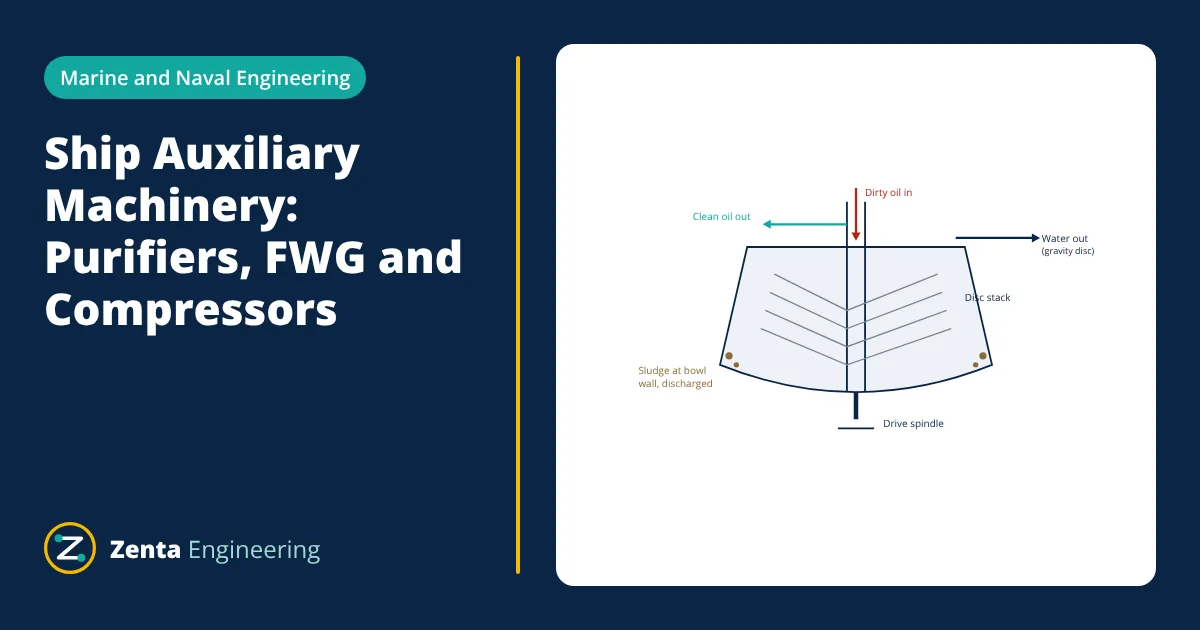
Heavy fuel oil and lubricating oil contain water, catalytic fines from refining, sludge and other contaminants that would damage fuel pumps, injectors, piston rings, liners and bearings. Gravity settling in tanks is too slow, so ships use disc stack centrifugal separators.
The bowl spins at about 6000 to 10 000 rpm, creating forces thousands of times gravity. Oil flows through the thin gaps between conical discs, where heavier water and solids move outward and lighter clean oil moves inward. Settling velocity in a centrifuge follows Stokes’ law with the centrifugal acceleration:
- Purifier: separates oil, water and solids; a gravity disc sized for oil density positions the oil and water interface.
- Clarifier: removes solids only, more efficient for fine particles.
- Self-cleaning bowls open periodically to discharge sludge without stopping.
- Heating the oil, typically to about 98 °C for heavy fuel, lowers viscosity and density, improving separation.
- Modern alcap or flexible separators handle fuels up to 1010 kg/m³ at 15 °C using water sensors instead of fixed gravity discs.
Freshwater generators
Ships need fresh water for boilers, engine cooling, drinking (after treatment) and washing. Most produce it on board.
Vacuum evaporator type
A plate or shell and tube evaporator under vacuum (created by a seawater driven ejector) boils seawater at about 40 to 60 °C, using heat from the main engine jacket cooling water. Vapour passes a demister to remove droplets, then condenses in a condenser cooled by seawater. A distillate pump delivers fresh water through a salinometer, which dumps water back to the evaporator if salinity exceeds about 2 to 10 ppm. The brine ejector removes concentrated brine. Output on large ships is typically 20 to 50 tonnes per day, with very low energy cost because the heat is waste heat. Heat exchanger principles are explained in heat exchanger types.
Reverse osmosis
High pressure pumps force seawater through semi-permeable membranes that reject salts. RO plants are common on passenger ships and offshore units, where demand is high, and need pre-filtration and periodic membrane cleaning.
Air compressors
Ships have several compressed air systems:
- Starting air: two or more two stage reciprocating compressors with intercooling and aftercooling charge air receivers to about 25 to 30 bar for starting main and auxiliary engines. Rules require enough air for a set number of starts.
- Control and service air: about 7 bar, reduced from starting air or produced by screw compressors, then dried and filtered for pneumatic controls and tools.
- Emergency air compressor: hand or diesel driven, to start an auxiliary engine from a dead ship condition.
Safety features include relief valves on each stage and receiver, fusible plugs, drain valves for condensate and oil, and non return valves. Multistage compression with intercooling reduces the work needed, a direct application of the laws of thermodynamics.
Other ship auxiliary machinery
- Pumps: centrifugal pumps for seawater and freshwater cooling, ballast, fire and general service; positive displacement pumps for fuel, lube oil and sludge, as described in centrifugal pump working principle.
- Boilers and exhaust gas economisers: steam for heating heavy fuel, cargo, accommodation and sometimes turbine driven pumps.
- Oily water separators: treat bilge water to below 15 ppm oil before discharge under MARPOL Annex I, with an oil content meter that stops overboard discharge if exceeded.
- Sewage treatment plants and incinerators.
- Steering gear: electro-hydraulic rams or rotary vanes moving the rudder, with duplicated power units.
- Refrigeration and air conditioning for provisions, cargo and accommodation.
- Generators: diesel generators, shaft generators and emergency generator, covered in ship electrical power system.
- Given
- A ship’s main engine burns 40 t of heavy fuel per day. The fuel contains 0.5% water by mass. The purifier must handle the daily consumption in 20 hours of operation, and the manufacturer recommends running at about 70% of rated throughput for good separation.
- Find
- Required throughput and water removed per day.
- Assumptions
- Fuel density about 0.97 t/m³ at separation temperature; all water removed.
- Solution
- Volume per day = 40 ÷ 0.97 = 41.2 m³; flow = 41.2 ÷ 20 = 2.06 m³/h = 2060 L/h
Rated capacity needed = 2060 ÷ 0.70 ≈ 2940 L/h
Water removed = 0.005 × 40 = 0.2 t = 200 kg per day - Answer
- Run the purifier at about 2060 L/h, using a unit rated for about 3000 L/h; it removes about 200 kg of water per day
- Limitations
- Lower flow improves separation of catalytic fines; fuel quality reports may require slower rates or series operation.
Maintaining ship auxiliary machinery
Many auxiliary systems are duplicated, with one running and one on standby, so that a single failure does not stop the ship.
Planned maintenance systems schedule overhauls of purifier bowls, compressor valves, evaporator plate cleaning and pump seals by running hours, supported by condition monitoring of vibration, temperatures and pressures. Engineers must also comply with MARPOL record keeping for oil, sludge and bilge water. Well maintained ship auxiliary machinery keeps the main two-stroke marine diesel engine supplied with clean fuel, cooling water and starting air, and keeps the ship safe and compliant.
Frequently asked questions
What is the difference between a purifier and a clarifier?
A purifier separates two liquids of different density, water and oil, plus solids, and discharges the water continuously through an outlet set by a gravity disc or controlled by a water transducer. A clarifier separates only solids (and small amounts of water) from oil and has no water outlet. Fuel is often treated by a purifier followed by a clarifier.
How does a freshwater generator work at low temperature?
It operates under vacuum, typically around 90 to 95% vacuum, so seawater boils at about 40 to 60 °C. Waste heat from the main engine jacket cooling water, at about 80 to 90 °C, is then hot enough to evaporate seawater. The vapour is condensed by cold seawater to produce distilled water.
Why do ships need starting air compressors?
Large main and auxiliary diesel engines are started by injecting compressed air at about 25 to 30 bar into the cylinders in firing order to turn the engine until it fires. Classification rules require enough stored air for a set number of consecutive starts, typically 12 for a reversible main engine, without recharging.
References
- D. A. Taylor, Introduction to Marine Engineering, 2nd ed., Butterworth-Heinemann
- H. D. McGeorge, Marine Auxiliary Machinery, 7th ed., Butterworth-Heinemann
- Alfa Laval, Fuel and Lubricating Oil Treatment Manuals
- IMO MARPOL Annex I, Regulations for the Prevention of Pollution by Oil
- SOLAS Chapter II-1, Part C, Machinery installations
Get one engineering email a week
New articles, worked examples and study notes every week. Free, no spam, unsubscribe any time.