MARPOL Annexes Explained: Annex I to VI

MARPOL annexes are the six technical parts of the IMO International Convention for the Prevention of Pollution from Ships. Annex I controls oil, Annex II noxious liquids in bulk, Annex III packaged harmful substances, Annex IV sewage, Annex V garbage and Annex VI air emissions, each with its own discharge limits, equipment, certificates and record books.
The MARPOL annexes are where the actual rules sit. The convention articles deal with legal matters such as enforcement and survey, while each annex sets out what a ship may discharge, where, and with what equipment.
MARPOL was adopted by the International Maritime Organization (IMO) in 1973. A Protocol in 1978 modified it, and the combined instrument, often written MARPOL 73/78, entered into force on 2 October 1983. A 1997 Protocol added Annex VI on air pollution.
The six MARPOL annexes at a glance
| Annex | Covers | Entry into force | Main certificate or record |
|---|---|---|---|
| I | Oil | 2 October 1983 | IOPP Certificate, Oil Record Book |
| II | Noxious liquid substances in bulk | 6 April 1987 | NLS Certificate, Cargo Record Book |
| III | Harmful substances in packaged form | 1 July 1992 | Dangerous goods documents (IMDG Code) |
| IV | Sewage | 27 September 2003 | ISPP Certificate |
| V | Garbage | 31 December 1988 | Garbage Record Book, placards, management plan |
| VI | Air pollution | 19 May 2005 | IAPP Certificate, bunker delivery notes |
Annexes I and II are compulsory for every state that joins MARPOL. Annexes III to VI are optional, so each state chooses whether to accept them.
Annex I: prevention of pollution by oil
Annex I covers oil from two sources: machinery space bilges on every ship, and cargo tank residues on oil tankers.
An oil tanker of 150 GT and above, and any other ship of 400 GT and above, needs an International Oil Pollution Prevention (IOPP) Certificate. The same ships carry a Shipboard Oil Pollution Emergency Plan (SOPEP) and an Oil Record Book.
Machinery space bilge water and the 15 ppm limit
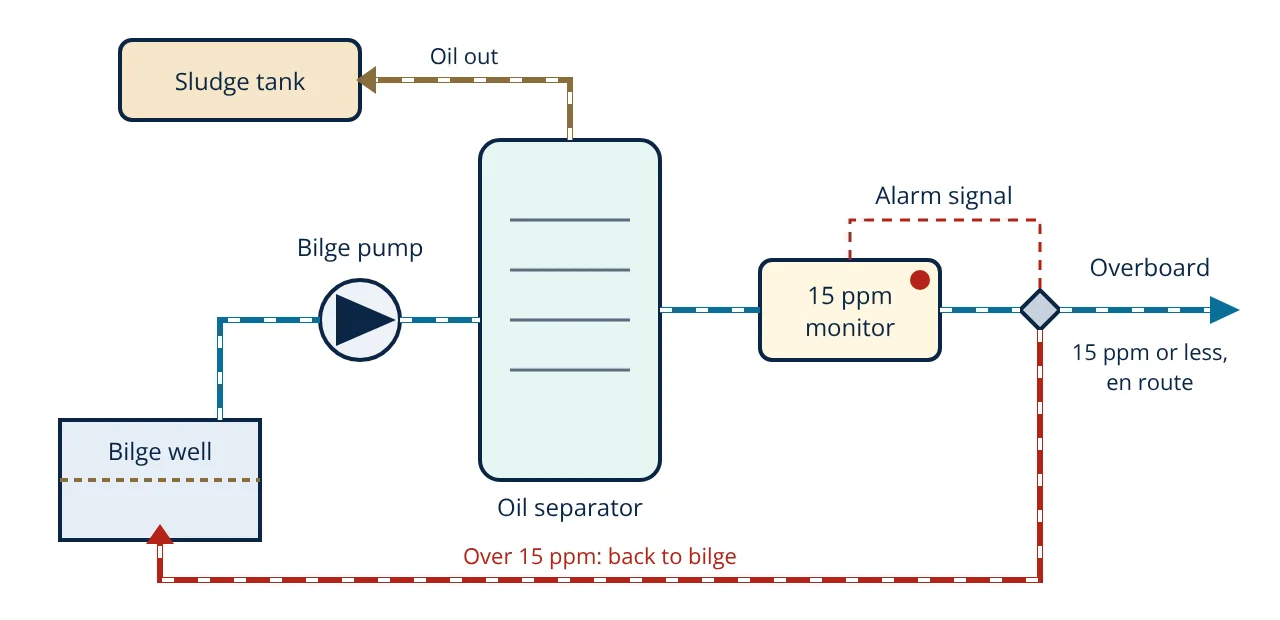
Bilge water collects oil from leaking pumps, purifiers and pipe joints. A ship of 400 GT and above may discharge it only while en route, only after it passes through approved oil filtering equipment, and only if the oil content without dilution does not exceed 15 ppm.
Ships of 10,000 GT and above also need a 15 ppm alarm and an automatic stopping device. Separated oil goes to a sludge tank and is burned on board or landed ashore. The ship auxiliary machinery article describes the separator alongside the other engine room plant.
- The bilge pump draws oily water from the bilge well or bilge holding tank.
- The separator lets oil rise and coalesce; the oil is drawn off to the sludge tank.
- The oil content meter measures the treated water continuously.
- At 15 ppm or less, and with the ship en route, the water goes overboard.
- Above 15 ppm, the alarm sounds and the three-way valve sends the water back to the bilge.
- The engineer records the operation in the Oil Record Book.
Cargo residues on oil tankers
Tank washings from the cargo area follow stricter rules. A tanker may discharge them only outside special areas, more than 50 nautical miles from the nearest land, while en route, at an instantaneous rate of no more than 30 litres per nautical mile.
The total quantity discharged on a ballast voyage must not exceed 1/30,000 of the cargo from which the residue came. The oil discharge monitoring and control system (ODME) must be working the whole time. Oil tankers of 5,000 tonnes deadweight and above delivered on or after 6 July 1996 must also have double hulls.
Annex II and Annex III: chemicals and packaged goods
Annex II covers noxious liquid substances carried in bulk, which means chemical tankers. Substances fall into four categories by hazard: X (major hazard, discharge prohibited), Y, Z (minor hazard) and OS (other substances outside those three). Ship construction and equipment follow the IBC Code.
When residues of these substances may be discharged, the ship must be en route at 7 knots or more if self-propelled, discharge below the waterline through an underwater outlet, and be at least 12 nautical miles from land in water at least 25 m deep.
Annex III deals with harmful substances in packaged form, such as drums and containers. Packages must be marked, labelled, documented and stowed according to the IMDG Code, which this annex makes mandatory.
Annex IV and Annex V: sewage and garbage
Both annexes set minimum discharge distances from the nearest land.
Annex IV applies to ships of 400 GT and above, and to smaller ships certified to carry more than 15 persons. These ships need an International Sewage Pollution Prevention (ISPP) Certificate.
- Comminuted and disinfected sewage: more than 3 nautical miles from the nearest land.
- Untreated sewage: more than 12 nautical miles, discharged at a moderate rate while en route at not less than 4 knots.
- Effluent from an approved sewage treatment plant: no distance limit, as long as it leaves no visible floating solids and does not discolour the water.
The revised Annex V, in force since 1 January 2013, prohibits discharge of all garbage except where a regulation allows it. Plastics may never be discharged anywhere at sea.
- Food waste ground to pass a 25 mm screen: more than 3 nautical miles from land outside special areas.
- Food waste not ground: more than 12 nautical miles.
- Ships of 400 GT and above and ships certified for 15 persons or more keep a Garbage Record Book.
Annex VI: air pollution and energy efficiency
Annex VI limits sulphur oxides (SOx), nitrogen oxides (NOx), ozone depleting substances and shipboard incineration. Ships of 400 GT and above carry an International Air Pollution Prevention (IAPP) Certificate.
The sulphur content of fuel oil has been capped at 0.50% m/m worldwide since 1 January 2020, down from 3.50%. Inside SOx emission control areas (ECAs) the cap has been 0.10% m/m since 1 January 2015. A ship can burn higher sulphur fuel only with an approved equivalent such as an exhaust gas cleaning system, described in the wet scrubber article.
NOx limits apply to diesel engines above 130 kW and depend on rated engine speed n in rpm. Tier II applies to engines on ships built on or after 1 January 2011. Tier III applies only inside NOx ECAs and usually needs selective catalytic reduction, covered in NOx control with SCR and SNCR.
Below 130 rpm the limits are fixed at 14.4 g/kWh (Tier II) and 3.4 g/kWh (Tier III). Large slow speed engines such as the two-stroke marine diesel engine fall in this band.
Energy efficiency rules in Annex VI
Chapter 4 of Annex VI adds energy efficiency rules. New ships must meet an Energy Efficiency Design Index (EEDI), and every ship keeps a Ship Energy Efficiency Management Plan (SEEMP).
From 1 January 2023, existing ships must also meet the Energy Efficiency Existing Ship Index (EEXI) and receive an annual Carbon Intensity Indicator (CII) rating. Using shore power in port is one way ships cut fuel burned at berth.
Worked example: sulphur cap effect on SO₂
- Given
- A ship burns 30 tonnes of fuel oil per day. Compare fuel at the old global limit of 3.50% sulphur, the current global limit of 0.50% and the ECA limit of 0.10% (all m/m).
- Find
- Sulphur burned and SO₂ emitted per day for each fuel.
- Assumptions
- All sulphur in the fuel burns to SO₂. Molar masses: S = 32 g/mol, SO₂ = 64 g/mol, so each tonne of sulphur gives 2 tonnes of SO₂. Each fuel is exactly at its limit.
- Solution
- 3.50%: sulphur = 30 × 0.035 = 1.05 t; SO₂ = 1.05 × 2 = 2.10 t/day.
- 0.50%: sulphur = 30 × 0.005 = 0.15 t; SO₂ = 0.15 × 2 = 0.30 t/day.
- 0.10%: sulphur = 30 × 0.001 = 0.03 t; SO₂ = 0.03 × 2 = 0.06 t/day.
- Answer
- About 2.10, 0.30 and 0.06 tonnes of SO₂ per day. The 2020 global cap cuts SO₂ from this ship by about 86%, and ECA fuel by about 97%, compared with 3.50% fuel.
- Limitations
- Some sulphur forms SO₃ and sulphate particles instead of SO₂.
Key formulas for MARPOL annexes
| Quantity | Formula | Symbols and units |
|---|---|---|
| Bilge water discharge limit (Annex I) | oil content ≤ 15 ppm, undiluted | ppm by volume of oil in the effluent |
| Tanker cargo residue rate (Annex I) | instantaneous rate ≤ 30 L per nautical mile | L/nm while en route |
| Tanker total cargo residue (Annex I) | total discharged ≤ cargo mass ÷ 30,000 | tonnes, ships delivered after 31 December 1979 |
| NOx Tier II, 130 ≤ n < 2000 (Annex VI) | NOx = 44 × n^(-0.23) | g/kWh; n = rated engine speed in rpm |
| NOx Tier III, 130 ≤ n < 2000 (Annex VI) | NOx = 9 × n^(-0.2) | g/kWh; n in rpm |
| SO₂ from fuel sulphur | m_SO₂ = 2 × m_fuel × S | m in t; S = sulphur mass fraction |
How MARPOL compliance is checked
Flag state surveys issue and renew the annex certificates. Port state control officers can board any foreign ship in port and check certificates, record books and equipment.
Record books are the main evidence of what the ship has discharged, burned or landed ashore.
The safety side of ship operation is covered separately by SOLAS; see SOLAS lifesaving and firefighting equipment.
MARPOL annexes interview and viva questions
- Which MARPOL annexes are mandatory? Annexes I and II are compulsory for every party; Annexes III to VI apply only to states that accept them.
- What conditions apply to discharging machinery space bilge water? The ship must be en route, the water must pass through approved oil filtering equipment, and the oil content without dilution must not exceed 15 ppm.
- What are the Annex II pollution categories? Category X is a major hazard and its discharge is prohibited, Y is a hazard, Z a minor hazard, and OS covers other substances outside X, Y and Z.
- Why does the Tier III NOx limit apply only in some areas? Tier III applies only when a ship operates inside a NOx emission control area; elsewhere Tier II applies to engines on ships built from 1 January 2011.
- How can a ship burn fuel above 0.50% sulphur and still comply? It must use an approved equivalent method, such as an exhaust gas cleaning system, that achieves the same SOx reduction as compliant fuel.
Frequently asked questions
How many annexes does MARPOL have?
MARPOL has six technical annexes. Annex I covers oil, Annex II noxious liquid substances carried in bulk, Annex III harmful substances in packaged form, Annex IV sewage, Annex V garbage and Annex VI air pollution from ships. Annexes I and II are mandatory for every party to the convention; Annexes III to VI are optional and each state chooses whether to accept them.
What is the 15 ppm rule in MARPOL?
Under MARPOL Annex I, a ship of 400 GT and above may discharge oily bilge water from its machinery spaces only while en route, after the water has passed through approved oil filtering equipment, and only if the oil content without dilution does not exceed 15 parts per million. The discharge must not come from cargo pump room bilges of an oil tanker or be mixed with oil cargo residues.
What is the current MARPOL sulphur limit for fuel oil?
Since 1 January 2020, MARPOL Annex VI limits the sulphur content of fuel oil used on board to 0.50% m/m outside emission control areas. Inside the SOx emission control areas the limit has been 0.10% m/m since 1 January 2015. A ship can use higher sulphur fuel only with an approved equivalent method, such as an exhaust gas cleaning system.
References
- IMO, MARPOL Consolidated Edition 2022: Articles, Protocols, Annexes and Unified Interpretations of the International Convention for the Prevention of Pollution from Ships, 1973, as modified by the Protocols of 1978 and 1997
- IMO Resolution MEPC.107(49), Revised Guidelines and Specifications for Pollution Prevention Equipment for Machinery Space Bilges of Ships, 2003
- IMO Resolution MEPC.177(58), Technical Code on Control of Emission of Nitrogen Oxides from Marine Diesel Engines (NOx Technical Code 2008)
- IMO, International Code for the Construction and Equipment of Ships Carrying Dangerous Chemicals in Bulk (IBC Code), as amended
- IMO, International Maritime Dangerous Goods (IMDG) Code, as amended
- D. A. Taylor, Introduction to Marine Engineering, 2nd ed., Butterworth-Heinemann
Get one engineering email a week
New articles, worked examples and study notes every week. Free, no spam, unsubscribe any time.