Ore Reserve vs Mineral Resource: JORC Categories Explained

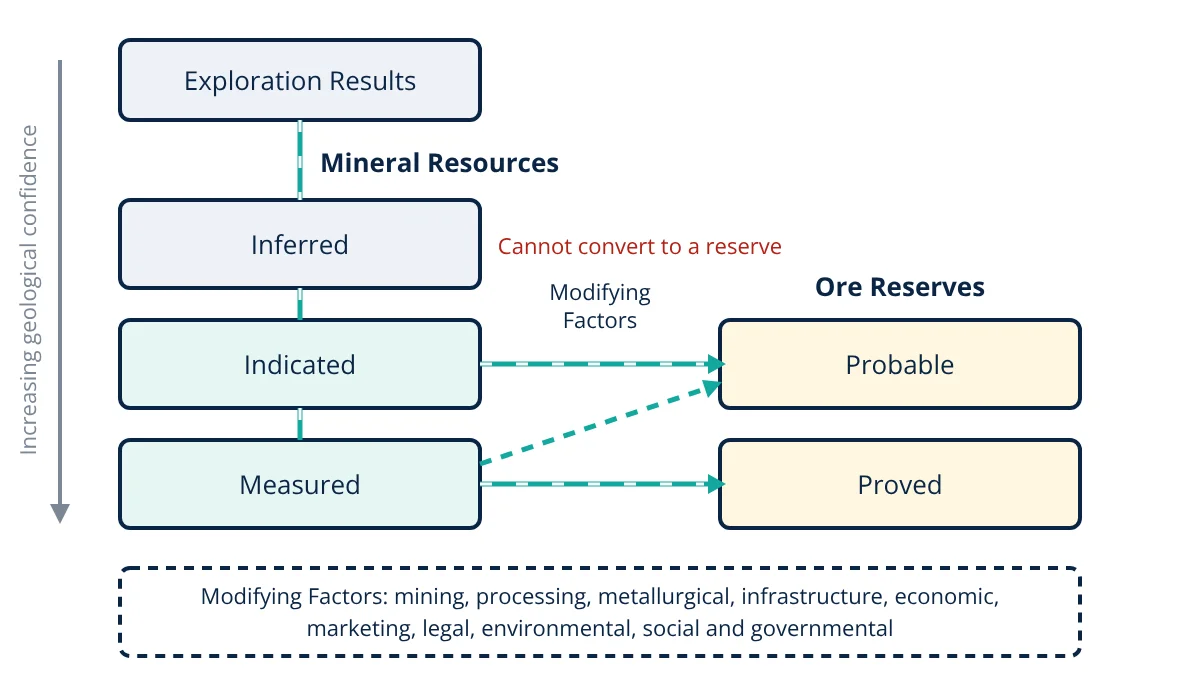
Ore reserve vs mineral resource: a mineral resource is a deposit with reasonable prospects for eventual economic extraction, classed Inferred, Indicated or Measured by geological confidence. An ore reserve is the economically mineable part of an Indicated or Measured resource, shown by a pre-feasibility or feasibility study, including dilution and losses, and classed Probable or Proved.
The question of ore reserve vs mineral resource comes up every time a mining company publishes a statement of its deposits. A resource describes what is in the ground and how well the geology is known. A reserve describes what a mine plan can extract at a profit once mining, processing, economic, legal, environmental and social factors are applied. The JORC Code 2012 and the CIM Definition Standards 2014 set these definitions, and both follow the CRIRSCO International Reporting Template.
Ore reserve vs mineral resource: comparison table
| Point | Mineral Resource | Ore Reserve (Mineral Reserve) |
|---|---|---|
| What it answers | What is in the ground and how well do we know it? | What can be mined and processed at a profit? |
| Test | Reasonable prospects for eventual economic extraction | Economic extraction demonstrated by a study |
| Categories | Inferred, Indicated, Measured | Probable, Proved (Proven under CIM) |
| Main input | Drilling, sampling, assays, geological model | The resource plus the Modifying Factors |
| Study level | No mining study required | At least a pre-feasibility study |
| Tonnes and grade | In situ, undiluted | Delivered to the plant, with dilution and losses |
| Who signs it | Competent Person (JORC) or Qualified Person (NI 43-101) | The same, usually with mining and processing input |
What a mineral resource is
A Mineral Resource is a concentration of material of economic interest in or on the earth’s crust, in such form, grade and quantity that there are reasonable prospects for eventual economic extraction. The location, quantity, grade, continuity and other geological characteristics are known, estimated or interpreted from specific geological evidence and knowledge, including sampling. That evidence comes from the work described in mineral exploration methods: mapping, geochemistry, geophysics and, above all, drilling with assays.
The three categories rise in confidence:
- Inferred: geological evidence is enough to imply, but not verify, geological and grade continuity. Drill spacing is usually wide.
- Indicated: evidence is enough to assume continuity between points of observation, so the Modifying Factors can be applied in enough detail for mine planning.
- Measured: evidence is enough to confirm continuity, with detailed and reliable sampling, so planning and evaluation can be done with greater confidence.
“Reasonable prospects for eventual economic extraction” means the estimate is limited to material that could plausibly be mined. A company typically constrains the resource with a cut-off grade and, for an open pit, an optimised pit shell at an assumed long term metal price. No mine plan has to exist at this stage.
What an ore reserve is
An Ore Reserve is the economically mineable part of a Measured or Indicated Mineral Resource. It includes diluting materials and allowances for losses that may occur when the material is mined, and it is defined by studies at pre-feasibility or feasibility level that apply the Modifying Factors. Those studies must show that extraction could reasonably be justified at the time of reporting.
The Modifying Factors are the considerations used to turn a resource into a reserve: mining, processing, metallurgical, infrastructure, economic, marketing, legal, environmental, social and governmental factors. In practice this means choosing a mining method (see surface vs underground mining), designing the pit or stopes, scheduling production, testing the metallurgical recovery of the crushing and grinding and concentration route, and costing the whole operation.
The two reserve categories are:
- Probable: the economically mineable part of an Indicated resource, and in some cases a Measured resource. A Measured resource is reported as Probable when uncertainty in the Modifying Factors means it does not qualify as Proved.
- Proved: the economically mineable part of a Measured resource, with a high degree of confidence in the Modifying Factors.
Inferred resources cannot be converted to reserves, whatever their grade.
How a mineral resource becomes an ore reserve
- Drill and sample the deposit, build a geological model and estimate grade block by block.
- Classify the blocks as Inferred, Indicated or Measured from data spacing and estimation quality.
- Run a pit optimisation or stope design using only Indicated and Measured blocks, with costs, prices and recoveries from the study. The method for open pits is covered in open pit mine design.
- Apply mining recovery and dilution to the tonnes and grade inside the design.
- Schedule the material, estimate cash flow and confirm the project is economic.
- Report what passes as Probable or Proved reserves, together with the assumptions used.
Key formulas for ore reserve estimation
| Quantity | Formula | Symbols and units |
|---|---|---|
| Contained metal | M = T × g | T = tonnes, g = grade (g/t or %) |
| Mining recovery | R = Tore mined ÷ Tin situ | dimensionless |
| Dilution | D = Twaste ÷ Tore mined | dimensionless |
| Diluted grade | gd = (Tore g + Twaste gw) ÷ (Tore + Twaste) | gw = grade of the diluting waste |
| Break-even cut-off grade | gc = c ÷ ((P − r) y) | c = processing and site cost per tonne, P = metal price, r = refining cost, y = metallurgical recovery |
The diluted grade in a reserve block is
and the break-even cut-off grade used to separate ore from waste is
Units must be consistent: if P is in dollars per gram and c in dollars per tonne, gc comes out in grams per tonne.
Worked example: converting a gold resource to a reserve
- Given
- A gold deposit inside a pit design: Measured resource 10 Mt at 1.8 g/t and Indicated resource 20 Mt at 1.5 g/t. Mining recovery 95 percent, dilution 10 percent of ore mined, diluting waste grade 0.2 g/t.
- Find
- Proved and Probable reserve tonnes and grade, and contained gold compared with the resource.
- Assumptions
- The feasibility study shows the pit is economic; confidence in the Modifying Factors is high enough for all Measured material to be Proved; 1 troy ounce = 31.1035 g.
- Solution
- Measured: ore mined = 10 × 0.95 = 9.5 Mt; waste = 0.10 × 9.5 = 0.95 Mt; reserve = 10.45 Mt
gd = (9.5 × 1.8 + 0.95 × 0.2) ÷ 10.45 = 17.29 ÷ 10.45 = 1.65 g/t
Indicated: ore mined = 20 × 0.95 = 19.0 Mt; waste = 1.9 Mt; reserve = 20.9 Mt
gd = (19.0 × 1.5 + 1.9 × 0.2) ÷ 20.9 = 28.88 ÷ 20.9 = 1.38 g/t
Contained gold in reserve = 17.29 + 28.88 = 46.2 t = 1.48 Moz
Contained gold in resource = 10 × 1.8 + 20 × 1.5 = 48.0 t = 1.54 Moz - Answer
- Proved reserve 10.45 Mt at 1.65 g/t and Probable reserve 20.9 Mt at 1.38 g/t, 46.2 t (1.48 Moz) of gold, against 48.0 t (1.54 Moz) in the resource
- Limitations
- Real conversions also drop resource blocks outside the economic pit and below cut-off, so reserves are often much smaller than resources. Metallurgical recovery is applied later, when recoverable gold is estimated.
The reserve has more tonnes than the resource inside the same pit but about 4 percent less contained gold, because dilution adds low grade waste and mining recovery leaves some ore behind.
JORC, NI 43-101, CIM and S-K 1300 terms
The CRIRSCO family of codes uses the same categories with small differences in wording:
| Code | Region | Reserve term | Highest reserve category |
|---|---|---|---|
| JORC Code 2012 | Australia, New Zealand | Ore Reserve | Proved |
| CIM Definition Standards 2014 with NI 43-101 | Canada | Mineral Reserve | Proven |
| CRIRSCO Template 2019 | International model | Mineral Reserve | Proved |
| SEC S-K 1300 | United States | Mineral Reserve | Proven |
JORC uses the term Competent Person and NI 43-101 uses Qualified Person. In both cases the person must have at least five years of experience relevant to the style of deposit and the activity, and belong to a recognised professional organisation.
Common mistakes when reading resource and reserve statements
- Adding resources and reserves together. Many companies report resources inclusive of the reserves, so adding the two counts the same tonnes twice. The statement must say whether resources are inclusive or exclusive.
- Treating Inferred tonnes as mineable. They carry the lowest confidence and are excluded from reserves.
- Comparing contained metal with recoverable metal. Contained metal is tonnes times grade; recoverable metal also applies the plant recovery.
- Ignoring the price assumption. Resources and reserves change when the metal price, costs or cut-off grade change, even if no new drilling is done.
Ore reserve vs mineral resource interview and viva questions
- What is the main difference between a mineral resource and an ore reserve? A resource has reasonable prospects for eventual economic extraction; a reserve is the part of an Indicated or Measured resource shown by a pre-feasibility or feasibility study to be economically mineable after the Modifying Factors are applied.
- Name the resource and reserve categories in order of confidence. Resources: Inferred, Indicated, Measured. Reserves: Probable, Proved (Proven under CIM and S-K 1300).
- Why can an Inferred resource not be converted to a reserve? Its geological and grade continuity is only implied, not verified, so there is not enough confidence to apply the Modifying Factors.
- What are the Modifying Factors? The mining, processing, metallurgical, infrastructure, economic, marketing, legal, environmental, social and governmental considerations used to convert a resource to a reserve.
- How does dilution change reserve tonnes and grade? Waste mined with the ore adds tonnes at low grade, so the reserve tonnage rises and the grade falls compared with the in situ resource.
Frequently asked questions
Can an inferred mineral resource become an ore reserve?
Not directly. Under JORC, CIM and the other CRIRSCO aligned codes, an Inferred Mineral Resource has too little geological confidence for the Modifying Factors to be applied, so it cannot be converted to an Ore Reserve. More drilling must first upgrade it to Indicated or Measured.
Is a mineral reserve the same as an ore reserve?
Yes. JORC and other Australasian usage say Ore Reserve, with the categories Probable and Proved. The CIM Definition Standards used with NI 43-101 in Canada say Mineral Reserve, with Probable and Proven. The meaning is the same because both follow the CRIRSCO template.
Why is reserve tonnage often higher but grade lower than the resource it came from?
A reserve is quoted as material delivered to the plant. It includes dilution, waste rock mined along with the ore, which adds tonnes at low grade, and it subtracts ore lost during mining. Dilution usually raises the tonnes and lowers the grade, while the contained metal falls a little.
References
- JORC Code, Australasian Code for Reporting of Exploration Results, Mineral Resources and Ore Reserves, 2012 Edition, Joint Ore Reserves Committee
- CIM Definition Standards for Mineral Resources and Mineral Reserves, Canadian Institute of Mining, Metallurgy and Petroleum, 2014
- National Instrument 43-101 Standards of Disclosure for Mineral Projects, Canadian Securities Administrators
- CRIRSCO International Reporting Template for the Public Reporting of Exploration Targets, Exploration Results, Mineral Resources and Mineral Reserves, 2019
- US SEC Regulation S-K Subpart 1300, Modernization of Property Disclosures for Mining Registrants, 2018
- W. A. Hustrulid, M. Kuchta and R. K. Martin, Open Pit Mine Planning and Design, 3rd ed., CRC Press, 2013
Get one engineering email a week
New articles, worked examples and study notes every week. Free, no spam, unsubscribe any time.